Stock Analysis · Vistry Group PLC (BVHMF)
Overview
Vistry Group PLC is a U.K.-based homebuilder focused on residential construction. The company builds homes for private buyers, but its business has increasingly shifted toward a partnerships model, where it works with housing associations, local authorities, and institutional partners to deliver mixed-tenure housing developments. In simple terms, Vistry is no longer just a traditional homebuilder selling houses one by one; it is trying to become a scaled delivery partner for organizations that need housing built efficiently and in volume.
This matters because the partnerships model is generally designed to produce more predictable demand than a pure private-for-sale approach. Instead of depending entirely on individual homebuyers and mortgage conditions, Vistry can secure larger development agreements with public and private counterparties. That does not remove cyclical risk, but it can reduce some of the volatility that normally comes with homebuilding.
Based on the company’s recent reporting structure and strategic positioning, revenue is mainly driven by housing delivery through its partnerships operations, with a smaller contribution from open market home sales and related activities. Exact percentages can vary year to year, but the broad mix appears to be:
- Partnerships and mixed-tenure housing delivery: the clear majority of revenue, likely around three-quarters or more of the business in the current model.
- Open market private home sales: a meaningful but smaller share, roughly in the mid-teens to low-twenties as the group continues its strategic pivot.
- Land sales and other property-related income: a relatively small contribution.
Over the past several years, revenue expanded strongly, rising from roughly £2.4 billion in 2021 to nearly £3.8 billion in 2024, before easing somewhat in 2025. However, the more important takeaway is that profit conversion has become much weaker than revenue growth alone would suggest. Revenue held up relatively well, but margins compressed sharply, showing that scale has not recently translated into stronger earnings.
The long-term revenue picture is positive, but the profit flow shows clear strain. Sales grew meaningfully from 2021 through 2024, yet gross profit, operating income, and net income did not keep pace. That suggests build cost pressure, project mix issues, and execution challenges have recently weighed more heavily on results than top-line growth would imply.
Key Figures
| Metric | Value | Sector ⓘ |
|---|---|---|
| Date | Sep 19, 2026 | |
| Context | ||
| Sector | Consumer Cyclical | |
| Industry | Residential Construction | |
| Market Cap ⓘ | $1.20B | |
| Beta ⓘ | 1.86 | |
Value (Cheapness) | ||
| P/E Ratio ⓘ | 6.60 | 17.10 |
| FCF Yield ⓘ | 24.69% | 8.82% |
| EBIT / EV ⓘ | N/A | 6.54% |
| PEG ⓘ | N/A | |
Growth (Business expansion) | ||
| Revenue Growth ⓘ | -3.80% | 6.00% |
| RPS Growth (5Y CAGR) ⓘ | 0.97% | 9.17% |
| EPS Growth (5Y CAGR) ⓘ | -9.98% | -17.84% |
| Margin Growth (5Y Trend) ⓘ | -10.22% | -0.42% |
| FCF Growth (5Y CAGR) ⓘ | -13.71% | 4.86% |
Quality (Business durability) | ||
| ROIC (Latest) ⓘ | 8.53% | 12.15% |
| ROIC (5Y Median) ⓘ | 6.51% | 10.76% |
| Net Debt / EBIT (Latest) ⓘ | 0.54 | 2.10 |
| Net Debt / EBIT (5Y Median) ⓘ | 0.55 | 2.31 |
| Operating Margin (Latest) ⓘ | 6.05% | 9.12% |
| Operating Margin (5Y Median) ⓘ | 9.27% | 9.57% |
| Debt to Equity (Latest) ⓘ | 17.93% | 75.99% |
| Profit Margin (Latest) ⓘ | 3.82% | 5.30% |
| Free Cash Flow (Latest) ⓘ | $295.07M | |
Momentum (Price trend) | ||
| 3Y Return ⓘ | -66.58% | +12.81% |
| 12M Return (excl. last month) ⓘ | -57.64% | +2.42% |
| 6M Return ⓘ | -25.54% | +1.10% |
| Price vs. 200-Day MA ⓘ | -31.73% | -2.66% |
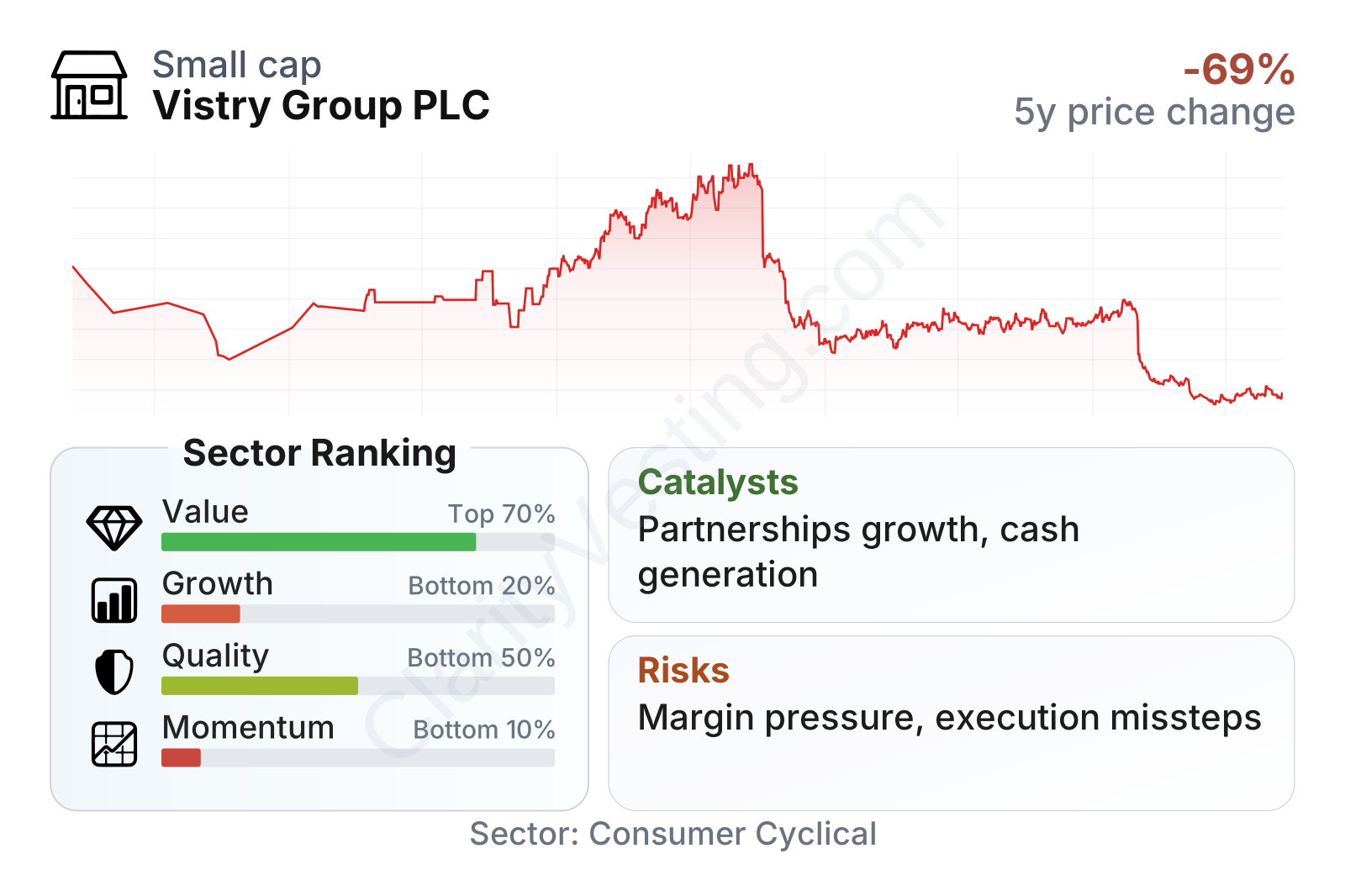
Vistry is now a much smaller company in market value terms than it was during the stronger part of the housing cycle, with a market capitalization of roughly $1.0 billion. The share price has fallen sharply over the last three years and remains far below its prior highs, which reflects a combination of weaker sentiment, lower profitability, and concerns about operational delivery.
The metrics show a split picture. On value, the company screens cheaply relative to much of the sector, helped by a low earnings multiple and unusually strong free cash flow yield. On balance sheet strength, leverage also looks relatively restrained, with debt levels well below typical sector levels. But those positives are offset by weak growth, below-median profitability, and very poor share price momentum. In other words, the market is assigning a low valuation because current business quality and confidence have deteriorated.
Growth
The sector itself has an attractive long-term foundation. The U.K. continues to face a structural housing shortage, and governments of different political leanings have generally supported higher housing supply. Affordable housing, regeneration projects, and partnerships between private builders and public-sector bodies are likely to remain important parts of the market for years. That creates a real demand backdrop for a company built around large-scale housing delivery.
Vistry’s strategy also has a sensible industrial logic. By emphasizing partnerships, the company is trying to reduce its dependence on volatile private buyer demand and position itself in areas where housing need is persistent. This approach can support forward visibility, improve site pipeline planning, and potentially make capital use more efficient if projects are executed well.
That said, recent growth has been uneven. Revenue momentum has weakened, and recent year-over-year performance has trailed the broader sector. Longer-term revenue-per-share growth has also been modest, which indicates that the strategic shift has not yet translated into a strong compounding profile for shareholders.
One encouraging feature is cash generation. Free cash flow remains a relative bright spot and stands out versus the company’s current market value. For a builder, that matters because cash can support land investment, reduce financial pressure, and provide flexibility during weaker housing conditions. If Vistry can stabilize margins while preserving healthy cash conversion, that would materially improve the overall picture.
A meaningful catalyst is the continued scaling of the partnerships model. If the company converts its pipeline into completed homes with better discipline, the market could start viewing the business less as a cyclical housebuilder and more as a specialist delivery platform linked to long-term housing demand. Another possible tailwind is any easing in U.K. mortgage conditions or broader housing market normalization, which could improve sentiment across the sector even if Vistry’s business model is only partly tied to private sales.
Recent company developments have also kept attention on execution and restructuring rather than pure expansion. That means the near-term opportunity is less about rapid growth and more about proving that the operating model can consistently deliver acceptable returns.
Risks
This article is for informational purposes only and does not constitute financial advice. Some content is AI-generated. See Disclaimer