Stock Analysis · Burlington Stores Inc (BURL)
Overview
Burlington Stores is a U.S. off-price retailer focused on apparel, footwear, accessories, beauty, home goods, toys, and seasonal merchandise. The company operates large-format discount stores under the Burlington banner and aims to sell recognizable brands at prices below those typically seen in department stores and many specialty retailers. Its model is based on opportunistic buying, fast inventory turnover, and a treasure-hunt shopping experience that encourages repeat store visits.
Revenue is overwhelmingly generated from in-store retail sales in the United States. Burlington does not report a broad set of operating segments with separate revenue lines, so the clearest way to understand the business is through merchandise categories described in company filings.
- Women’s apparel and accessories: approximately 25% to 30% of sales. This includes clothing, handbags, and related accessories.
- Home, toys, gifts, and coats: approximately 20% to 25% of sales. This category helps diversify the chain beyond fashion and supports seasonal traffic.
- Men’s apparel and accessories: approximately 15% to 20% of sales.
- Youth apparel: approximately 15% to 20% of sales. This includes children’s and baby-related clothing assortments.
- Footwear: approximately 10% to 15% of sales.
- Beauty and fragrance, jewelry, and other: a smaller remaining share, generally below 10% combined.
The business is not heavily dependent on e-commerce. Burlington has emphasized physical stores as the core of its operating model, which makes store execution, merchandising discipline, and inventory availability especially important.
Over the last several years, the company’s revenue, gross profit, operating income, and net income have all moved higher after a weaker 2023 period. The most visible improvement has come from stronger sales and better operating leverage, with operating income rising faster than revenue as profitability recovered.
The flow of revenue through the business shows a retailer that has been regaining scale. Sales have risen from roughly $8.7 billion in fiscal 2023 to about $11.6 billion in fiscal 2026, while operating income and net income have expanded at a faster pace, suggesting improved efficiency as the store base grows.
Key Figures
| Metric | Value | Sector ⓘ |
|---|---|---|
| Date | Sep 12, 2026 | |
| Context | ||
| Sector | Consumer Cyclical | |
| Industry | Apparel Retail | |
| Market Cap ⓘ | $15.02B | |
| Beta ⓘ | 1.42 | |
Value (Cheapness) | ||
| P/E Ratio ⓘ | 21.36 | 17.10 |
| FCF Yield ⓘ | 6.73% | 8.53% |
| EBIT / EV ⓘ | 5.03% | 6.46% |
| PEG ⓘ | 2.99 | |
Growth (Business expansion) | ||
| Revenue Growth ⓘ | 11.00% | 5.75% |
| RPS Growth (5Y CAGR) ⓘ | 7.15% | 9.14% |
| EPS Growth (5Y CAGR) ⓘ | 4.37% | -18.21% |
| Margin Growth (5Y Trend) ⓘ | 1.10% | -0.23% |
| FCF Growth (5Y CAGR) ⓘ | -22.68% | 4.91% |
Quality (Business durability) | ||
| ROIC (Latest) ⓘ | 20.39% | 12.61% |
| ROIC (5Y Median) ⓘ | N/A | 10.72% |
| Net Debt / EBIT (Latest) ⓘ | 5.13 | 2.10 |
| Net Debt / EBIT (5Y Median) ⓘ | 5.88 | 2.32 |
| Operating Margin (Latest) ⓘ | 8.31% | 9.25% |
| Operating Margin (5Y Median) ⓘ | 6.57% | 9.64% |
| Debt to Equity (Latest) ⓘ | 294.97% | 75.78% |
| Profit Margin (Latest) ⓘ | 5.85% | 5.33% |
| Free Cash Flow (Latest) ⓘ | $1.01B | |
Momentum (Price trend) | ||
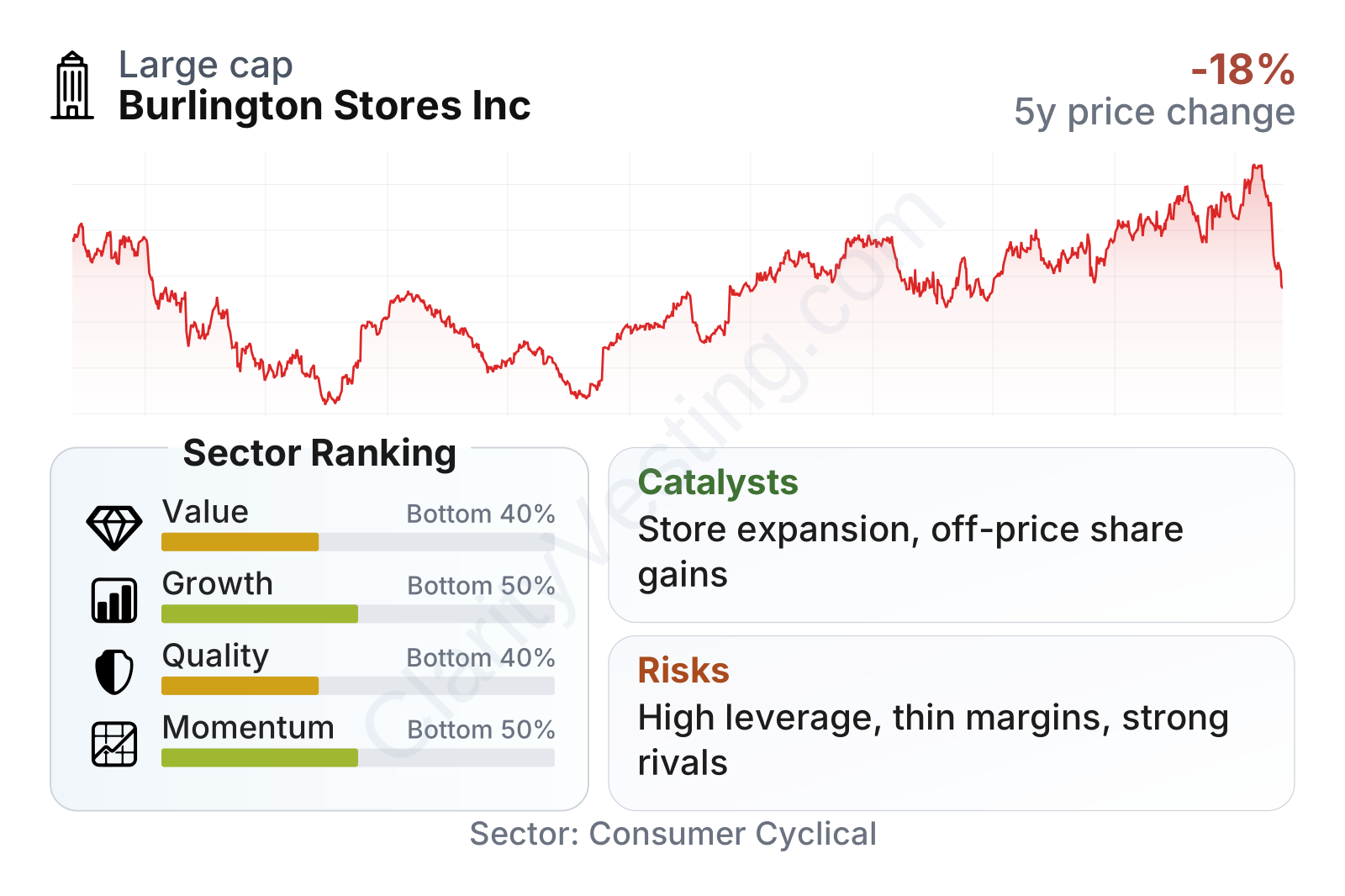
| 3Y Return ⓘ | +56.66% | +14.53% |
| 12M Return (excl. last month) ⓘ | +27.00% | +3.08% |
| 6M Return ⓘ | -18.42% | +0.55% |
| Price vs. 200-Day MA ⓘ | -23.26% | -0.54% |
Burlington is a large public retailer with above-average share price volatility, which is common in consumer discretionary names. The overall profile is mixed: recent revenue growth is stronger than much of the sector, profitability has improved materially, and return on invested capital stands above the sector median. On the other hand, leverage remains elevated, free cash flow has been uneven over a multi-year period, and the valuation is richer than the sector median on earnings and cash flow-based measures.
Growth
The off-price retail niche remains one of the more durable corners of apparel retail. In difficult consumer environments, shoppers often trade down and search for value. In healthier environments, branded bargains still attract traffic. That gives Burlington exposure to a part of retail that can continue gaining share from full-price department stores and weaker specialty chains.
Burlington’s strategy for future growth is straightforward and easy to understand: open more stores, improve comparable-store sales, keep inventory fresh, and use a smaller-box format to increase flexibility in site selection and store economics. Management has spent the last few years pushing a model sometimes described as “Burlington 2.0,” centered on sharper merchandising, faster inventory turns, and more consistent value perception. For a chain that still has room to expand its store footprint in the U.S., that approach has a credible long-term logic.
Recent revenue growth has been solid, generally landing in the high-single-digit to low-double-digit range over the last several reported periods. That is meaningfully better than the broader sector median and suggests Burlington is still taking share rather than simply moving with the wider retail cycle.
Cash generation has been more uneven than revenue growth. Free cash flow has improved sharply from the low point after 2023, but it has also shown that store growth, working capital swings, and inventory timing can create volatility from year to year. Even so, the business is producing substantial cash in absolute terms, which helps support expansion and balance sheet improvement.
A notable growth catalyst is the supply environment. Off-price chains tend to benefit when branded manufacturers and traditional retailers have excess inventory, order cancellations, or a need to clear goods quickly. Burlington’s buying organization can turn that dislocation into attractive merchandise and traffic. Another catalyst is continued store expansion: as Burlington adds units and refines a smaller-store model, it can enter more trade areas while potentially improving returns on new openings.
Recent company updates have also pointed to ongoing store openings, merchandising initiatives, and inventory discipline as central themes. None of these are one-time events, but together they support the view that Burlington still has a meaningful runway if execution remains strong.
Risks
This article is for informational purposes only and does not constitute financial advice. Some content is AI-generated. See Disclaimer


