Stock Analysis · Bitdeer Technologies Group (BTDR)
Overview
Bitdeer Technologies Group is a digital infrastructure company focused on Bitcoin mining and high-performance computing. In simple terms, it runs large data center sites filled with specialized machines that process computing tasks. Historically, the business has been tied mainly to Bitcoin mining, but management has been expanding into chip design, mining rigs, energy and data center development, and artificial intelligence-oriented computing capacity.
The company’s business model is more diversified than a pure Bitcoin miner. Based on recent company disclosures, revenue comes from several activities that can shift meaningfully from quarter to quarter depending on Bitcoin prices, network difficulty, machine sales, hosting demand, and build-out activity.
- Self-mining: Bitcoin produced using Bitdeer’s own machines and infrastructure. This has become one of the largest revenue drivers as the company scales its proprietary mining fleet.
- Cloud hash rate and hosted mining: Computing capacity sold or provided to customers who want Bitcoin exposure or mining services without building their own facilities.
- Mining machine sales: Sales of mining rigs and related hardware, including systems tied to Bitdeer’s SEALMINER product line.
- Membership hosting and other services: Colocation, maintenance, and related infrastructure services for third parties.
- Emerging HPC/AI infrastructure: Early-stage activity connected to high-performance computing and AI data center opportunities; this is strategically important but still not the core of current revenue.
For long-term readers, the important point is that Bitdeer is evolving from a single-exposure Bitcoin miner into a broader operator of energy-backed digital infrastructure. That transition matters because mining earnings are highly cyclical, while equipment, hosting, and data center services can potentially make the business less dependent on Bitcoin alone. At the same time, the latest financial flow shows that revenue recovered sharply in 2025, but cost of revenue also rose heavily, and profitability remains less stable than revenue growth.
The long-term pattern is a business that moved from profitability in 2021 to losses in 2022 through 2024, then back to much stronger top-line expansion in 2025. That rebound is encouraging, but it also shows how sensitive results are to operating scale, financing costs, and the economics of mining equipment and power.
Key Figures
| Metric | Value | Sector ⓘ |
|---|---|---|
| Date | Sep 12, 2026 | |
| Context | ||
| Sector | Technology | |
| Industry | Software - Application | |
| Market Cap ⓘ | $3.25B | |
| Beta ⓘ | 2.50 | |
Value (Cheapness) | ||
| P/E Ratio ⓘ | N/A | 29.51 |
| FCF Yield ⓘ | -64.43% | 4.25% |
| EBIT / EV ⓘ | N/A | 2.85% |
| PEG ⓘ | N/A | |
Growth (Business expansion) | ||
| Revenue Growth ⓘ | 47.10% | 15.40% |
| RPS Growth (5Y CAGR) ⓘ | -7.05% | 8.56% |
| EPS Growth (5Y CAGR) ⓘ | N/A | -11.88% |
| Margin Growth (5Y Trend) ⓘ | N/A | 0.46% |
| FCF Growth (5Y CAGR) ⓘ | N/A | 9.80% |
Quality (Business durability) | ||
| ROIC (Latest) ⓘ | N/A | 9.44% |
| ROIC (5Y Median) ⓘ | -10.18% | 8.30% |
| Net Debt / EBIT (Latest) ⓘ | N/A | 0.54 |
| Net Debt / EBIT (5Y Median) ⓘ | N/A | 0.44 |
| Operating Margin (Latest) ⓘ | N/A | 9.58% |
| Operating Margin (5Y Median) ⓘ | -12.45% | 8.25% |
| Debt to Equity (Latest) ⓘ | 177.03% | 33.33% |
| Profit Margin (Latest) ⓘ | -28.14% | 7.14% |
| Free Cash Flow (Latest) ⓘ | -$2.09B | |
Momentum (Price trend) | ||
| 3Y Return ⓘ | +23.30% | +45.48% |
| 12M Return (excl. last month) ⓘ | -31.72% | +23.48% |
| 6M Return ⓘ | +62.94% | +20.93% |
| Price vs. 200-Day MA ⓘ | -0.58% | +7.43% |
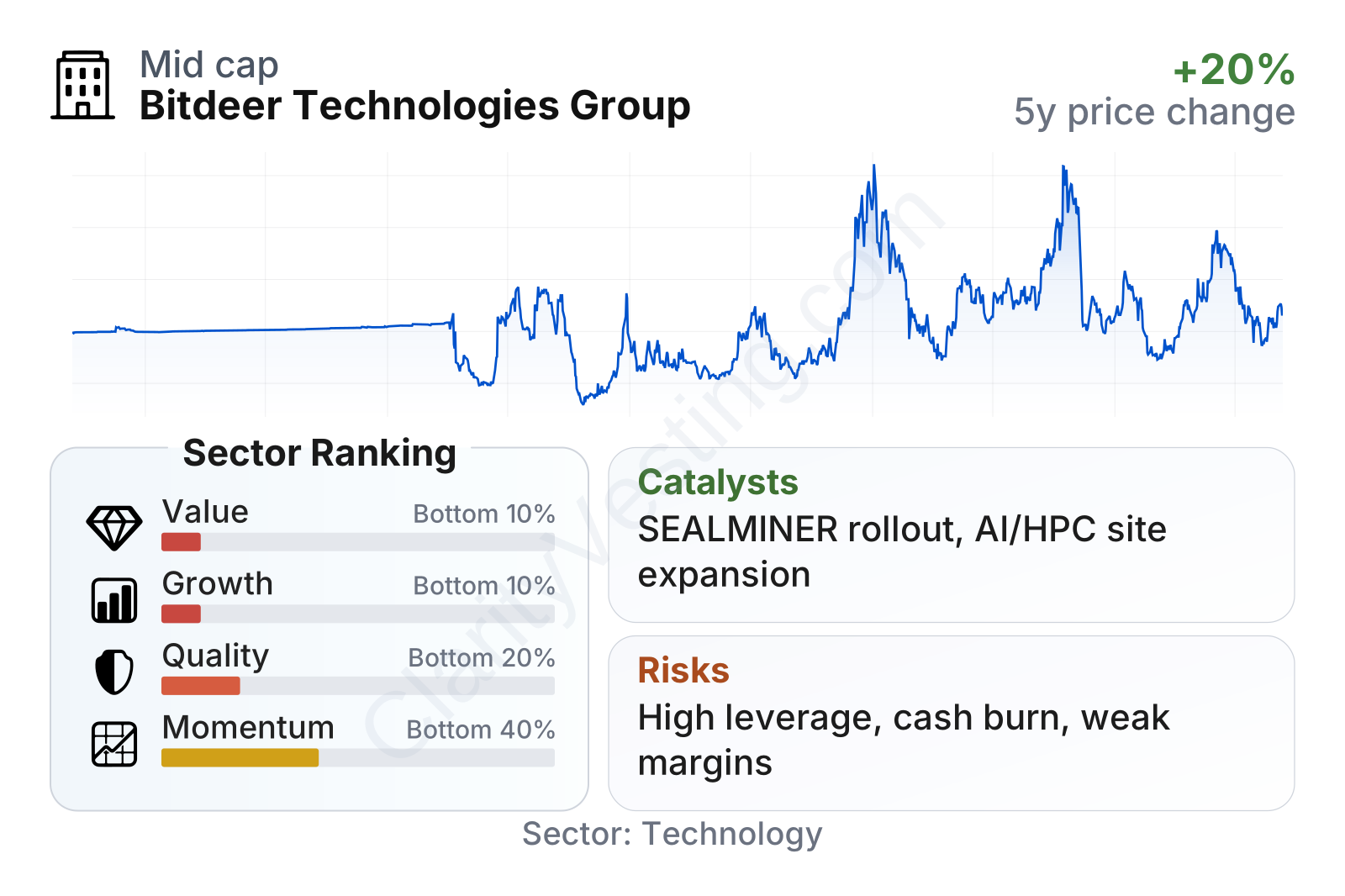
Bitdeer is a mid-sized company by market value, but the stock has behaved much more like a high-volatility small-cap growth name. Its beta above 2 suggests price swings that are far larger than the broader market. The factor profile is weak overall: value, growth, quality, and momentum all rank near the lower end of the technology sector. The most positive element in the table is recent revenue growth, which is running well above the sector median. The main negatives are deeply negative free cash flow, weak margins, and a debt-to-equity ratio far above the sector norm. In short, the business is showing expansion, but the financial base underneath that expansion is still fragile.
Growth
Bitdeer operates in a sector with real long-term growth potential, but it sits at the intersection of two very different markets. One is Bitcoin mining, which can expand over time but is extremely cyclical and depends on Bitcoin prices, mining difficulty, machine efficiency, and access to low-cost electricity. The other is digital infrastructure for high-performance computing and AI, where demand has been rising quickly as data center capacity and power availability become strategic assets.
The company’s strategy makes sense on paper because it tries to combine these two worlds. Bitdeer already knows how to secure sites, power, cooling, and large-scale compute operations. Those capabilities are directly relevant to both mining and AI infrastructure. The company has also been investing in its own mining chips and machines, which could improve control over equipment supply and economics if execution goes well.
Revenue growth has been highly uneven, which is normal for a business exposed to crypto cycles, but the latest period still shows strong year-over-year expansion at roughly 47%, well ahead of the technology sector median near 16%. That is an important signal: demand and operating activity are growing again, even if the path has been volatile. The challenge is that past five-year per-share growth remains weak, meaning recent acceleration has not yet translated into a consistently compounding record.
The biggest growth contradiction is cash generation. Free cash flow has deteriorated sharply and is deeply negative, indicating that Bitdeer is spending aggressively on expansion. In infrastructure-heavy businesses, negative free cash flow is not automatically a bad sign if it funds assets that later produce durable returns. For Bitdeer, that likely reflects spending on mining rigs, chips, and site development. The key issue is whether those investments eventually create better margins and steadier revenue, or simply require more capital to maintain growth.
Recent company updates have pointed to major expansion projects, including additional power capacity, deployment of SEALMINER machines, and development tied to AI and high-performance computing. Those are meaningful catalysts because access to energized sites has become one of the most valuable pieces of digital infrastructure. If Bitdeer can convert its power footprint into both mining output and third-party compute demand, the business could become structurally more diverse than many crypto miners.
Risks
This article is for informational purposes only and does not constitute financial advice. Some content is AI-generated. See Disclaimer


