Stock Analysis · Barratt Developments plc (BTDPF)
Overview
Barratt Developments plc is one of the largest homebuilders in the United Kingdom. The group develops residential communities, acquires land, secures planning permissions, builds homes, and sells them to individual buyers, investors, and housing associations. Its brands have historically included Barratt Homes and David Wilson Homes, and the company has also expanded its scale through the planned combination with Redrow, which is important because it increases land access, regional coverage, and product breadth across the U.K. housing market.
The business is relatively simple to understand: Barratt makes money by buying land, building homes, and selling those homes at a profit. Revenue is driven mainly by the number of completions and the average selling price of those homes. Compared with many industrial or technology businesses, the economics are tied more directly to housing demand, mortgage availability, build costs, and land discipline.
The company’s revenue sources are concentrated, with home sales clearly dominating the mix. Based on annual reporting structure and industry practice, the breakdown is approximately as follows:
- Private and affordable homebuilding: roughly 90%+ of revenue, by far the largest contributor.
- Land sales and other property-related activity: a small single-digit share, varying by year.
- Joint ventures and other income: typically a low-single-digit contribution.
This concentration means Barratt is not a diversified conglomerate. Its fortunes are closely linked to the U.K. new-build housing cycle, but that also gives the company a clear operating focus and makes the business easier to follow than many more complex listed groups.
The long-term picture of the income flow shows a cyclical business rather than a structurally broken one. Revenue and gross profit weakened sharply in 2024 as the housing slowdown hit volumes and margins, then improved again in 2025. Even so, profitability remains well below the peak reached earlier in the cycle, which is a useful reminder that homebuilding results can change quickly when selling conditions shift.
Key Figures
| Metric | Value | Sector ⓘ |
|---|---|---|
| Date | Sep 12, 2026 | |
| Context | ||
| Sector | Consumer Cyclical | |
| Industry | Residential Construction | |
| Market Cap ⓘ | $5.38B | |
| Beta ⓘ | 1.37 | |
Value (Cheapness) | ||
| P/E Ratio ⓘ | 19.45 | 17.10 |
| FCF Yield ⓘ | -1.97% | 8.53% |
| EBIT / EV ⓘ | N/A | 6.46% |
| PEG ⓘ | 0.44 | |
Growth (Business expansion) | ||
| Revenue Growth ⓘ | 15.40% | 5.75% |
| RPS Growth (5Y CAGR) ⓘ | -4.00% | 9.14% |
| EPS Growth (5Y CAGR) ⓘ | -2.13% | -18.21% |
| Margin Growth (5Y Trend) ⓘ | -10.17% | -0.23% |
| FCF Growth (5Y CAGR) ⓘ | -65.42% | 4.91% |
Quality (Business durability) | ||
| ROIC (Latest) ⓘ | 8.17% | 12.61% |
| ROIC (5Y Median) ⓘ | 11.50% | 10.72% |
| Net Debt / EBIT (Latest) ⓘ | -0.18 | 2.10 |
| Net Debt / EBIT (5Y Median) ⓘ | -0.73 | 2.32 |
| Operating Margin (Latest) ⓘ | 6.57% | 9.25% |
| Operating Margin (5Y Median) ⓘ | 12.32% | 9.64% |
| Debt to Equity (Latest) ⓘ | 3.24% | 75.78% |
| Profit Margin (Latest) ⓘ | 3.64% | 5.33% |
| Free Cash Flow (Latest) ⓘ | -$106.12M | |
Momentum (Price trend) | ||
| 3Y Return ⓘ | -17.91% | +14.53% |
| 12M Return (excl. last month) ⓘ | -15.79% | +3.08% |
| 6M Return ⓘ | -5.12% | +0.55% |
| Price vs. 200-Day MA ⓘ | -9.93% | -0.54% |
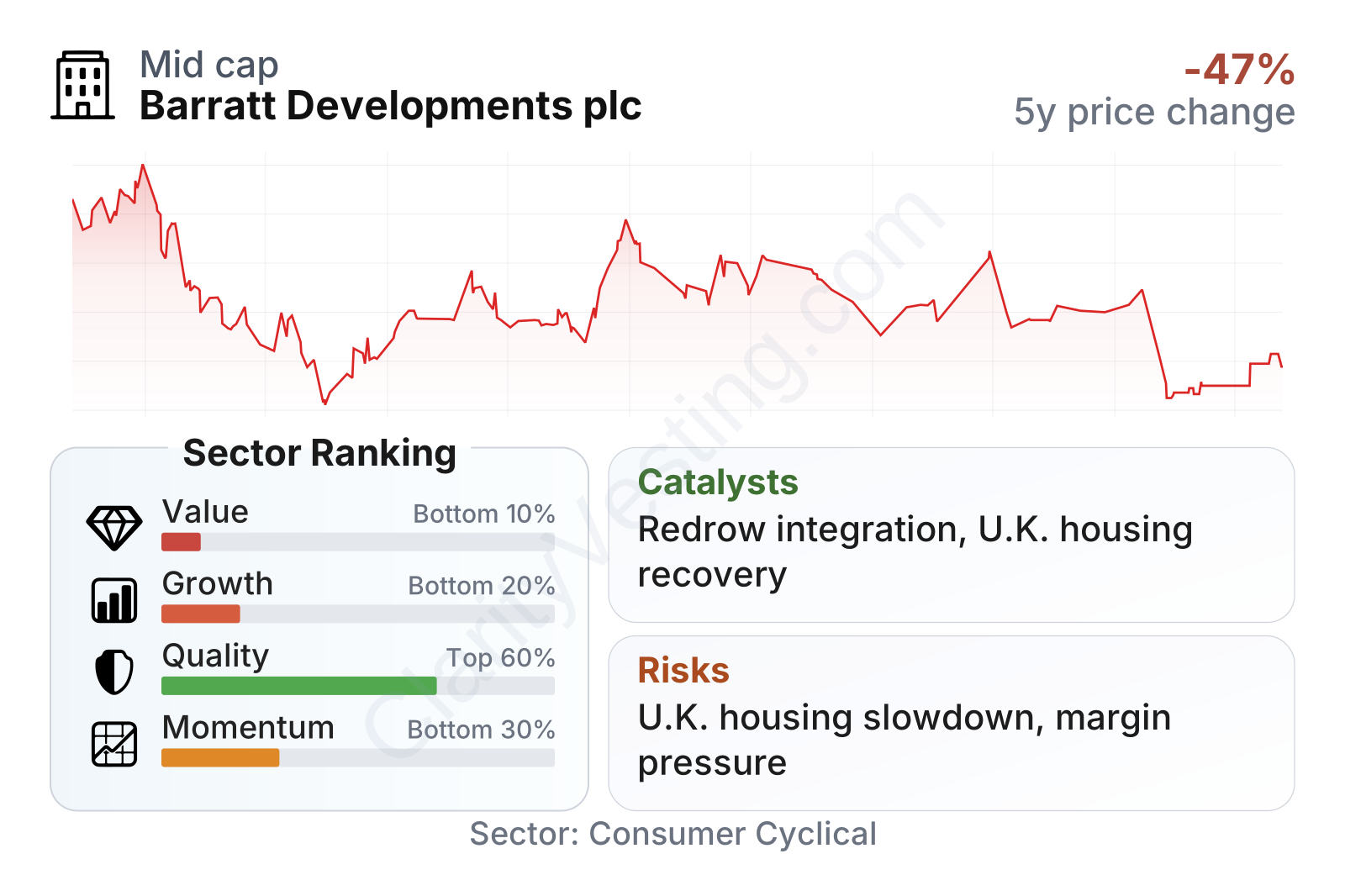
Barratt currently sits in a mixed position. On quality, the balance sheet stands out positively, with very low debt relative to equity and even net cash on an operating basis, which is uncommon in a cyclical industry. On the other hand, value, growth, and momentum indicators are weaker. Recent revenue growth has rebounded, but the longer five-year trend in revenue per share, free cash flow, and margins has been much less favorable. Market performance has also been soft, with the shares well below past highs and trailing much of the sector over recent periods.
Its market capitalization is around the mid-single-digit billions of dollars, making it a substantial listed builder rather than a niche operator. The stock’s beta above 1 also suggests it tends to move more sharply than the broader market, which fits the cyclical nature of housing and construction.
Growth
The company operates in a sector that has solid long-term structural support, even if short-term conditions are often volatile. The U.K. has faced a persistent housing shortage for years, supported by population trends, household formation, and limited supply in many regions. In that sense, residential construction remains an important sector with room for long-term demand. The challenge is that demand does not move in a straight line: mortgage rates, consumer confidence, and affordability can slow activity for several quarters at a time.
Barratt’s strategy is broadly sensible for this environment. Scale matters in homebuilding because larger groups can spread overhead, manage supply chains better, negotiate land more efficiently, and maintain a wider outlet network. The Redrow transaction is therefore a major strategic catalyst. It creates a larger combined builder with broader geographic reach and greater exposure to different customer segments. If integration is handled well, that could improve operating efficiency and strengthen future land replenishment.
Near-term growth signs have improved compared with the downturn phase. Revenue growth has turned positive on a year-over-year basis and looks stronger than the sector median, which suggests the worst of the recent demand shock may have passed. That said, the five-year record remains uneven, so one better year should be viewed as an early recovery sign rather than proof of a fully restored growth profile.
Cash generation is the more cautious part of the picture. Free cash flow remains negative on a trailing basis, which is not unusual for a builder during periods of land investment, work-in-progress buildup, or changing completion timing, but it does mean growth is not yet converting cleanly into surplus cash. For long-term analysis, the key question is whether the company can turn the recent revenue recovery into consistently stronger cash conversion over the next few reporting periods.
A meaningful external catalyst is the direction of U.K. interest rates and mortgage affordability. If financing conditions continue to stabilize or improve, that can support reservation rates and transaction volumes. In addition, any planning reform or policy support aimed at increasing housebuilding could benefit larger, well-capitalized developers such as Barratt more than smaller players.
Risks
This article is for informational purposes only and does not constitute financial advice. Some content is AI-generated. See Disclaimer


