Stock Analysis · Bentley Systems Inc (BSY)
Overview
Bentley Systems is a software company focused on the design, construction, and operation of infrastructure. In simple terms, it provides digital tools used by engineers, architects, contractors, utilities, rail operators, road agencies, water systems, and industrial asset owners to plan projects and manage physical assets over long periods. Its products are used on infrastructure such as roads, bridges, rail networks, power systems, water networks, factories, and data centers.
The company mainly sells software subscriptions and related services. Bentley’s business is attractive to long-term market observers because infrastructure assets are complex, expensive to replace, and often managed over decades, which can support recurring demand for specialized software.
Based on the company’s recent annual filing, revenue is primarily generated from recurring software usage, with services representing a much smaller share. The broad mix can be summarized as follows:
- Subscriptions and recurring software revenue: approximately 85% to 90% — this includes term subscriptions, enterprise agreements, and other recurring arrangements tied to Bentley’s engineering and infrastructure software portfolio.
- Perpetual licenses and other license-related revenue: approximately 5% to 10% — this is a smaller and declining part of the business compared with recurring models.
- Services: approximately 5% to 10% — this includes implementation, training, consulting, and support work tied to customer deployments.
Within its software portfolio, Bentley organizes offerings around engineering applications and infrastructure lifecycle workflows. Its products span modeling and simulation, geotechnical and structural analysis, construction management, asset performance, and infrastructure digital twin applications. The customer base is diversified across public agencies, engineering firms, owner-operators, and industrial clients, which helps reduce dependence on any single project.
The business model also has a favorable financial shape. Revenue has steadily expanded over recent years, while gross profit has grown faster than direct delivery costs, showing the economics typical of mature software platforms. Research and development remains a major expense, which is normal for a company that must keep its tools current and integrated across many infrastructure use cases.
The broad picture is a company with rising sales, very high gross profit, and improving operating income over time. That combination points to a scalable software model, even though spending on product development remains significant.
Key Figures
| Metric | Value | Sector ⓘ |
|---|---|---|
| Date | Sep 12, 2026 | |
| Context | ||
| Sector | Technology | |
| Industry | Software - Application | |
| Market Cap ⓘ | $9.36B | |
| Beta ⓘ | 0.98 | |
Value (Cheapness) | ||
| P/E Ratio ⓘ | 35.63 | 29.51 |
| FCF Yield ⓘ | 5.32% | 4.25% |
| EBIT / EV ⓘ | 3.83% | 2.85% |
| PEG ⓘ | 1.23 | |
Growth (Business expansion) | ||
| Revenue Growth ⓘ | 12.80% | 15.40% |
| RPS Growth (5Y CAGR) ⓘ | 10.11% | 8.56% |
| EPS Growth (5Y CAGR) ⓘ | -6.67% | -11.88% |
| Margin Growth (5Y Trend) ⓘ | 13.05% | 0.46% |
| FCF Growth (5Y CAGR) ⓘ | 17.76% | 9.80% |
Quality (Business durability) | ||
| ROIC (Latest) ⓘ | 13.32% | 9.44% |
| ROIC (5Y Median) ⓘ | 10.50% | 8.30% |
| Net Debt / EBIT (Latest) ⓘ | 2.71 | 0.54 |
| Net Debt / EBIT (5Y Median) ⓘ | 6.68 | 0.44 |
| Operating Margin (Latest) ⓘ | 25.78% | 9.58% |
| Operating Margin (5Y Median) ⓘ | 21.23% | 8.25% |
| Debt to Equity (Latest) ⓘ | 105.44% | 33.33% |
| Profit Margin (Latest) ⓘ | 18.10% | 7.14% |
| Free Cash Flow (Latest) ⓘ | $498.50M | |
Momentum (Price trend) | ||
| 3Y Return ⓘ | -34.82% | +45.48% |
| 12M Return (excl. last month) ⓘ | -31.32% | +23.48% |
| 6M Return ⓘ | -19.27% | +20.93% |
| Price vs. 200-Day MA ⓘ | -12.05% | +7.43% |
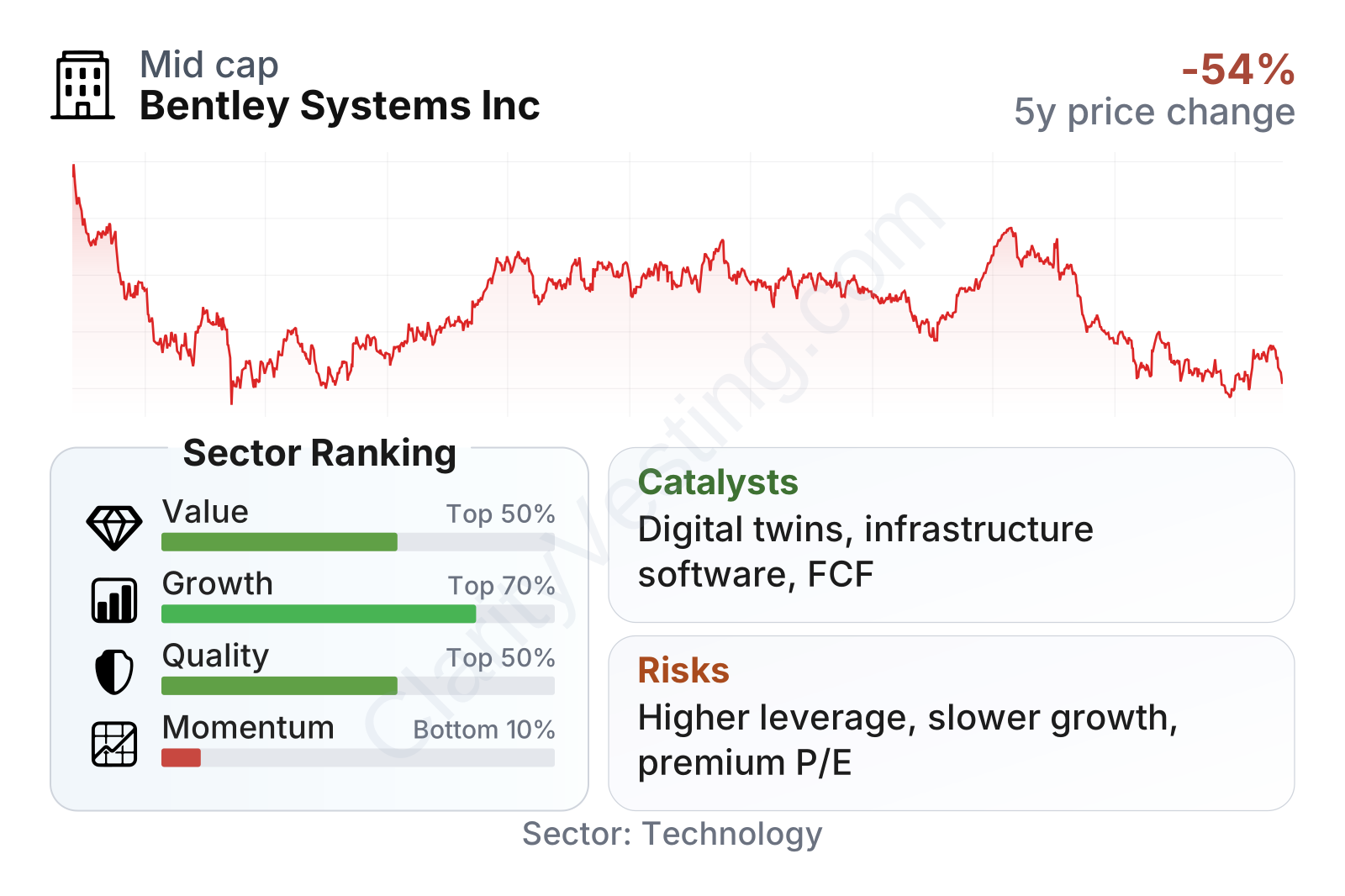
Bentley sits in the large mid-cap range, with share-price volatility close to the broader market rather than extreme software-stock behavior. The quality profile is solid: operating margin is around 26% and profit margin is about 18%, both clearly above typical software sector medians. Returns on invested capital are also ahead of the sector median, which suggests the company converts its software franchise into profits more efficiently than many peers.
Growth is good rather than exceptional. Recent revenue growth is around 13%, below the sector median, but the longer-term picture is better: revenue per share and free cash flow have compounded at healthy rates over five years, and margin improvement has been especially strong. On value, the stock trades at a P/E in the high 30s, above the sector median, although its free-cash-flow yield and EBIT-to-enterprise-value ratio look more favorable than that headline multiple alone suggests. Price momentum has been weak over multi-year and recent trailing periods, which helps explain why valuation has compressed from much higher levels seen in earlier years.
Growth
Bentley operates in a sector with durable long-term demand. Infrastructure spending is not a short-lived theme: governments and private operators continue to invest in transportation, water, energy, utilities, and industrial facilities. At the same time, owners are under pressure to reduce project delays, improve maintenance, and digitize physical assets. That creates a structural need for software that can help design and manage infrastructure more efficiently.
The company’s strategy appears aligned with that backdrop. Bentley is not trying to be a broad consumer or office software platform. Instead, it stays focused on infrastructure engineering, where workflows are specialized and switching costs can be meaningful. Once a firm trains engineers, stores project information, and links operations around a certain software environment, replacing that system can be disruptive. That tends to support retention and recurring revenue.
Revenue growth has cooled from the unusually strong levels seen earlier in the decade, but it has remained in a healthy range around low-double digits more recently. That is not the fastest pace in software, yet it is respectable for a business serving infrastructure customers that often move more slowly than consumer or enterprise IT markets. The steadier pattern may actually fit the company’s niche: less explosive, but potentially more durable.
Another encouraging point is cash generation.
Free cash flow has moved upward over the last several years, showing that growth is not only accounting-based. The latest trailing figure is comfortably above historical levels, and the five-year cash flow growth rate is stronger than the sector median. For a long-term analysis, this matters because recurring software revenue becomes more valuable when it turns into cash consistently.
Recent company updates have also highlighted continued interest in infrastructure digital twins, asset analytics, and software tied to data center and energy-related projects. Bentley has been positioning itself around the full lifecycle of infrastructure assets, not just the initial design stage. That increases the potential revenue opportunity per customer because software can remain relevant after construction is complete, during operations and maintenance.
A further catalyst is the broader push toward modernizing aging infrastructure and using AI-enabled or data-driven tools in engineering workflows. Bentley’s domain focus gives it a credible place in that trend, especially where complex physical systems require specialized engineering data rather than generic productivity software.
Risks
This article is for informational purposes only and does not constitute financial advice. Some content is AI-generated. See Disclaimer


