Stock Analysis · Bending Spoons S.p.A (BSP)
Overview
Bending Spoons is an Italian software company that builds, acquires, and operates consumer digital products. It first became known for mobile apps, and over time it expanded into a broader portfolio that includes photo and video editing tools, productivity software, and digital publishing or file-management products. Its model is relatively simple to understand: acquire or develop apps with large user bases, improve monetization and operations, and scale subscriptions across a global audience.
The business is largely driven by recurring digital subscriptions and in-app purchases rather than hardware or one-off enterprise contracts. That gives the company exposure to a part of software that can grow quickly, although it can also be volatile because user preferences and app-store dynamics change fast. The company has also become more active in acquisitions, which has materially changed its size and revenue mix in recent years.
Public reporting does not provide a precise product-by-product revenue split detailed enough to rank every app with reliable percentages. At a high level, revenue appears to come mainly from consumer software subscriptions and app monetization across its portfolio, with contribution from acquired software assets increasing the mix over time.
- Consumer app subscriptions and in-app purchases: the core source of revenue, covering photo editing, video editing, productivity, and utility applications sold mainly through app stores and direct digital channels.
- Acquired software products: revenue from businesses added through acquisitions, which broaden the portfolio and can materially expand the user base and average revenue per customer.
- Other digital monetization streams: smaller contributions may include one-time purchases, licensing, or ancillary digital services tied to the company’s software ecosystem.
The financial profile shows a business that has scaled very quickly: revenue moved from about $387 million in 2023 to about $671 million in 2024 and then to roughly $1.3 billion in 2025. Gross profit also expanded sharply over that period, showing that the company’s software-heavy model still carries attractive unit economics even as it gets larger. At the same time, the path from operating profit to net income became much less favorable in 2025 because financing costs rose significantly.
The progression over the last three years shows a company that is getting much bigger very fast, with gross profit rising strongly alongside revenue. The notable change is below operating income: interest expense increased sharply in 2025, which largely explains why rapid top-line expansion did not translate into net earnings growth.
Key Figures
| Metric | Value | Sector ⓘ |
|---|---|---|
| Date | Oct 31, 2026 | |
| Context | ||
| Sector | Technology | |
| Industry | Software - Application | |
| Market Cap ⓘ | $29.62B | |
| Beta ⓘ | N/A | |
Value (Cheapness) | ||
| P/E Ratio ⓘ | 105.98 | 29.73 |
| FCF Yield ⓘ | 0.98% | 3.96% |
| Dividend Yield ⓘ | N/A | 1.30% |
| EBIT / EV ⓘ | 1.36% | 2.90% |
| PEG ⓘ | N/A | |
Growth (Business expansion) | ||
| Revenue Growth ⓘ | 126.30% | 15.80% |
| RPS Growth (5Y CAGR) ⓘ | 89.11% | 8.54% |
| EPS Growth (5Y CAGR) ⓘ | N/A | -10.19% |
| Margin Growth (5Y Trend) ⓘ | -0.70% | 0.45% |
| FCF Growth (5Y CAGR) ⓘ | 131.32% | 9.80% |
| DPS Growth (5Y CAGR) ⓘ | N/A | 7.67% |
Quality (Business durability) | ||
| ROIC (Latest) ⓘ | N/A | 9.74% |
| ROIC (5Y Median) ⓘ | N/A | 8.31% |
| Net Debt / EBIT (Latest) ⓘ | 9.04 | 0.53 |
| Net Debt / EBIT (5Y Median) ⓘ | 4.21 | 0.46 |
| Net Debt / EBITDA (Latest) ⓘ | 7.65 | 0.29 |
| Net Debt / Assets ⓘ | 51.71% | 3.45% |
| EBITDA / Interest ⓘ | 2.09 | 13.54 |
| Operating Margin (Latest) ⓘ | 23.89% | 10.12% |
| Operating Margin (5Y Median) ⓘ | 20.13% | 8.50% |
| Debt to Equity (Latest) ⓘ | 394.02% | 35.18% |
| Profit Margin (Latest) ⓘ | 12.30% | 7.13% |
| Free Cash Flow (Latest) ⓘ | $289.67M | |
Momentum (Price trend) | ||
| 3Y Return ⓘ | N/A | +61.79% |
| 12M Return (excl. last month) ⓘ | N/A | +12.78% |
| 6M Return ⓘ | N/A | +7.85% |
| Price vs. 200-Day MA ⓘ | N/A | +5.43% |
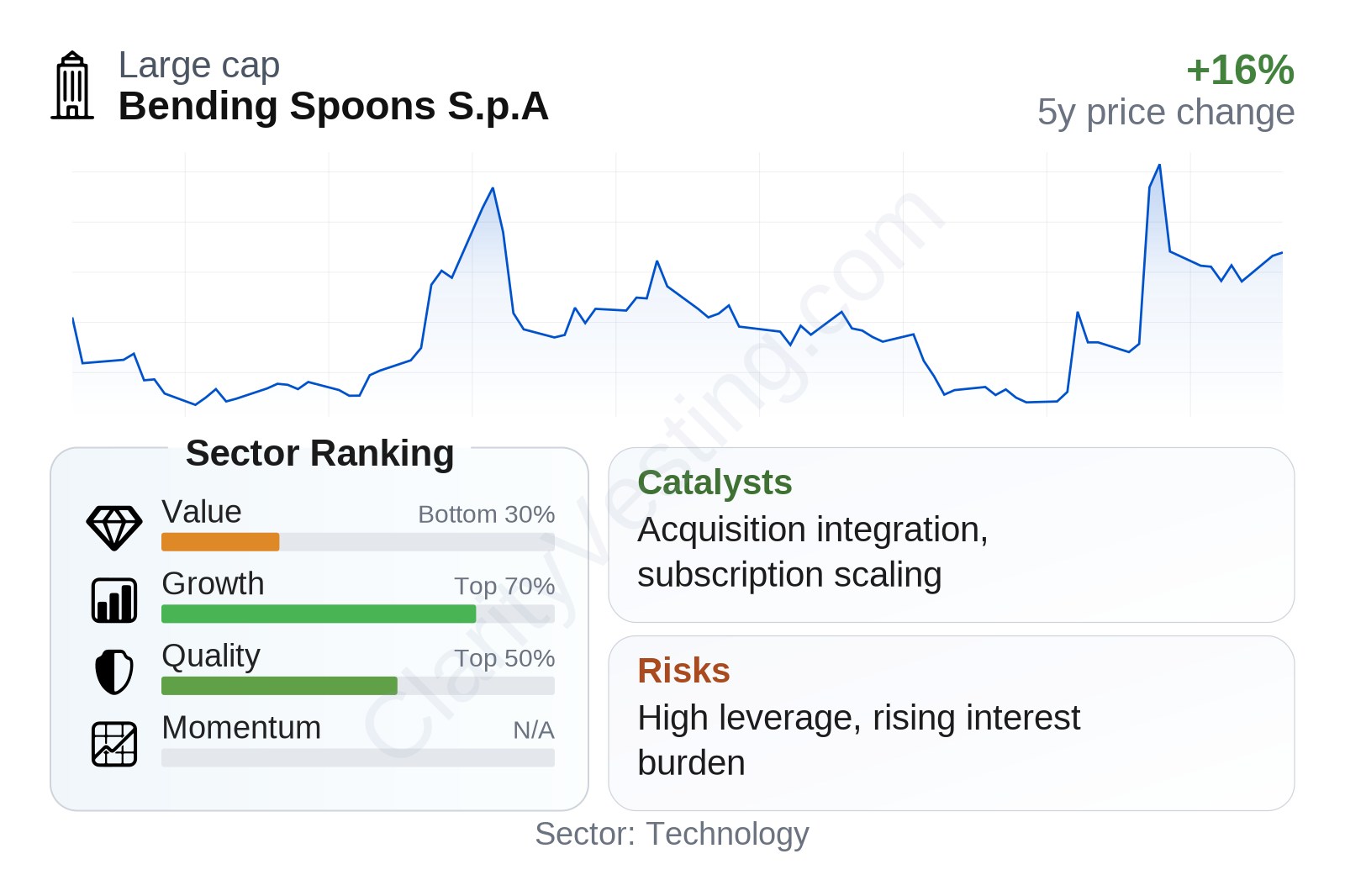
The overall picture is unusually polarized. Growth metrics are far above most software peers, with revenue and free cash flow compounding at a pace that stands out across the sector. Profitability at the net margin level is still respectable, but the balance sheet carries much more leverage than the typical application software company, and the valuation multiples remain elevated versus the sector median. In short, the market is attaching a premium to expansion, while the capital structure is the main counterweight.
Bending Spoons is now a large software company by market value, with free cash flow of roughly $290 million over the last twelve months. However, its earnings multiple is well above the software sector median and its free-cash-flow yield is notably lower than typical peers, which suggests that the stock price is already discounting substantial future progress.
Growth
Bending Spoons operates in a favorable long-term area of technology. Consumer and prosumer software remains a growing market as more creative work, communication, and personal productivity shift to digital subscriptions. Mobile-first software is no longer a niche, and the company’s expanding product set gives it more ways to monetize users across editing, publishing, and utility categories. This is not the same growth profile as infrastructure software or cloud platforms, but it is still part of a large and expanding software economy.
The company’s strategy is coherent for future growth. It combines internal product optimization with acquisitions of established digital products. That can work well when the buyer has stronger pricing, marketing, retention, and cost-management discipline than the prior owner. The recent financial trajectory suggests that Bending Spoons has been effective at increasing the scale of its portfolio. Revenue growth of roughly 126% year over year and a five-year revenue-per-share growth rate near 89% place it among the strongest growers in its sector.
A key catalyst is the company’s ability to integrate acquired assets and raise their monetization without destroying the user base. Another is the shift toward recurring subscriptions, which can improve visibility and cash generation if retention remains healthy. The software portfolio approach also creates optionality: a single successful acquisition or product relaunch can move the overall business more than it would for a narrowly focused app developer.
Recent expansion in revenue and gross profit indicates a much larger operating platform than just a few years ago. If management can keep scaling acquired products while containing operating costs and financing burdens, the business could convert its enlarged footprint into stronger earnings power. That is the central growth debate around the company today.
Risks
This article is for informational purposes only and does not constitute financial advice. Some content is AI-generated. See Disclaimer