Stock Analysis · Bosideng International Holdings Limited (BSDGF)
Overview
Bosideng International Holdings Limited is a China-based apparel company best known for down jackets. Its business has gradually evolved from a seasonal outerwear specialist into a broader branded apparel platform, but down apparel remains the economic core of the group. The company sells through a mix of self-operated retail stores, distributor-managed stores, and online channels, with mainland China as its main market.
The largest source of revenue is branded down apparel under the Bosideng name and related labels. Based on the company’s recent annual reporting structure, revenue is concentrated as follows:
- Down apparel: approximately 80% to 85% of revenue. This includes premium and mass-market down jackets, light down products, and related seasonal outerwear.
- OEM management: approximately 10% to 15% of revenue. This business manufactures apparel for international brands and retail partners.
- Ladieswear: approximately 3% to 6% of revenue. This covers non-down fashion apparel sold under acquired and internally managed brands.
- Diversified apparel: approximately 1% to 3% of revenue. This usually includes newer categories and other clothing-related activities outside the main down jacket franchise.
That revenue mix matters because it shows both strength and concentration. Bosideng’s leading brand gives the company pricing power and recognition in its niche, but it also means performance is still closely tied to the health of the down apparel category.
The business model has become more profitable over time. Revenue has expanded strongly since 2022, while gross profit and net income have risen faster than sales, showing that the company has been able to improve its product mix and preserve pricing. Interest expense has also become less significant, which supports earnings quality.
Over the last several years, Bosideng has turned a larger share of sales into operating profit and net income. The clearest pattern is that revenue growth has not been driven only by scale; margins also improved meaningfully, which suggests stronger brand positioning and better cost control.
Key Figures
| Metric | Value | Sector ⓘ |
|---|---|---|
| Date | Sep 12, 2026 | |
| Context | ||
| Sector | Consumer Cyclical | |
| Industry | Apparel Manufacturing | |
| Market Cap ⓘ | $6.73B | |
| Beta ⓘ | 0.59 | |
Value (Cheapness) | ||
| P/E Ratio ⓘ | 11.54 | 17.10 |
| FCF Yield ⓘ | 119.99% | 8.53% |
| EBIT / EV ⓘ | 235.29% | 6.46% |
| PEG ⓘ | 2.16 | |
Growth (Business expansion) | ||
| Revenue Growth ⓘ | 7.70% | 5.75% |
| RPS Growth (5Y CAGR) ⓘ | 12.14% | 9.14% |
| EPS Growth (5Y CAGR) ⓘ | -20.00% | -18.21% |
| Margin Growth (5Y Trend) ⓘ | 4.47% | -0.23% |
| FCF Growth (5Y CAGR) ⓘ | 26.83% | 4.91% |
Quality (Business durability) | ||
| ROIC (Latest) ⓘ | N/A | 12.61% |
| ROIC (5Y Median) ⓘ | 17.56% | 10.72% |
| Net Debt / EBIT (Latest) ⓘ | 0.28 | 2.10 |
| Net Debt / EBIT (5Y Median) ⓘ | 0.12 | 2.32 |
| Operating Margin (Latest) ⓘ | 20.00% | 9.25% |
| Operating Margin (5Y Median) ⓘ | 18.32% | 9.64% |
| Debt to Equity (Latest) ⓘ | 34.90% | 75.78% |
| Profit Margin (Latest) ⓘ | 14.60% | 5.33% |
| Free Cash Flow (Latest) ⓘ | $8.08B | |
Momentum (Price trend) | ||
| 3Y Return ⓘ | +55.67% | +14.53% |
| 12M Return (excl. last month) ⓘ | +13.12% | +3.08% |
| 6M Return ⓘ | +7.99% | +0.55% |
| Price vs. 200-Day MA ⓘ | +1.08% | -0.54% |
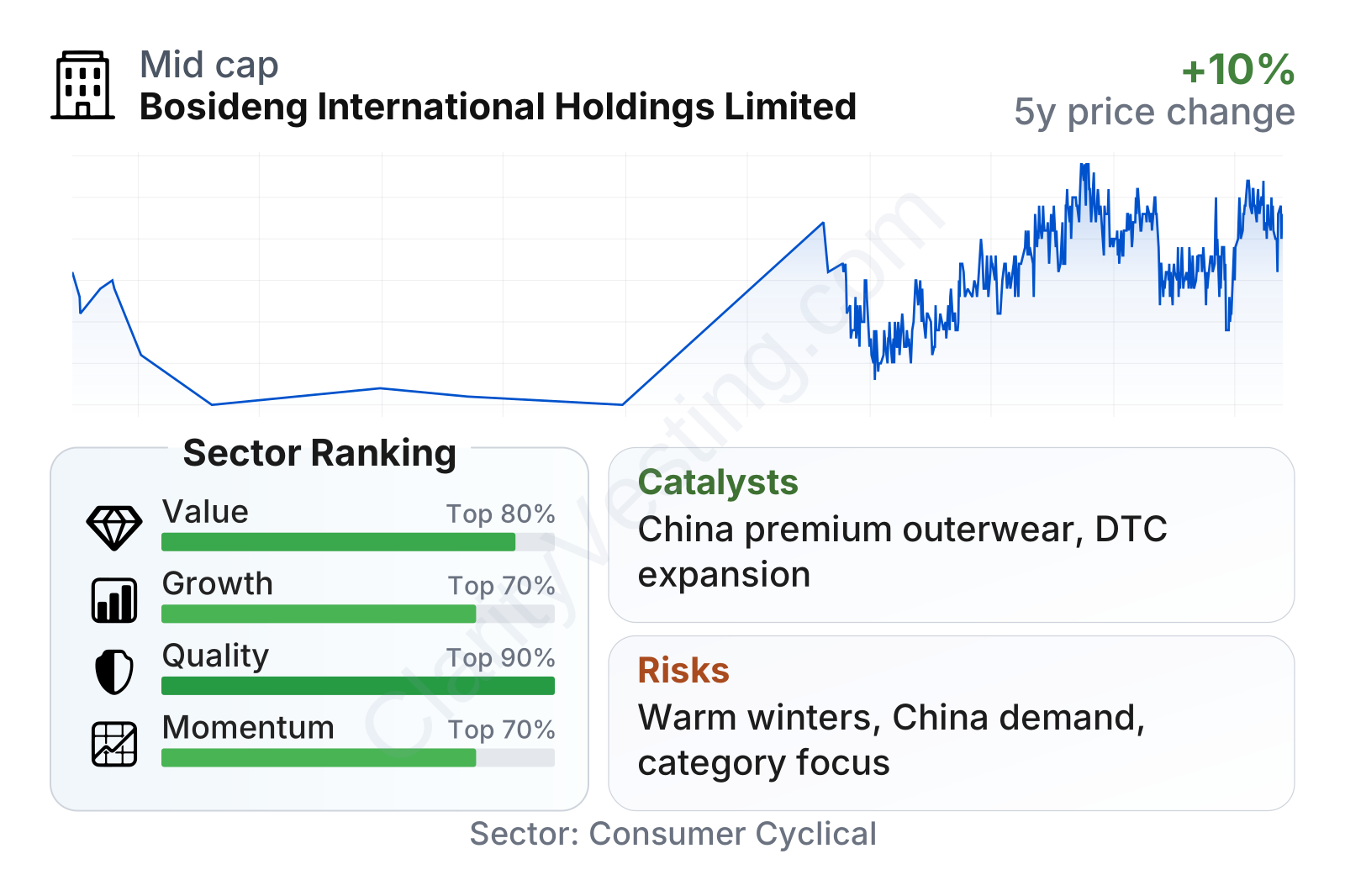
Bosideng screens well on business quality and balance-sheet strength. Profitability is well above the sector median, with operating margin around 20% and profit margin around 15%, both notably stronger than many apparel peers. Leverage also looks conservative: debt to equity is roughly 35%, and net debt relative to EBIT is far lower than the sector median. Growth is positive rather than explosive, but free cash flow generation stands out as especially strong over a multi-year period. On valuation measures, the shares appear cheaper than the sector median on earnings, while recent price performance has been better than much of the broader consumer cyclical group.
Growth
Bosideng operates in a part of apparel that still has room for long-term development, even though it is not a classic high-growth technology market. In China, consumers have shown willingness to pay more for functional, premium, and brand-led clothing, especially in categories where product performance matters. Down jackets fit that pattern well because warmth, design, materials, and brand reputation all influence purchasing decisions. This gives established leaders more room to defend pricing than in basic commodity apparel.
The company’s strategy also looks coherent. Management has spent years pushing Bosideng further upmarket, improving store quality, building direct retail capabilities, and investing in digital sales. That matters because premiumization can lift margins even when unit growth slows. The company also benefits from expanding product use beyond extreme winter conditions through lighter down products and broader seasonal offerings, which can reduce some of the category’s seasonality over time.
Recent growth has been steady rather than spectacular. Year-over-year revenue growth is ahead of the sector median, and the longer five-year revenue-per-share trend is also favorable. The more important point is that growth has been accompanied by improving operating economics, which tends to be more durable than pure volume expansion.
Cash generation is one of the more attractive features in the current profile. Free cash flow has compounded much faster than the sector median over five years, indicating that accounting profits are being converted into real cash at a healthy rate. That supports flexibility for store upgrades, brand investment, working capital needs, and shareholder distributions without depending heavily on external financing.
A meaningful catalyst is the continued rise of domestic premium brands in China. Bosideng has already established itself as a leading name in down apparel, and if Chinese consumers continue favoring recognized local brands with strong product identity, the company is positioned to benefit. Another catalyst is channel optimization: more direct retail and online engagement can strengthen margins and customer data, while improving control over pricing and inventory.
Recent company reporting for the fiscal year ended March 31, 2026 showed continued revenue and profit growth, reinforcing that the brand has maintained momentum despite a more uneven consumer environment. That does not guarantee acceleration, but it does suggest the company is still executing effectively in its core market.
Risks
This article is for informational purposes only and does not constitute financial advice. Some content is AI-generated. See Disclaimer


