Stock Analysis · Dutch Bros Inc (BROS)
Overview
Dutch Bros is a fast-growing U.S. beverage chain centered on handcrafted drinks, especially espresso-based beverages, cold drinks, energy drinks, teas, lemonades, and related food items. The company started in Oregon and has expanded across the western and southern United States with a drive-thru-focused format that aims for speed, convenience, and a distinctive customer experience. Its brand is built around customization, younger consumers, and a menu that reaches beyond traditional coffee.
The business makes money primarily from company-operated shops and, to a smaller extent, from franchised locations and related activities. In recent years, Dutch Bros has also been shifting toward a larger company-operated base, which gives it more direct control over operations and unit economics but also requires more capital.
Based on recent company disclosures, Dutch Bros’ revenue mix is approximately as follows:
- Company-operated shops: about 90% to 92% of revenue. This includes beverage and food sales made directly through stores owned and run by the company.
- Franchising and related revenue: about 8% to 10% of revenue. This includes franchise fees, royalties, leasing and other support-related income tied to franchised shops.
Within store sales, beverages are the dominant economic driver. The menu is led by coffee drinks and the company’s proprietary energy drink platform, with food representing a much smaller contribution than at many quick-service restaurant peers. That makes Dutch Bros less dependent on meal traffic and more exposed to beverage demand, repeat visits, and new drink launches.
The business model has improved meaningfully over the last several years. Revenue has climbed from roughly $500 million in 2021 to more than $1.6 billion in 2025, while operating income and net income moved from losses to solid profitability. The biggest structural change has been a combination of unit expansion, rising sales volumes, and better cost absorption as the chain scales.
The financial flow shows a business that has grown quickly while steadily converting more of its sales into operating profit and net income. Revenue has expanded sharply, gross profit has widened, and overhead has grown more slowly than sales, which points to improving scale benefits.
Key Figures
| Metric | Value | Sector ⓘ |
|---|---|---|
| Date | Sep 12, 2026 | |
| Context | ||
| Sector | Consumer Cyclical | |
| Industry | Restaurants | |
| Market Cap ⓘ | $7.62B | |
| Beta ⓘ | 2.29 | |
Value (Cheapness) | ||
| P/E Ratio ⓘ | 62.06 | 17.10 |
| FCF Yield ⓘ | 1.25% | 8.53% |
| EBIT / EV ⓘ | 2.37% | 6.46% |
| PEG ⓘ | 1.48 | |
Growth (Business expansion) | ||
| Revenue Growth ⓘ | 32.50% | 5.75% |
| RPS Growth (5Y CAGR) ⓘ | 4.66% | 9.14% |
| EPS Growth (5Y CAGR) ⓘ | 36.04% | -18.21% |
| Margin Growth (5Y Trend) ⓘ | 32.60% | -0.23% |
| FCF Growth (5Y CAGR) ⓘ | N/A | 4.91% |
Quality (Business durability) | ||
| ROIC (Latest) ⓘ | 15.63% | 12.61% |
| ROIC (5Y Median) ⓘ | 7.23% | 10.72% |
| Net Debt / EBIT (Latest) ⓘ | 5.54 | 2.10 |
| Net Debt / EBIT (5Y Median) ⓘ | 8.42 | 2.32 |
| Operating Margin (Latest) ⓘ | 9.01% | 9.25% |
| Operating Margin (5Y Median) ⓘ | 5.10% | 9.64% |
| Debt to Equity (Latest) ⓘ | 151.36% | 75.78% |
| Profit Margin (Latest) ⓘ | 4.91% | 5.33% |
| Free Cash Flow (Latest) ⓘ | $95.03M | |
Momentum (Price trend) | ||
| 3Y Return ⓘ | +64.23% | +14.53% |
| 12M Return (excl. last month) ⓘ | -25.86% | +3.08% |
| 6M Return ⓘ | -8.86% | +0.55% |
| Price vs. 200-Day MA ⓘ | -23.05% | -0.54% |
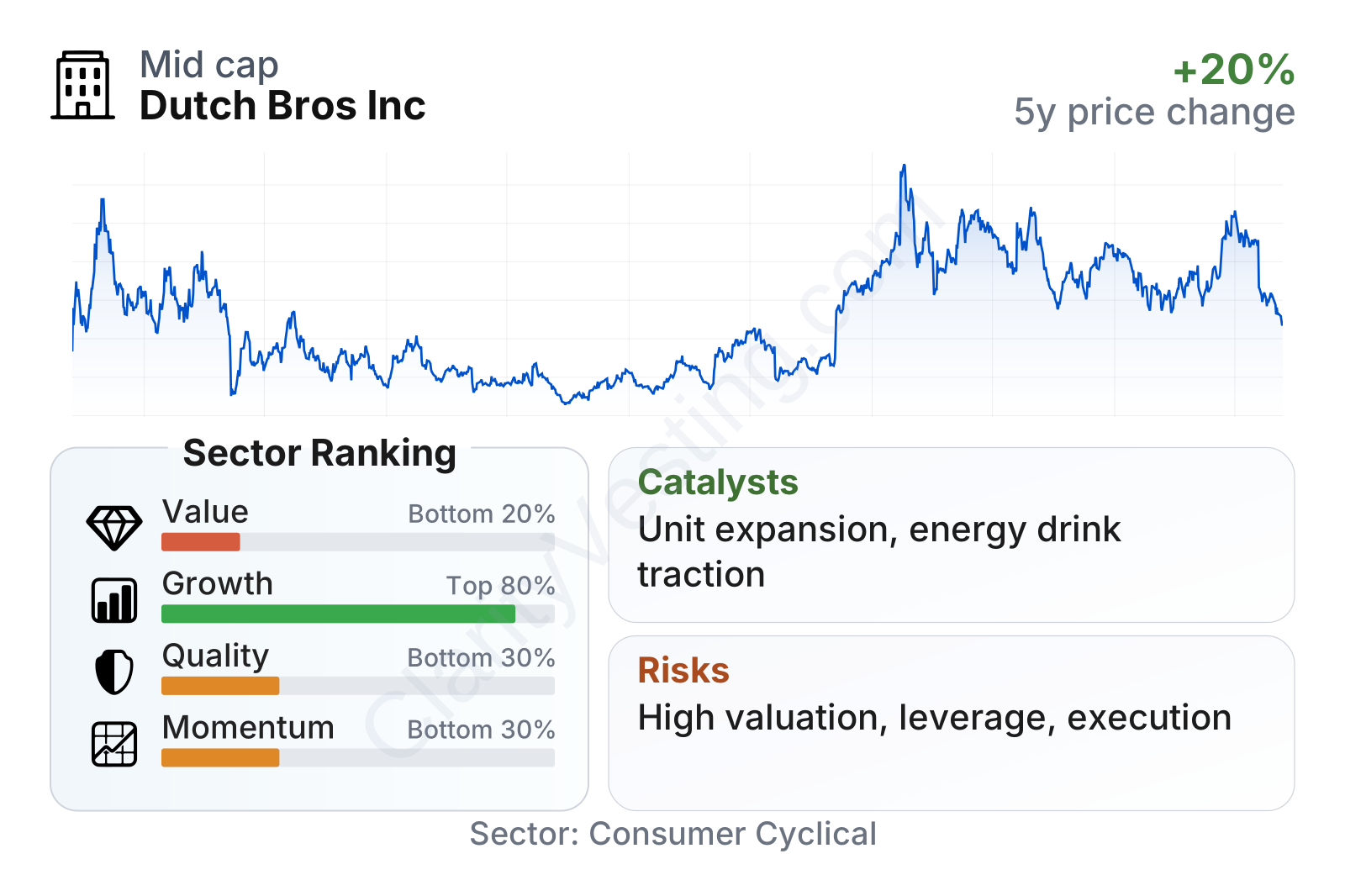
Dutch Bros stands out as a mid-sized restaurant company with unusually high share-price volatility, reflected in a beta above 2. Its growth profile is strong relative to most restaurant peers, but the stock’s valuation and balance-sheet leverage are notably less conservative. The table also suggests a company in transition: profitability and returns have improved, yet valuation remains demanding and quality measures are held back by debt.
The stock history reflects that mix. Since its public listing, the shares have gone through large swings, which is common for companies priced for rapid expansion. Over a longer stretch, performance has been strong, but the path has been uneven.
Growth
Dutch Bros operates in a large and still attractive part of consumer spending: specialty beverages, convenience-oriented coffee, and energy-style drinks. This category benefits from repeat purchases, strong customer habits, and room for premium pricing when the brand connection is strong. It also fits well with drive-thru formats, where speed and convenience matter as much as the product itself.
The company’s strategy for future growth is straightforward and logical. It is opening new shops at a fast pace, concentrating on underpenetrated markets, and leaning into a format that has already shown customer appeal. Management has also emphasized operational discipline, local marketing, and menu innovation. That combination matters because a chain can only scale successfully if growth in shop count is matched by execution quality and efficient site selection.
Revenue growth has remained very high even as the company has become much larger. Annual growth rates have cooled from the earliest post-IPO surge, but they are still around the low-30% range recently, far above the broader sector. That suggests Dutch Bros is still in an expansion phase rather than maturing into a slower restaurant operator.
One of the most important signs of progress is cash generation. Young growth chains often expand quickly but consume cash for years. Dutch Bros has been moving in the other direction.
Free cash flow has improved from deeply negative levels to clearly positive territory. That shift is important because it indicates the business is no longer relying only on future promise; it is increasingly producing cash while still opening new units. If sustained, that gives the company more flexibility to fund growth internally.
Recent company updates have also pointed to continued development opportunities through new market entry, better throughput, and stronger same-shop sales execution. Another meaningful catalyst is menu diversification beyond standard coffee. Dutch Bros has built traction in energy drinks and cold beverages, which broadens demand across dayparts and can support frequency with younger consumers. The brand’s social-media-friendly menu and high customization also help it stay relevant in a category where novelty drives repeat visits.
Risks
This article is for informational purposes only and does not constitute financial advice. Some content is AI-generated. See Disclaimer


