Stock Analysis · Broadridge Financial Solutions Inc (BR)
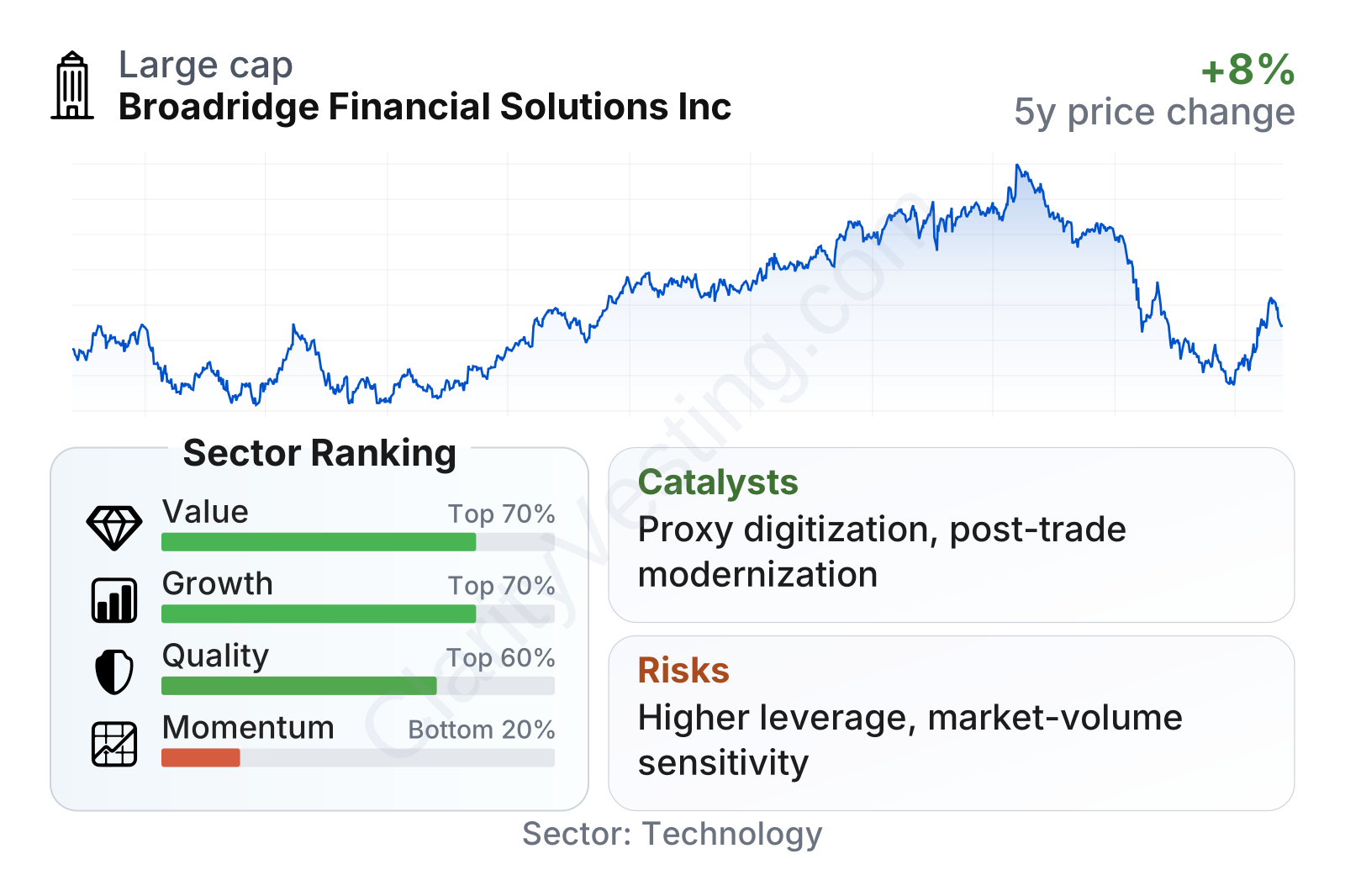
Stock Analysis · Broadridge Financial Solutions Inc (BR)

Overview

Broadridge Financial Solutions is a business infrastructure company for the financial industry. In simple terms, it provides the systems, processing, and communications that help banks, brokers, asset managers, and public companies handle critical back-office work. Its services include investor communications, proxy voting, trade processing, portfolio data and analytics, and other software-based tools used across the securities industry.

The company operates in areas that are deeply embedded in financial market plumbing. That matters because many of its services are recurring, regulation-driven, and difficult for clients to replace quickly. Broadridge is especially well known for helping distribute proxy materials and shareholder communications, an activity where scale, compliance, and reliability are essential.

Its revenue is mainly split between two large segments. Based on recent company reporting, the business is broadly organized as follows:

  • Investor Communication Solutions: roughly about 55% to 60% of revenue. This includes proxy distribution, regulatory communications, customer communications, and related digital engagement services for banks, brokers, mutual funds, ETFs, and corporations.
  • Global Technology and Operations: roughly about 40% to 45% of revenue. This includes capital markets processing, wealth management technology, trading and post-trade platforms, data and analytics, and operational outsourcing.

Within those categories, an important distinction is that a meaningful share of revenue is recurring and tied to long-term client relationships, while another share depends on trading volumes, equity positions, interest rates, or event-driven activity such as mutual fund communications and proxy campaigns. That mix gives Broadridge both stability and some cyclical exposure.

The long-term financial pattern has been constructive: revenue has expanded steadily over the last several years, while operating income and net income have grown faster than sales. That suggests not only expansion, but also improving efficiency and pricing power.

The business has been converting a larger share of revenue into profit over time. Sales have risen from roughly $5.0 billion to nearly $6.9 billion over the period shown, while operating income and net income increased faster, pointing to improving margins rather than growth driven only by scale.

Key Figures

MetricValueSector
DateJul 18, 2026
Context
SectorTechnology
IndustryInformation Technology Services
Market Cap $17.70B
Beta 0.90
Value
(Cheapness)
P/E Ratio 15.7831.76
FCF Yield 7.32%4.18%
EBIT / EV 7.46%2.56%
PEG 1.01
Growth
(Business expansion)
Revenue Growth 7.80%13.50%
RPS Growth (5Y CAGR) 8.26%8.57%
EPS Growth (5Y CAGR) -2.61%-21.87%
Margin Growth (5Y Trend) 3.75%0.41%
FCF Growth (5Y CAGR) 18.30%9.76%
Quality
(Business durability)
ROIC (Latest) 19.81%8.54%
ROIC (5Y Median) 13.10%8.12%
Net Debt / EBIT (Latest) 2.070.38
Net Debt / EBIT (5Y Median) 3.620.38
Operating Margin (Latest) 20.52%9.58%
Operating Margin (5Y Median) 15.49%8.25%
Debt to Equity (Latest) 120.88%33.52%
Profit Margin (Latest) 15.03%6.96%
Free Cash Flow (Latest) $1.30B
Momentum
(Price trend)
3Y Return -5.60%+30.91%
12M Return (excl. last month) -40.32%+28.90%
6M Return -30.82%+5.38%
Price vs. 200-Day MA -19.28%+7.61%
Better than sector median
Slightly worse than sector median
More than 20% worse than sector median

Broadridge stands out more for business quality and cash generation than for stock-price momentum. Profitability is comfortably above the sector median, returns on invested capital are strong, and free cash flow is notable for a company of this size. Growth is respectable rather than exceptional, but margin improvement and cash conversion help offset that. The weak area is market sentiment: recent share-price performance has lagged the sector by a wide margin, showing that the market has become much less optimistic even though operating fundamentals remain solid.

With a market capitalization around the mid-teens in billions and a beta below 1, Broadridge sits in the profile of a relatively defensive technology-enabled financial infrastructure company rather than a high-volatility software name. That lower sensitivity can be attractive in uncertain markets, but it also means the stock is usually judged more on consistency and execution than on rapid expansion.

Growth

Broadridge operates in a sector with durable long-term demand. Financial institutions continue to outsource non-core processing, regulation continues to support mandatory communications and governance workflows, and the securities industry keeps pushing toward automation. These are favorable conditions for a company whose products are tied to compliance, transaction processing, and digital modernization.

The company’s strategy also fits where the industry is going. Broadridge has spent years building platforms that help clients reduce manual work, improve transparency, and connect legacy systems to more modern digital tools. In capital markets, wealth management, and investor communications, clients often prefer proven vendors with deep regulatory knowledge because operational failure can be costly. That creates room for Broadridge to deepen client relationships, cross-sell additional modules, and benefit from steady technology budgets across large financial institutions.

Revenue growth has not been explosive, but it has been consistently positive in most periods, usually landing in the mid-single-digit to low-double-digit range. That pattern is more typical of an established financial infrastructure provider than a fast-growing software disruptor. The important point is that growth has remained resilient even through periods of market volatility.

Free cash flow has improved sharply over the last several years and now sits well above earlier levels. That is an important signal for long-term analysis because cash flow gives the company flexibility to support dividends, acquisitions, debt reduction, and internal investment. It also suggests that earnings quality is backed by real cash generation rather than accounting effects alone.

A meaningful catalyst is the ongoing digitization of shareholder communications and governance. Broadridge has a strong position in proxy processing and investor communications, where paper-based workflows continue to move toward digital channels. Another catalyst is modernization in capital markets operations, where institutions are trying to lower costs and automate post-trade and data-intensive functions. Broadridge’s role as a trusted intermediary may become more valuable as clients seek fewer vendors with broader capabilities.

Recent company updates have also emphasized product expansion in areas such as wealth technology, corporate issuer tools, and digital communications. These are not overnight growth drivers, but they do align with long-duration trends and can strengthen recurring revenue over time.

Risks

Broadridge’s main risks are less about demand disappearing and more about execution, leverage, and the limits of its growth profile. The company serves critical functions, but that does not automatically guarantee high growth. Some parts of the business depend on trading activity, distribution volumes, mutual fund and ETF trends, and corporate event cycles. If market activity softens, some revenue streams can slow even while the broader franchise remains healthy.

Another important risk is balance-sheet leverage. Broadridge’s debt levels are clearly above the sector median, even though they have improved from earlier highs.

The trend has moved in the right direction, but debt to equity still remains well above most peers in the technology sector. That does not look alarming in isolation because the company produces strong cash flow and serves sticky clients, yet it does reduce flexibility if borrowing costs rise or if operating conditions weaken unexpectedly.

Competition is also worth watching, although Broadridge is not competing in a single simple market. In investor communications and proxy services, its scale and established network are major advantages, and it is widely viewed as a leading provider. In wealth technology, capital markets platforms, and data solutions, competition is broader and includes firms such as SS&C Technologies, FIS, Fiserv, Conduent in certain processing areas, and exchange or market infrastructure groups that offer adjacent post-trade and data services. Broadridge’s position is strongest where regulation, connectivity, and entrenched workflows create switching costs. It is less dominant in broader financial software categories where clients have more alternatives.

Profit margins have improved steadily and remain much better than the sector median, which is a real strength. The flip side is that strong margins create a higher bar for future improvement. If growth slows or client spending shifts toward lower-margin services, the market may become more sensitive to even small signs of margin pressure.

Another risk is that the stock’s recent weakness may reflect more than temporary sentiment. A large decline from prior highs can mean the market is reassessing the company’s growth outlook, acquisition integration, or cyclical exposure. That does not prove a structural problem, but it raises the importance of watching future execution closely. No major public red flag such as a scandal or severe governance controversy stands out from official disclosures, but as with any company handling regulated financial workflows, operational reliability and cybersecurity remain ongoing reputation risks.

Valuation

Broadridge now looks very different from where it traded through much of the last several years. Historically, the market often valued the company at a premium earnings multiple relative to much of the sector, reflecting its recurring revenue, steady execution, and defensive characteristics. That premium has narrowed sharply.

The current earnings multiple is materially below both its own recent history and the sector median. On the surface, that makes the shares look less expensive than they used to be, especially given the company’s above-average margins, strong returns on capital, and healthy free cash flow yield. The valuation picture is also helped by a PEG ratio near 1 and cash flow metrics that compare favorably with peers.

At the same time, the lower multiple likely reflects a slower-growth profile than many technology companies, as well as concern around leverage and weaker recent price momentum. In other words, the market is no longer paying a premium simply for consistency. The current valuation appears to recognize that Broadridge is a solid business, but not a high-growth one.

In context, the stock does not look stretched on fundamentals. The key question is whether the market’s reset has already accounted for the company’s moderate growth and higher debt load, or whether earnings expectations still need to cool further. Relative to the company’s profitability and cash generation, the present valuation looks more grounded than it did during its higher-multiple years.

Conclusion

Broadridge combines a useful set of long-term qualities: mission-critical services, recurring client relationships, solid margins, strong free cash flow, and a leading role in parts of financial market infrastructure that are difficult to replicate. It is not a fast-moving growth company, but it has shown an ability to expand steadily while improving profitability over time.

The central challenge is that this is still a mature business with leverage above many technology peers and some exposure to market-driven activity. That means the investment case depends less on breakthrough upside and more on durable execution, operating discipline, and continued demand for outsourcing, compliance, and digital processing across finance.

With the share price well below prior peaks and valuation multiples much lower than their historical range, the market appears to be treating Broadridge with more caution than before. Yet the underlying business still looks financially strong and competitively relevant. The overall picture is of a high-quality operator whose current market rating seems notably more conservative than the strength of its business model, even if slower growth and balance-sheet leverage keep the outlook from looking straightforward.

Sources:

  • Broadridge Financial Solutions, Inc. — Form 10-Q for the quarterly period ended March 31, 2026
  • Broadridge Financial Solutions, Inc. — Form 10-K for the fiscal year ended June 30, 2025
  • Broadridge Investor Relations — Quarterly earnings releases and supplemental materials, fiscal 2026
  • SEC EDGAR — Broadridge Financial Solutions, Inc. filings
  • Broadridge Investor Relations — Corporate overview and business segment information
  • Wikipedia — Broadridge Financial Solutions

This article is for informational purposes only and does not constitute financial advice. Some content is AI-generated. See Disclaimer
Sign up for exclusive research and insights.

Unsubscribe anytime.