Stock Analysis · Box Inc (BOX)
Overview
Box is a cloud software company focused on managing, securing, and sharing business content. In simple terms, it helps organizations store files, collaborate on documents, automate content-based workflows, and apply security and governance controls so information can be used safely across employees, customers, and partners. Its customers range from small businesses to large enterprises and regulated industries such as healthcare, financial services, and government.
The business model is largely subscription-based, which means customers usually pay recurring fees for access to the platform. That tends to make revenue more predictable than one-time software sales. Box has also been expanding its platform beyond basic cloud storage into content workflows, e-signature, publishing, data protection, and AI-powered tools that help users search, summarize, extract, and work with enterprise content.
Based on company filings, revenue is overwhelmingly concentrated in subscription and support arrangements, with professional services representing only a small portion.
- Subscription revenue: about 95% to 97% of total revenue. This includes access to Box’s cloud content management platform, security, governance, workflow tools, and add-on capabilities such as Box Sign, Box Shield, Box Relay, metadata, archive, and AI-related features.
- Professional services and other revenue: about 3% to 5% of total revenue. This mainly includes implementation, consulting, training, and support-related work tied to customer deployments.
Financially, Box looks like a mature software platform rather than a high-burn startup. Revenue has continued to rise, gross profit remains high, and operating income has improved meaningfully over the last several years. One notable pattern is that revenue growth has slowed from earlier post-pandemic levels, but profitability and cash generation have strengthened.
The business mix points to a software model with strong gross margins and recurring revenue. Over the last five fiscal years, sales moved from under $900 million to around $1.2 billion, while operating income turned from a loss into a solid positive result. Research and development spending has also kept rising, showing that Box is still investing in product expansion rather than simply harvesting an older platform.
Key Figures
| Metric | Value | Sector ⓘ |
|---|---|---|
| Date | Sep 12, 2026 | |
| Context | ||
| Sector | Technology | |
| Industry | Software - Infrastructure | |
| Market Cap ⓘ | $4.68B | |
| Beta ⓘ | 1.41 | |
Value (Cheapness) | ||
| P/E Ratio ⓘ | 50.18 | 29.51 |
| FCF Yield ⓘ | 8.11% | 4.25% |
| EBIT / EV ⓘ | 2.42% | 2.85% |
| PEG ⓘ | 0.67 | |
Growth (Business expansion) | ||
| Revenue Growth ⓘ | 13.60% | 15.40% |
| RPS Growth (5Y CAGR) ⓘ | 9.37% | 8.56% |
| EPS Growth (5Y CAGR) ⓘ | -25.76% | -11.88% |
| Margin Growth (5Y Trend) ⓘ | 11.96% | 0.46% |
| FCF Growth (5Y CAGR) ⓘ | 11.79% | 9.80% |
Quality (Business durability) | ||
| ROIC (Latest) ⓘ | 53.19% | 9.44% |
| ROIC (5Y Median) ⓘ | 47.71% | 8.30% |
| Net Debt / EBIT (Latest) ⓘ | 1.50 | 0.54 |
| Net Debt / EBIT (5Y Median) ⓘ | 2.22 | 0.44 |
| Operating Margin (Latest) ⓘ | 10.23% | 9.58% |
| Operating Margin (5Y Median) ⓘ | 6.03% | 8.25% |
| Debt to Equity (Latest) ⓘ | 50.01% | 33.33% |
| Profit Margin (Latest) ⓘ | -19.76% | 7.14% |
| Free Cash Flow (Latest) ⓘ | $379.58M | |
Momentum (Price trend) | ||
| 3Y Return ⓘ | +32.61% | +45.48% |
| 12M Return (excl. last month) ⓘ | +4.15% | +23.48% |
| 6M Return ⓘ | +36.64% | +20.93% |
| Price vs. 200-Day MA ⓘ | +22.78% | +7.43% |
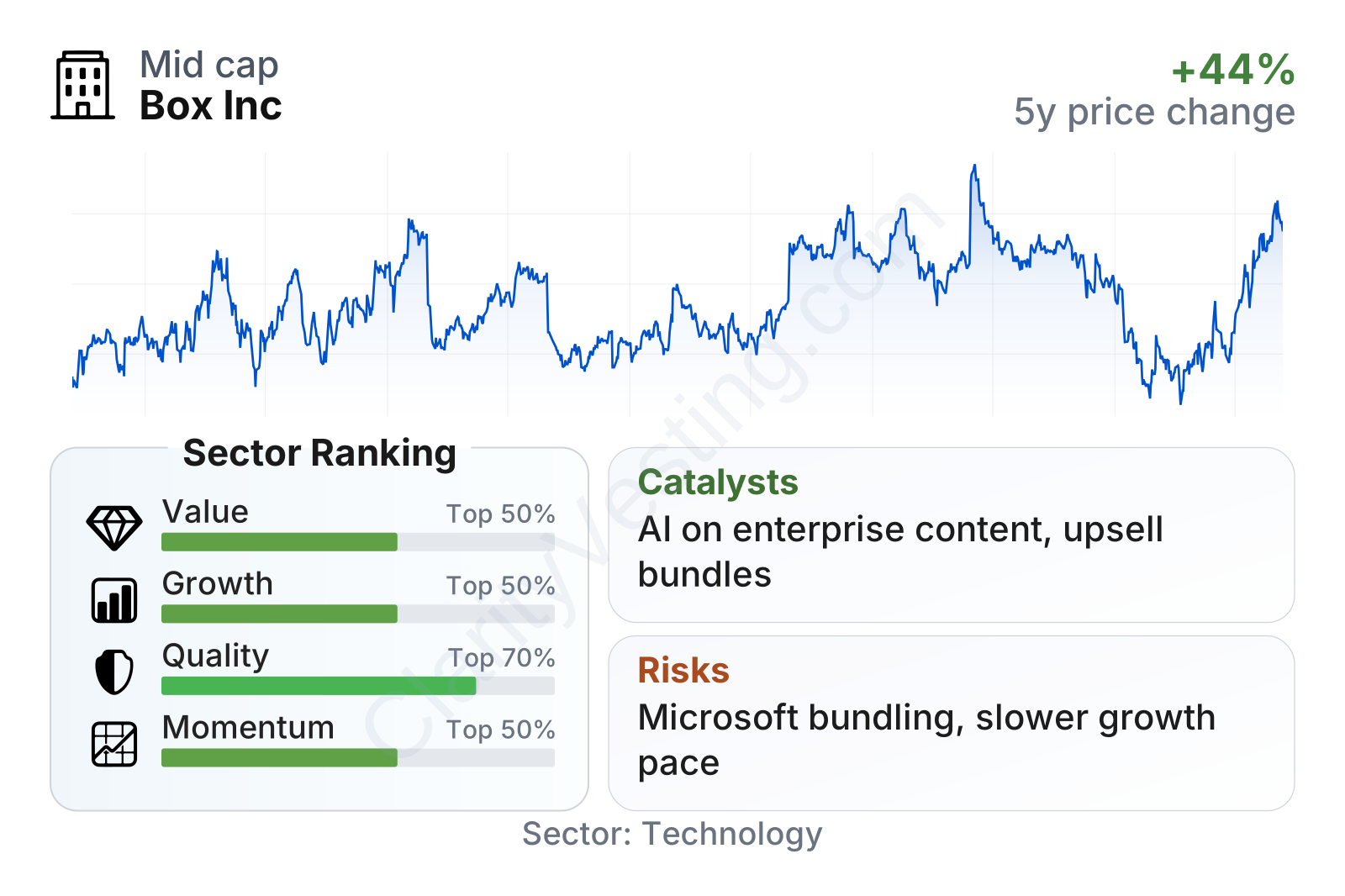
Box sits in the mid-sized range within software, with share-price behavior that has been more volatile than the broader market. The overall factor picture is mixed but understandable: value metrics are helped by strong cash generation, quality is supported by unusually high returns on invested capital, and growth is decent rather than exceptional. Momentum has improved recently after a weaker longer-term stock performance.
A notable point in the table is the gap between earnings-based valuation and cash-based valuation. The P/E ratio appears elevated versus the sector median, but free cash flow yield is clearly stronger than many peers. That usually suggests a business where accounting earnings and cash generation tell somewhat different stories, so cash flow matters more than headline net income alone.
Growth
Box operates in a favorable long-term market. Companies are still moving more content, workflows, compliance processes, and collaboration tools into the cloud. At the same time, the amount of unstructured enterprise data keeps growing. This supports demand for platforms that do more than simple storage: businesses increasingly want search, automation, security, records management, and AI tools built around their content.
Box’s strategy for future growth is coherent. Rather than trying to outspend hyperscale cloud vendors in raw infrastructure, it is positioning itself at the content layer: the place where files, metadata, compliance, and business processes come together. That allows the company to sell additional products into its installed base, especially to enterprise customers that already trust Box with sensitive information. The broad idea is straightforward: once content is already inside the system, it becomes easier to add security, workflow automation, e-signature, archive, and AI features.
Growth has not been linear. Year-over-year revenue expansion was much stronger a few years ago, then cooled into the low-single-digit range, and more recently improved back toward high-single-digit to low-double-digit territory. That pattern suggests Box is no longer in an early hyper-growth phase, but it has shown an ability to reaccelerate somewhat through product expansion and larger enterprise use cases.
Cash generation is one of the clearest positives. Free cash flow has risen steadily over multiple years, reaching roughly the high-$300 million range on a trailing basis. For a company of Box’s size, that is meaningful because it creates room for product investment, acquisitions, debt management, and shareholder returns without needing external capital.
One of the strongest current catalysts is AI attached to enterprise content. Box has been pushing tools that let customers use AI to search, summarize, classify, and extract insights from documents while keeping security and governance controls in place. That positioning is important because many businesses want productivity gains from AI but cannot simply expose confidential content to open systems without controls. Box’s value proposition is that it already sits where the content is, and that can make AI more usable in regulated and security-conscious environments.
Another growth opportunity comes from deeper enterprise penetration. Box has consistently emphasized large-customer expansion, multi-product adoption, and platform bundles. If more customers use Box not only for storage and collaboration but also for workflow automation, security, and e-signature, average revenue per customer can rise even if the overall customer count grows more slowly.
Risks
This article is for informational purposes only and does not constitute financial advice. Some content is AI-generated. See Disclaimer


