Stock Analysis · Boot Barn Holdings Inc (BOOT)
Overview
Boot Barn Holdings Inc. is a specialty retailer focused on western and work-related footwear, apparel, and accessories. The company sells cowboy boots, work boots, jeans, shirts, hats, belts, outerwear, and related items for men, women, and children. Its positioning is distinctive within apparel retail because it serves both a lifestyle category, centered on western fashion, and a practical category, centered on workwear and job-site footwear. That mix gives the business exposure to trend-driven consumer demand as well as more functional, repeat-purchase needs.
Boot Barn operates through a combination of physical stores and e-commerce. Its store base is the core of the business, while digital sales expand reach beyond local markets and help support omnichannel shopping. The company also benefits from exclusive and private-label brands, which can improve margins and make the assortment less directly comparable with general footwear and apparel retailers.
Based on the company’s recent annual filing, revenue is largely generated from merchandise sales across a few broad categories. Approximate revenue mix by product type is commonly centered around footwear as the largest contributor, followed by apparel, then hats and accessories. A simple way to think about the business is:
- Footwear: roughly half of sales, including western boots and work boots
- Apparel: roughly one-third of sales, including denim, shirts, outerwear, and work clothing
- Hats and accessories: the remaining share, including belts, hats, jewelry, and related items
Another useful split is by channel:
- Retail stores: the clear majority of revenue
- E-commerce: a meaningful but smaller share
In recent years, the company has expanded revenue from about $1.5 billion to above $2.2 billion while also lifting gross profit and net income. That suggests growth has not come only from opening more stores, but also from maintaining pricing power and product appeal.
The profit flow shows a business that has scaled meaningfully over the last several years. Revenue and gross profit have risen strongly, and operating income has also climbed, although selling and administrative costs have grown alongside expansion. Even so, the latest year points to a healthy earnings structure, with very low interest expense relative to operating profit.
Key Figures
| Metric | Value | Sector ⓘ |
|---|---|---|
| Date | Jul 18, 2026 | |
| Context | ||
| Sector | Consumer Cyclical | |
| Industry | Apparel Retail | |
| Market Cap ⓘ | $4.67B | |
| Beta ⓘ | 1.70 | |
Value (Cheapness) | ||
| P/E Ratio ⓘ | 20.93 | 18.58 |
| FCF Yield ⓘ | 2.70% | 7.99% |
| EBIT / EV ⓘ | 5.69% | 5.91% |
| PEG ⓘ | 1.72 | |
Growth (Business expansion) | ||
| Revenue Growth ⓘ | 18.70% | 5.50% |
| RPS Growth (5Y CAGR) ⓘ | 10.62% | 9.20% |
| EPS Growth (5Y CAGR) ⓘ | 2.98% | -26.43% |
| Margin Growth (5Y Trend) ⓘ | -3.96% | -0.18% |
| FCF Growth (5Y CAGR) ⓘ | 45.20% | 5.02% |
Quality (Business durability) | ||
| ROIC (Latest) ⓘ | 18.24% | 12.03% |
| ROIC (5Y Median) ⓘ | 18.54% | 10.82% |
| Net Debt / EBIT (Latest) ⓘ | 2.09 | 2.12 |
| Net Debt / EBIT (5Y Median) ⓘ | 1.96 | 2.25 |
| Operating Margin (Latest) ⓘ | 13.40% | 9.28% |
| Operating Margin (5Y Median) ⓘ | 13.40% | 9.64% |
| Debt to Equity (Latest) ⓘ | 58.66% | 75.23% |
| Profit Margin (Latest) ⓘ | 10.02% | 5.28% |
| Free Cash Flow (Latest) ⓘ | $126.04M | |
Momentum (Price trend) | ||
| 3Y Return ⓘ | +65.55% | +10.68% |
| 12M Return (excl. last month) ⓘ | +2.34% | +5.26% |
| 6M Return ⓘ | -18.64% | -2.41% |
| Price vs. 200-Day MA ⓘ | -13.16% | +1.55% |
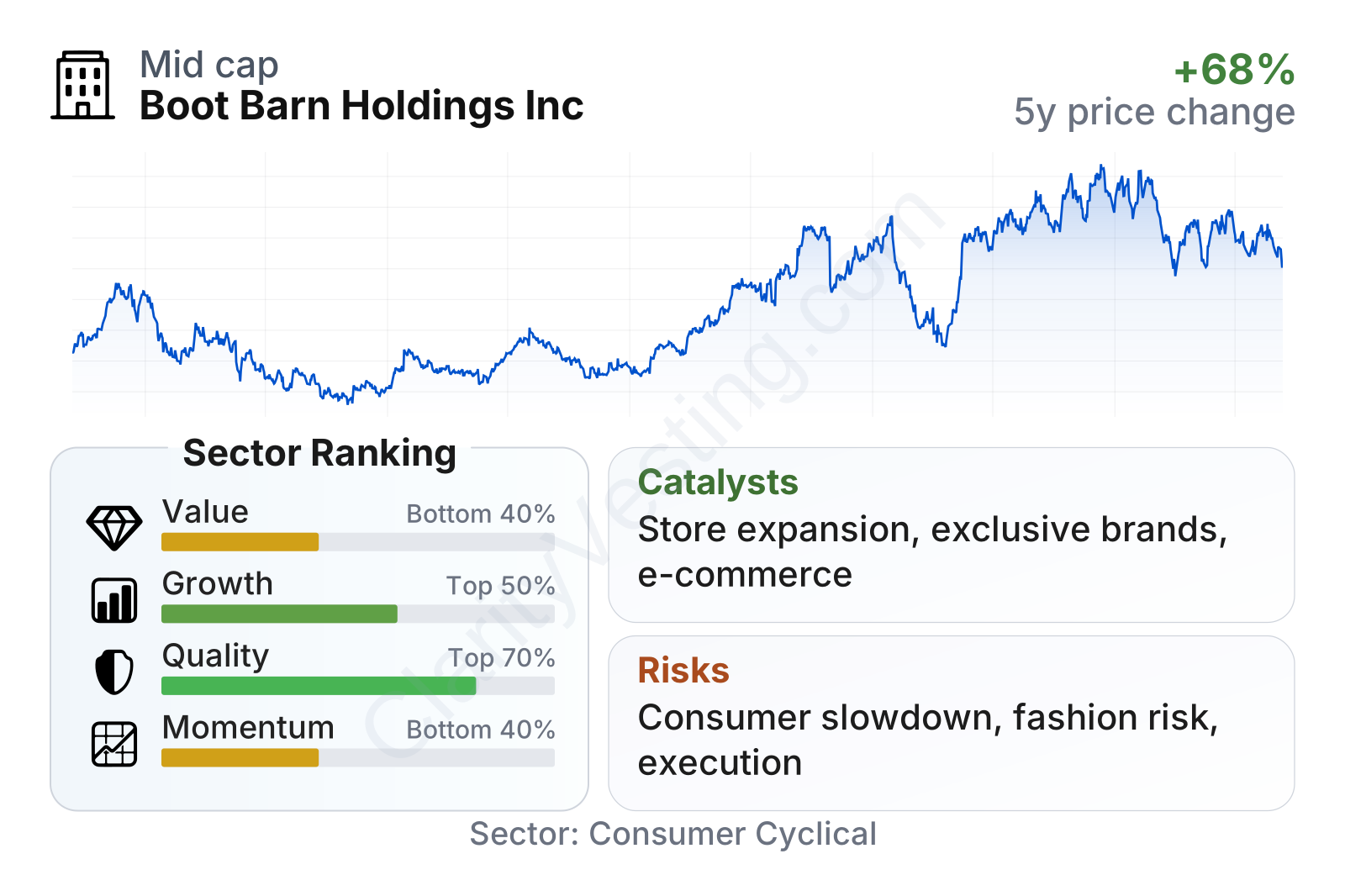
Boot Barn’s current profile looks stronger in business quality and growth than in pure valuation appeal. Profitability sits well above the typical company in its sector, with operating margin, profit margin, and returns on invested capital all standing out positively. Growth has also been solid, especially on recent revenue trends and longer-term free cash flow expansion. The weaker area is valuation, where the shares trade above the sector median on earnings multiples while free cash flow yield is lower than many peers. Price momentum has cooled after a strong multi-year run, which helps explain why the stock’s recent trading pattern looks less impressive than its longer-term performance.
The company’s market capitalization is in the mid-single-digit billions, making it a sizable specialty retailer but still much smaller than the largest broadline apparel and footwear chains. Its beta is elevated, which means the shares have historically moved more sharply than the broader market. For long-term analysis, that matters less than the underlying operating trend, but it does suggest the stock can be volatile.
Growth
Boot Barn operates in a retail niche that still appears to have room for expansion. Western wear has moved beyond a narrow regional market and has become more visible in mainstream fashion, while workwear remains tied to practical replacement demand. This combination is important: it means the company is not relying only on a temporary style trend, even though fashion can amplify results during strong periods.
The company’s strategy for future growth is relatively easy to understand. It continues to open new stores in underpenetrated markets, grows digital capabilities, and builds private-label brands that can raise margins and strengthen customer loyalty. That approach makes strategic sense because new stores increase physical presence, online sales widen customer reach, and exclusive brands reduce direct price comparison with rivals.
Revenue growth has gone through phases, cooling after earlier surges and then reaccelerating sharply. The latest pace is well ahead of the sector median, which indicates Boot Barn is still gaining ground rather than merely tracking the broader apparel retail environment. That is a positive sign because it suggests demand remains healthy despite a more uneven consumer backdrop.
Free cash flow has been more volatile than revenue, which is common for retailers because inventory swings, store openings, and seasonal working capital can heavily affect cash generation. Still, the latest trailing twelve-month figure shows a strong rebound to a healthy positive level. Over a multi-year period, cash flow growth has been impressive, supporting the view that expansion has translated into real financial capacity rather than only accounting earnings.
A notable catalyst is store expansion. Boot Barn has repeatedly described a long runway for additional locations across the United States, and this is one of the most important drivers in the long-term case. Another catalyst is the continued growth of exclusive brands, which generally carry better economics than third-party merchandise. The company has also emphasized omnichannel execution, where stores and digital sales support each other rather than compete.
Recent corporate updates have also highlighted continued demand trends, new store openings, and confidence in long-term unit growth potential. None of that guarantees a straight path, but it reinforces that management still sees meaningful whitespace ahead.
Risks
Boot Barn’s main risks start with consumer cyclicality. This is a discretionary retail business, even if part of the assortment is functional. If the economy weakens, shoppers may delay purchases of premium boots, western apparel, and accessories. A second risk is fashion sensitivity. Western wear has enjoyed broader popularity, but style-driven demand can reverse more quickly than basic essentials.
Competition is another important factor. Boot Barn has a recognizable niche, but it does not operate without rivals. It competes with broad footwear sellers, workwear specialists, department stores, farm and ranch chains, online marketplaces, and western specialty retailers. Major names that overlap in parts of its assortment include Tractor Supply in rural lifestyle retail, Cavender’s in western wear, Work World in work apparel, and large online sellers such as Amazon for basic work and casual categories. Boot Barn’s advantage is that it combines scale, category specialization, store experience, and exclusive brands in a way that many smaller western retailers cannot match.
Within its niche, the company appears to be one of the leading specialized players in the U.S. market, especially in terms of brand recognition and national store footprint. That leadership does not make it untouchable, but it does create some defensible qualities. Customers shopping for western and work merchandise often value assortment depth, fit, and in-store service, which can be harder for generalist competitors to replicate.
The balance sheet looks manageable. Debt relative to equity has stayed below the sector median for several years, even with some recent increase. That reduces financial strain compared with more leveraged retailers. In addition, net debt relative to EBIT is close to sector norms and not stretched. The main takeaway is that Boot Barn’s financial risk appears moderate rather than aggressive.
Profit margin has come down from earlier peaks but remains far above the sector median. That is encouraging because it shows the business retains a profitability edge even after normalization. At the same time, margin pressure is still a real risk. Freight, labor, occupancy costs, markdowns, and a weaker product mix can all hurt results quickly in retail. The company’s five-year operating margin trend shows some erosion, so future expansion will need to be matched by disciplined cost control.
Other operational risks include inventory execution, sourcing concentration, tariff exposure, and dependence on store openings going smoothly. Retailers that expand rapidly can run into location quality issues or cannibalization if growth gets too aggressive. There has not been a major public scandal or governance event standing out as a defining red flag in recent official disclosures, but normal retail execution risk remains significant.
Valuation
Boot Barn’s valuation sits in a somewhat demanding area relative to its sector. The earnings multiple is above the sector median, and the free cash flow yield is lower than many peers. In simple terms, the market is assigning a premium to the business, likely because of its above-average margins, strong return on capital, and visible store expansion runway.
The earnings multiple has moved through wide swings over the last several years, at times trading below the sector and at other times far above it. The current level is not at the most stretched point seen recently, but it still reflects expectations of continued solid execution. That means the valuation is easier to justify when revenue growth stays strong and margins remain resilient. If those strengths weaken, the premium could become harder to defend.
From a long-term analytical perspective, the current price appears to reflect a good part of Boot Barn’s quality and expansion prospects rather than offering a clearly discounted setup. The premium is not extreme for a retailer with this profitability profile, but it does leave less room for disappointment than a cheaper stock would. The valuation context therefore looks acceptable only if the company continues to deliver on store growth, private-label development, and above-sector profitability.
Conclusion
Boot Barn stands out as a specialized retailer with an unusual combination of niche brand identity, national expansion potential, and profitability that is well above much of apparel retail. The company has built a strong position in western and work-related merchandise, and recent years show that it has been able to translate that positioning into rising revenue, healthy margins, and renewed cash generation.
The central challenge is that retail success can look strongest near the top of a favorable demand cycle. Western fashion momentum, consumer spending, and execution on new stores all need to remain supportive for the current market optimism to keep making sense. Competition is real, fashion risk has not disappeared, and the share price already reflects meaningful confidence in the business.
Overall, Boot Barn looks more like a high-quality growth retailer than a cheap cyclical name. The company’s operating profile is clearly attractive, but the valuation leaves the long-term picture dependent on continued expansion and steady margins rather than on a large cushion from a low price.
Sources:
- Boot Barn Holdings, Inc. — Annual Report on Form 10-K for fiscal year ended March 29, 2026
- Boot Barn Holdings, Inc. — SEC EDGAR filings, including recent 8-K and quarterly materials filed in 2026
- Boot Barn Holdings, Inc. Investor Relations — earnings releases and investor presentation materials published in 2026
- Boot Barn Holdings, Inc. — company-hosted earnings call materials and transcripts published on Investor Relations
- SEC EDGAR Database — company filing history and official disclosures
- Wikipedia — Boot Barn basic company background and history
This article is for informational purposes only and does not constitute financial advice. Some content is AI-generated. See Disclaimer