Stock Analysis · Liberty Latin America Ltd (LILAK)
Overview
Liberty Latin America Ltd (LILAK) is a telecommunications operator focused on consumer and business connectivity services across parts of Latin America and the Caribbean. In plain terms, it builds and runs networks (mainly fixed broadband and cable infrastructure, and in some markets mobile services) and then sells recurring subscriptions to households and organizations.
Its business model is typically subscription-based, meaning a large share of revenue tends to come from monthly service fees rather than one-time sales. The company reports results by operating markets, and its services generally fall into familiar categories such as internet access, video/TV services, mobile, and business connectivity solutions.
Main revenue streams (typical telecom mix; exact percentages vary by market and period and are detailed in company filings):
- Broadband internet subscriptions (recurring monthly fees)
- Video / pay-TV services (subscription bundles in certain markets)
- Mobile services (in markets where the company operates mobile networks or mobile offerings)
- Business-to-business services (connectivity, managed services, and related enterprise products)
- Equipment and other (devices, installation, and miscellaneous items, usually a smaller portion)
Looking at the company’s overall profit-and-loss flow over time, total revenue has been in the mid-single-digit billions of dollars annually in recent years, while profitability has been heavily influenced by operating costs and especially financing costs (interest expense), which can be meaningful for leveraged telecom operators.
Across the years shown, revenue appears relatively steady overall, while interest expense remains large in absolute dollars. That dynamic helps explain why net income can stay negative even when operating income is positive in some years.
Key Figures
| Metric | Value | Industry ⓘ |
|---|---|---|
| Date | Mar 02, 2026 | |
| Context | ||
| Sector | Communication Services | |
| Industry | Telecom Services | |
| Market Cap ⓘ | $1.59B | |
| Beta ⓘ | 1.01 | |
| Fundamental | ||
| P/E Ratio ⓘ | N/A | 16.24 |
| Profit Margin ⓘ | -13.76% | 6.34% |
| Revenue Growth ⓘ | 1.70% | 2.05% |
| Debt to Equity ⓘ | 1659.72% | 119.24% |
| PEG ⓘ | 0.83 | |
| Free Cash Flow ⓘ | $408.02M | |
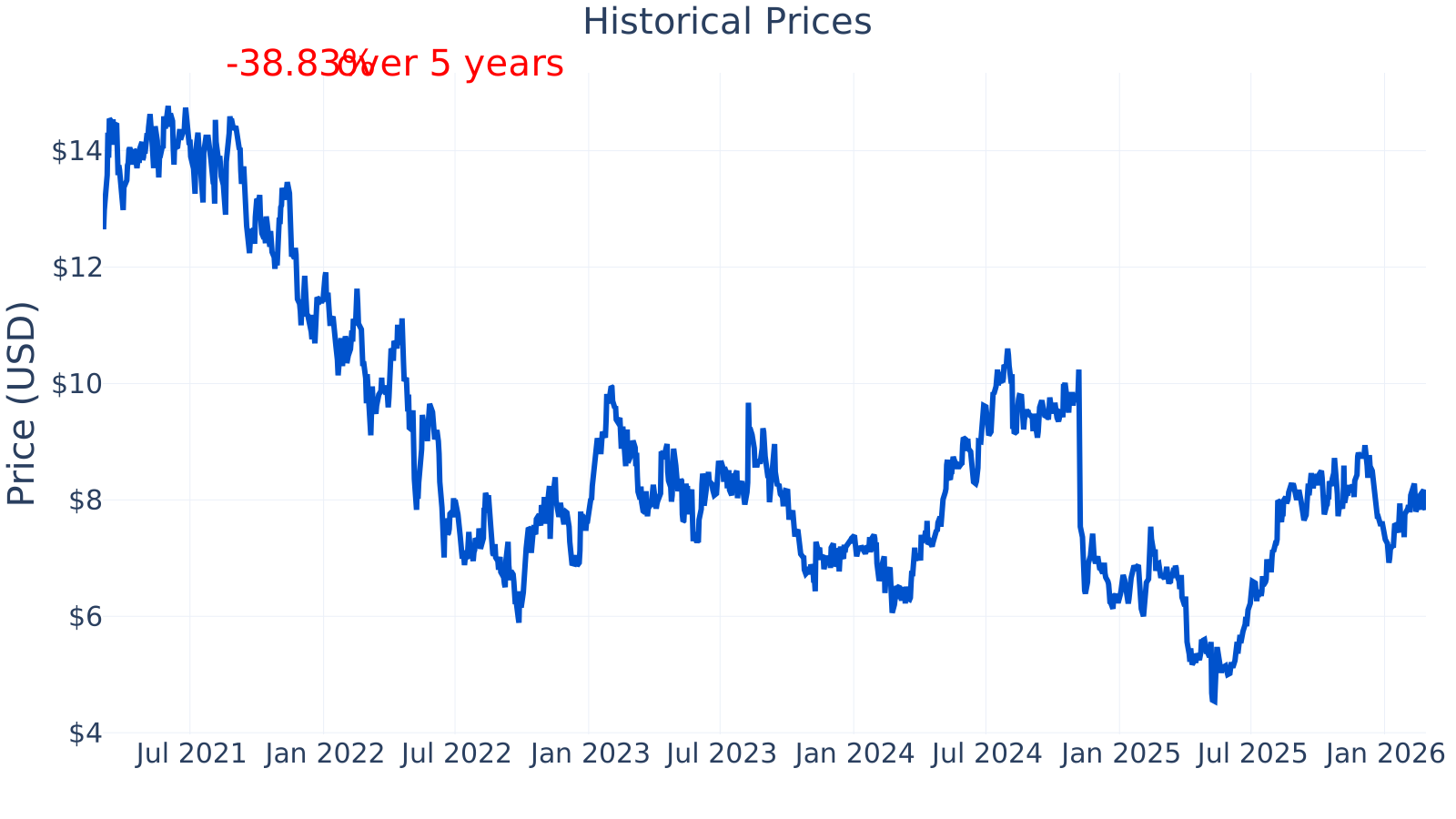
At the latest point shown, Liberty Latin America’s market capitalization is about $1.59B, and the stock’s beta is about 1.01 (roughly in line with broad market volatility). The company shows a negative profit margin of about -13.8%, compared with an industry median near +6.3%, indicating weaker bottom-line profitability than many peers. Year-over-year revenue growth is about +1.7% versus an industry median near +2.1%, suggesting growth is modest and close to sector norms. Debt-to-equity is shown at roughly 1,660% versus an industry median near 119%, highlighting substantially higher leverage than the typical company in the same broad industry grouping. Trailing twelve-month free cash flow is about $408M, which indicates the business is generating cash even while reported earnings are negative.
Growth (Low to Medium)
Telecom and broadband are generally considered mature industries. Demand for data connectivity tends to be resilient over time because households and businesses treat internet access as a staple service. However, mature industries often grow slowly, and competition plus ongoing network investment can limit how much of that demand turns into higher profits.
For Liberty Latin America, a key long-term question is whether it can expand high-value connectivity (for example, faster broadband tiers, better network reliability, and stronger business services) while controlling costs and keeping capital spending efficient. In many telecom models, the most durable growth tends to come less from rapid revenue expansion and more from improving customer mix, reducing churn, and increasing cash generation relative to investment needs.
The year-over-year revenue growth pattern shown is uneven: strong growth in 2021 fades substantially, with several periods of flat to negative growth through 2023–2025, and only small positive readings more recently. That profile points to a business that may be stabilizing rather than expanding rapidly.
Free cash flow over the trailing twelve months rises from roughly $176.5M (2021) to about $322.9M (2025 Q1), which is a constructive trend for a capital-intensive telecom operator. A potential catalyst over time would be the ability to sustain or grow free cash flow while also managing refinancing needs and network investment requirements.
Risks (High)
This article is for informational purposes only and does not constitute financial advice. Some content is AI-generated. See Disclaimer