Stock Analysis · Zoom Video Communications Inc (ZM)
Overview
Zoom Video Communications, Inc. is a software company best known for video meetings, but its broader goal is to provide a single platform for workplace communications. Its products are typically used by businesses and organizations to run virtual meetings and webinars, set up business phone systems, chat internally, host virtual events, and connect customer support teams with tools such as contact center software.
Zoom generally sells its services through subscriptions (paid plans), with additional usage-based fees in some areas (for example, phone calling). The business is commonly described as “cloud-based,” meaning customers access Zoom over the internet rather than installing and operating the core system on their own servers.
In its SEC filings, Zoom reports revenue in two broad categories rather than a long list of product-by-product percentages:
- Subscription revenue (the large majority of revenue): recurring fees for paid plans and licenses.
- Other revenue (the remainder): items such as usage-based and other non-subscription revenue streams.
The company’s recent financial structure shows high gross profit relative to revenue (typical for software), meaningful operating expenses to support product development and sales, and strong cash generation relative to reported revenue.
Across the periods shown, total revenue increases steadily, while operating income and net income fluctuate more. One visible pattern is that operating income improves significantly in the most recent period shown, suggesting tighter cost control and/or better monetization versus earlier years where operating expenses were a heavier drag.
Key Figures
| Metric | Value | Industry ⓘ |
|---|---|---|
| Date | Mar 02, 2026 | |
| Context | ||
| Sector | Technology | |
| Industry | Software - Application | |
| Market Cap ⓘ | $22.13B | |
| Beta ⓘ | 0.90 | |
| Fundamental | ||
| P/E Ratio ⓘ | 14.39 | 25.64 |
| Profit Margin ⓘ | 39.03% | 7.25% |
| Revenue Growth ⓘ | 5.30% | 16.65% |
| Debt to Equity ⓘ | 0.31% | 24.64% |
| PEG ⓘ | 4.02 | |
| Free Cash Flow ⓘ | $1.92B | |
Zoom’s market capitalization is about $22.1B. The stock’s beta (~0.90) suggests price moves have been somewhat less volatile than the broader market on average (though single stocks can still be volatile). Profit margin is shown at about 39.0%, which is well above the industry median (about 7.2%), while revenue growth year over year is about 5.3%, below the industry median (about 16.7%). Zoom’s debt-to-equity is extremely low at about 0.3% versus an industry median around 24.6%, indicating the company uses very little debt relative to shareholder equity. The P/E ratio is about 14.4 compared with an industry median near 25.6, while the PEG ratio (which relates valuation to growth expectations) is shown at about 4.0. Trailing twelve-month free cash flow is about $1.92B.
Growth (Medium)
Zoom operates in workplace communications software, a category supported by long-term trends such as distributed teams, hybrid work, global collaboration, and the broader shift of business tools to subscription software. However, the post-pandemic environment has been different from the surge period: many organizations already adopted video meetings, so growth tends to come more from expanding into adjacent products (phone, contact center, events, and broader platform features) and moving customers to larger bundles, rather than from first-time adoption.
A key question for long-term growth is whether Zoom can increase revenue per customer by becoming a broader communications platform (not only meetings). This strategy can make sense because it aims to reduce “single-product” dependence and compete in larger markets like enterprise telephony and customer experience tools, where budgets can be sizable and multi-year.
The trend shown indicates revenue growth has normalized to mid-single digits recently (about 5.3% in the latest period), far below the very high growth rates seen earlier in the time series. This typically signals a more mature phase for the core product and places more importance on expansion products and enterprise execution.
Free cash flow rises over time in the period shown, reaching about $1.92B most recently. From a business-quality perspective, consistent cash generation can provide flexibility to invest in product development, withstand competitive pressure, and return capital to shareholders over time (depending on management decisions disclosed in filings).
Risks (High)
The main business risk is competitive pressure in a category where many customers view video meetings and messaging as “must-have utilities.” Large software vendors bundle communication tools into broader suites, sometimes reducing the need for a standalone provider. This can increase pricing pressure, raise customer acquisition costs, and make it harder to re-accelerate growth.
Another risk is product transition and execution: expanding from meetings into a full platform (phone, contact center, and other tools) requires sustained product investment, strong reliability, and effective enterprise sales. This shift can take time, and results may vary depending on how well Zoom wins larger multi-product deployments.
There is also operational and reputational risk. Communications tools are mission-critical and security-sensitive. Service outages, security vulnerabilities, or privacy issues can harm customer trust and retention, especially with large organizations and regulated industries.
Zoom’s debt-to-equity is extremely low (about 0.3% most recently), and it trends downward across the periods shown. Low leverage reduces financial risk from interest-rate changes and refinancing needs, though it does not remove business risks like competition or slowing demand.
Profitability has improved markedly over the periods shown, ending at about 39.0% net profit margin most recently, far above the industry median (about 7.4%). While strong margins can be a competitive strength, they can also be sensitive to pricing pressure and to how much the company chooses to reinvest in sales and research to pursue growth.
In competitive positioning, Zoom remains one of the best-known brands in video meetings, but it faces strong competitors with broad ecosystems. Key competitors commonly include Microsoft (Teams), Google (Meet), and Cisco (Webex), with additional pressure from other communications and customer-experience software providers depending on the specific product category (such as business phone and contact center). Zoom’s differentiators often center on ease of use, meeting quality, and a focused communications experience, but the market includes well-capitalized rivals that can bundle products.
Valuation
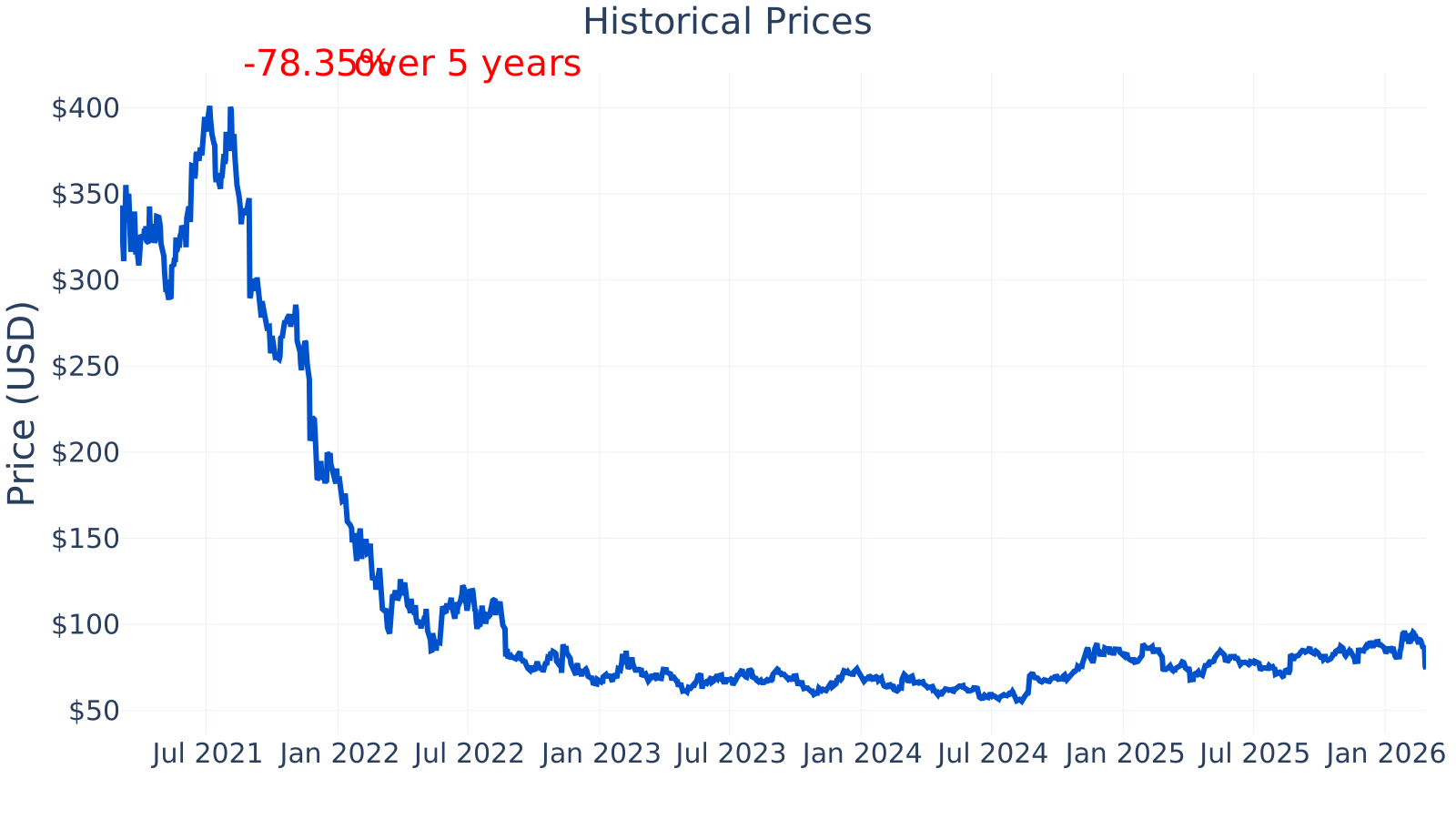
Zoom’s current P/E ratio is about 14.4, below the industry median shown (about 25.6). Over the historical series, the P/E ratio compresses substantially from very elevated levels in earlier years to much lower levels more recently, reflecting a combination of normalized growth rates and changes in market expectations.
Interpreting whether the valuation is “high” or “low” depends heavily on how a reader weighs several counterbalancing fundamentals: (1) revenue growth is currently modest (mid-single digits in the latest period), which often results in lower valuation multiples; (2) profitability and free cash flow appear strong in the latest period; and (3) competitive intensity is high, which can limit pricing power and the likelihood of a rapid re-acceleration without successful platform expansion.
The PEG ratio shown (about 4.0) is one signal that, when growth expectations are incorporated, the valuation may not look cheap relative to growth. That said, PEG is sensitive to how growth is estimated and may not capture factors such as changes in margins, buybacks, or longer-term product cycle outcomes.
Conclusion
Zoom is a well-known communications software provider that has shifted from a period of exceptional growth to a more mature phase, where the central challenge is expanding beyond meetings and increasing customer value through a broader platform. The company shows strong profitability in the latest period, rising free cash flow over time in the period shown, and very low financial leverage, which lowers balance-sheet risk.
At the same time, the company operates in a highly competitive market where large technology vendors can bundle competing products, and recent revenue growth is modest compared to the broader application software industry median provided. Long-term outcomes are likely to depend on execution in adjacent products (such as phone and contact center), the ability to sustain differentiation, and whether margins can remain strong while funding growth initiatives.
Sources:
- U.S. SEC EDGAR — Zoom Video Communications, Inc. Form 10-K (Annual Report)
- U.S. SEC EDGAR — Zoom Video Communications, Inc. Form 10-Q (Quarterly Reports)
- Zoom Video Communications — Investor Relations materials (including shareholder letters / prepared remarks when provided by the company)
- Wikipedia — “Zoom Video Communications” (basic company background only)
This article is for informational purposes only and does not constitute financial advice. Some content is AI-generated. See Disclaimer


