Stock Analysis · Blackbaud Inc (BLKB)
Overview
Blackbaud is a software company focused on organizations that serve social good. Its customers are mainly nonprofits, educational institutions, healthcare foundations, arts and cultural groups, faith communities, and companies running social impact programs. Rather than selling general-purpose business software, Blackbaud builds tools for fundraising, donor management, financial management, grantmaking, education administration, and digital engagement for this specific customer base.
The company’s business model is largely subscription-based, which makes revenue more recurring than a traditional software vendor that depends on one-time licenses. Blackbaud also earns money from payment processing tied to fundraising activity, professional services such as implementation and consulting, and some maintenance or other recurring support streams.
Based on recent company reporting, revenue is broadly organized as follows:
- Recurring revenue: about 88% to 90% of total revenue. This includes subscription contracts, maintenance, and transaction-based recurring streams. This is the core of the business and is the main reason Blackbaud has relatively predictable sales.
- Merchant fees and payment-related revenue: a meaningful part of recurring revenue. Blackbaud processes donations and payments through its platforms, so customer fundraising activity can directly support revenue growth.
- One-time services and other revenue: about 10% to 12% of total revenue. This includes implementation, training, consulting, and other non-recurring items tied to helping customers deploy or optimize the software.
Blackbaud’s revenue mix matters because it shows a company that is not only selling software seats, but also participating in customer activity over time. That creates a closer tie between the platform and the mission-critical operations of its clients. Over the last several years, revenue has stayed above the $1 billion mark, while operating profitability has improved materially even when headline net income was distorted by non-cash charges.
The business has gradually shifted toward better operating efficiency. Gross profit has expanded over time, operating income has improved sharply since 2021, and cash generation has remained solid. One important nuance is that reported net income has been much more volatile than operating performance, partly because interest expense and non-operating items have had a large effect.
Key Figures
| Metric | Value | Sector ⓘ |
|---|---|---|
| Date | Sep 12, 2026 | |
| Context | ||
| Sector | Technology | |
| Industry | Software - Application | |
| Market Cap ⓘ | $2.01B | |
| Beta ⓘ | 0.99 | |
Value (Cheapness) | ||
| P/E Ratio ⓘ | 13.73 | 29.51 |
| FCF Yield ⓘ | 13.88% | 4.25% |
| EBIT / EV ⓘ | 7.63% | 2.85% |
| PEG ⓘ | 0.47 | |
Growth (Business expansion) | ||
| Revenue Growth ⓘ | 3.00% | 15.40% |
| RPS Growth (5Y CAGR) ⓘ | 4.89% | 8.56% |
| EPS Growth (5Y CAGR) ⓘ | -8.52% | -11.88% |
| Margin Growth (5Y Trend) ⓘ | 14.22% | 0.46% |
| FCF Growth (5Y CAGR) ⓘ | 12.40% | 9.80% |
Quality (Business durability) | ||
| ROIC (Latest) ⓘ | 17.43% | 9.44% |
| ROIC (5Y Median) ⓘ | 1.59% | 8.30% |
| Net Debt / EBIT (Latest) ⓘ | 4.70 | 0.54 |
| Net Debt / EBIT (5Y Median) ⓘ | 16.56 | 0.44 |
| Operating Margin (Latest) ⓘ | 20.67% | 9.58% |
| Operating Margin (5Y Median) ⓘ | 3.48% | 8.25% |
| Debt to Equity (Latest) ⓘ | 1715.66% | 33.33% |
| Profit Margin (Latest) ⓘ | 13.12% | 7.14% |
| Free Cash Flow (Latest) ⓘ | $278.51M | |
Momentum (Price trend) | ||
| 3Y Return ⓘ | -37.94% | +45.48% |
| 12M Return (excl. last month) ⓘ | -27.22% | +23.48% |
| 6M Return ⓘ | +1.84% | +20.93% |
| Price vs. 200-Day MA ⓘ | +3.98% | +7.43% |
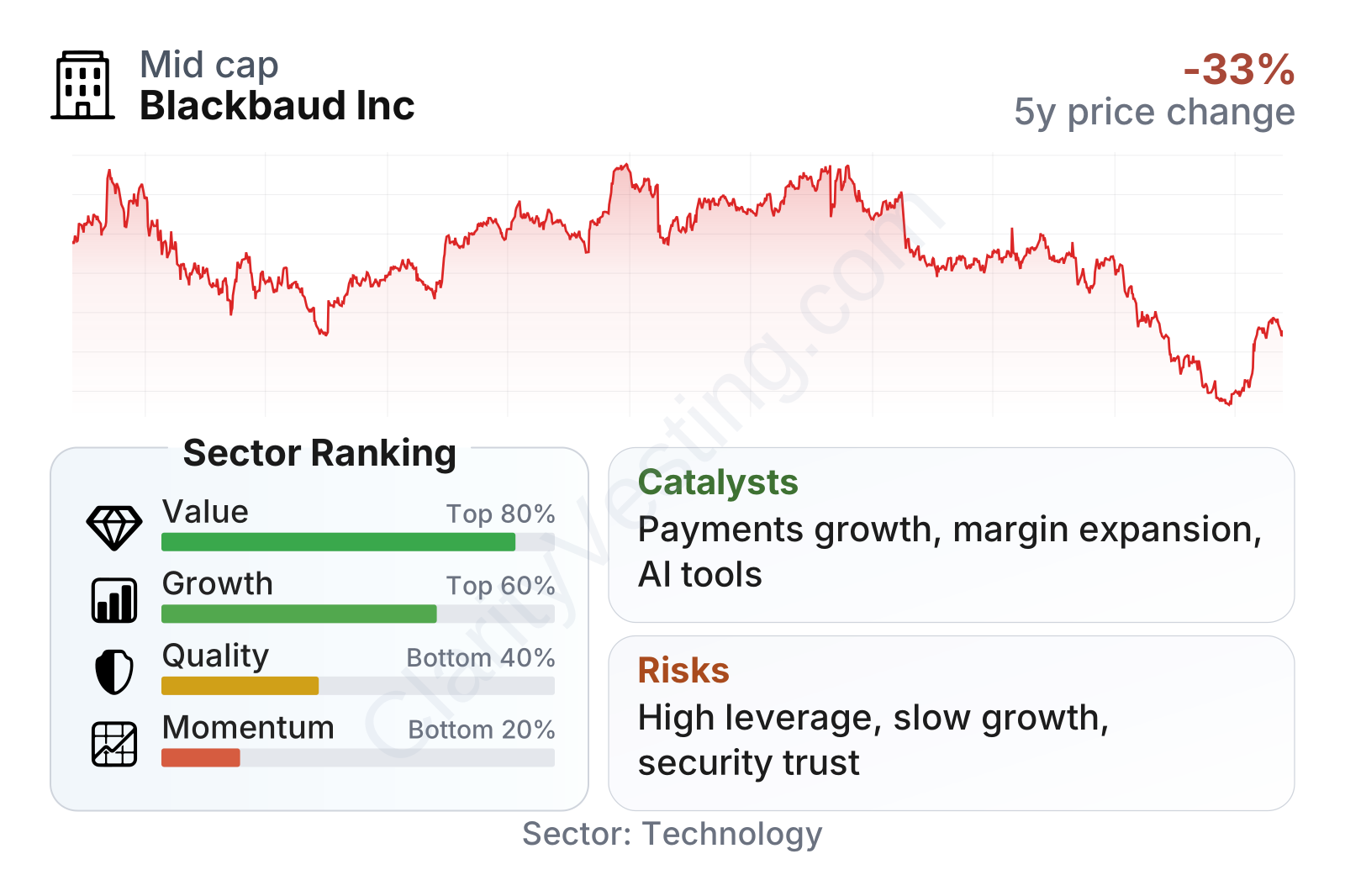
Blackbaud is a mid-sized software company with market value around the low single-digit billions of dollars and share-price volatility close to the broader market. The table suggests a mixed profile: valuation looks comparatively modest within software, cash generation is strong, and margins are healthier than many peers. Growth is present but not especially fast, while balance-sheet leverage remains a clear weak point. Price momentum has been particularly soft, which helps explain why the stock has fallen sharply from earlier highs.
Growth
Blackbaud operates in a niche that should remain relevant for years: nonprofits, schools, foundations, and mission-driven institutions are steadily digitizing fundraising, financial workflows, constituent engagement, and administrative operations. This is not the fastest-growing corner of software, but it benefits from durable demand because these customers still need to attract donors, manage relationships, and operate efficiently regardless of the economic cycle.
The company’s strategy also makes logical sense for long-term expansion. Blackbaud is deeply embedded in workflows that can be difficult to replace once installed. A nonprofit that uses the company for donor data, online giving, event fundraising, accounting, grant management, and stewardship communications is more likely to stay within the same ecosystem. That creates room for cross-selling additional products and increasing payment volume through Blackbaud’s own infrastructure.
Recent growth has been steady rather than explosive. Revenue growth was stronger in 2022, slowed meaningfully afterward, turned slightly negative during parts of 2025, and then returned to low single-digit growth in 2026. That pattern suggests Blackbaud is not in a hypergrowth phase. The more encouraging point is that the business appears to have stabilized after a softer patch.
Cash generation is a more positive part of the growth picture. Free cash flow has trended upward over the last few years and recently moved close to $300 million on a trailing basis. That matters because it gives Blackbaud more flexibility to invest in product development, reduce debt, and support shareholder returns without depending on external financing.
Potential catalysts are tied less to dramatic industry disruption and more to execution. Areas worth watching include stronger adoption of integrated payments, further migration toward modern cloud offerings, product bundling across fundraising and financial management, and continued margin expansion from cost discipline. In recent company communications, management has also emphasized AI-related capabilities aimed at improving fundraising effectiveness and user productivity. For Blackbaud, AI is unlikely to be a transformational revenue stream on its own in the near term, but it can make existing products more valuable and improve retention.
A recent strategic development that stands out is Blackbaud’s continued focus on recurring revenue quality and operating efficiency rather than chasing growth at any cost. For a company serving institutions that often have tighter budgets than large enterprises, that approach is sensible: durable retention and expanding cash flow can be more important than headline growth.
Risks
This article is for informational purposes only and does not constitute financial advice. Some content is AI-generated. See Disclaimer


