Stock Analysis · Blackline Inc (BL)
Overview
BlackLine is a cloud software company focused on finance and accounting departments. Its products help businesses automate routine work such as closing the books at the end of a month or quarter, reconciling accounts, managing intercompany transactions, processing invoices, and improving cash collection. In simple terms, BlackLine sells software that tries to make back-office finance work faster, more accurate, and easier to track.
The company mainly earns revenue from recurring software subscriptions and related services. Based on its filings, subscription and support revenue is by far the dominant source, while professional services are much smaller. A practical breakdown is:
- Subscription and support: about 91% to 93% of revenue. This includes access to BlackLine’s cloud platform, ongoing product updates, and customer support.
- Professional services and other: about 7% to 9% of revenue. This includes implementation, training, and consulting tied to product deployment.
That revenue mix matters because a business built mostly on subscriptions tends to be more predictable than one that depends heavily on one-time projects. BlackLine’s financial profile also shows the classic software pattern of high gross margins, meaning a large share of revenue remains after direct delivery costs, even though operating expenses still absorb a meaningful portion of that gross profit.
Over the last several years, revenue has continued to rise, gross profit has expanded, and the company has moved from losses into profitability. However, earnings have also shown some volatility, which is important for judging whether the business has reached a more durable level of efficiency or is still in transition.
The business model has gradually improved: sales have climbed from the low-$400 million range a few years ago to about $700 million in 2025, while the company shifted from net losses to positive net income. At the same time, research and development spending has remained meaningful, showing that BlackLine is still investing to keep its platform competitive.
Key Figures
| Metric | Value | Sector ⓘ |
|---|---|---|
| Date | Sep 12, 2026 | |
| Context | ||
| Sector | Technology | |
| Industry | Software - Application | |
| Market Cap ⓘ | $1.67B | |
| Beta ⓘ | 0.65 | |
Value (Cheapness) | ||
| P/E Ratio ⓘ | 51.34 | 29.51 |
| FCF Yield ⓘ | 10.19% | 4.25% |
| EBIT / EV ⓘ | 2.83% | 2.85% |
| PEG ⓘ | 4.53 | |
Growth (Business expansion) | ||
| Revenue Growth ⓘ | 9.20% | 15.40% |
| RPS Growth (5Y CAGR) ⓘ | 7.61% | 8.56% |
| EPS Growth (5Y CAGR) ⓘ | 4.64% | -11.88% |
| Margin Growth (5Y Trend) ⓘ | 17.33% | 0.46% |
| FCF Growth (5Y CAGR) ⓘ | 29.84% | 9.80% |
Quality (Business durability) | ||
| ROIC (Latest) ⓘ | 2.76% | 9.44% |
| ROIC (5Y Median) ⓘ | 2.60% | 8.30% |
| Net Debt / EBIT (Latest) ⓘ | 8.44 | 0.54 |
| Net Debt / EBIT (5Y Median) ⓘ | 9.32 | 0.44 |
| Operating Margin (Latest) ⓘ | 7.25% | 9.58% |
| Operating Margin (5Y Median) ⓘ | 8.43% | 8.25% |
| Debt to Equity (Latest) ⓘ | 218.47% | 33.33% |
| Profit Margin (Latest) ⓘ | 4.75% | 7.14% |
| Free Cash Flow (Latest) ⓘ | $170.32M | |
Momentum (Price trend) | ||
| 3Y Return ⓘ | -49.03% | +45.48% |
| 12M Return (excl. last month) ⓘ | -42.40% | +23.48% |
| 6M Return ⓘ | -20.23% | +20.93% |
| Price vs. 200-Day MA ⓘ | -24.73% | +7.43% |
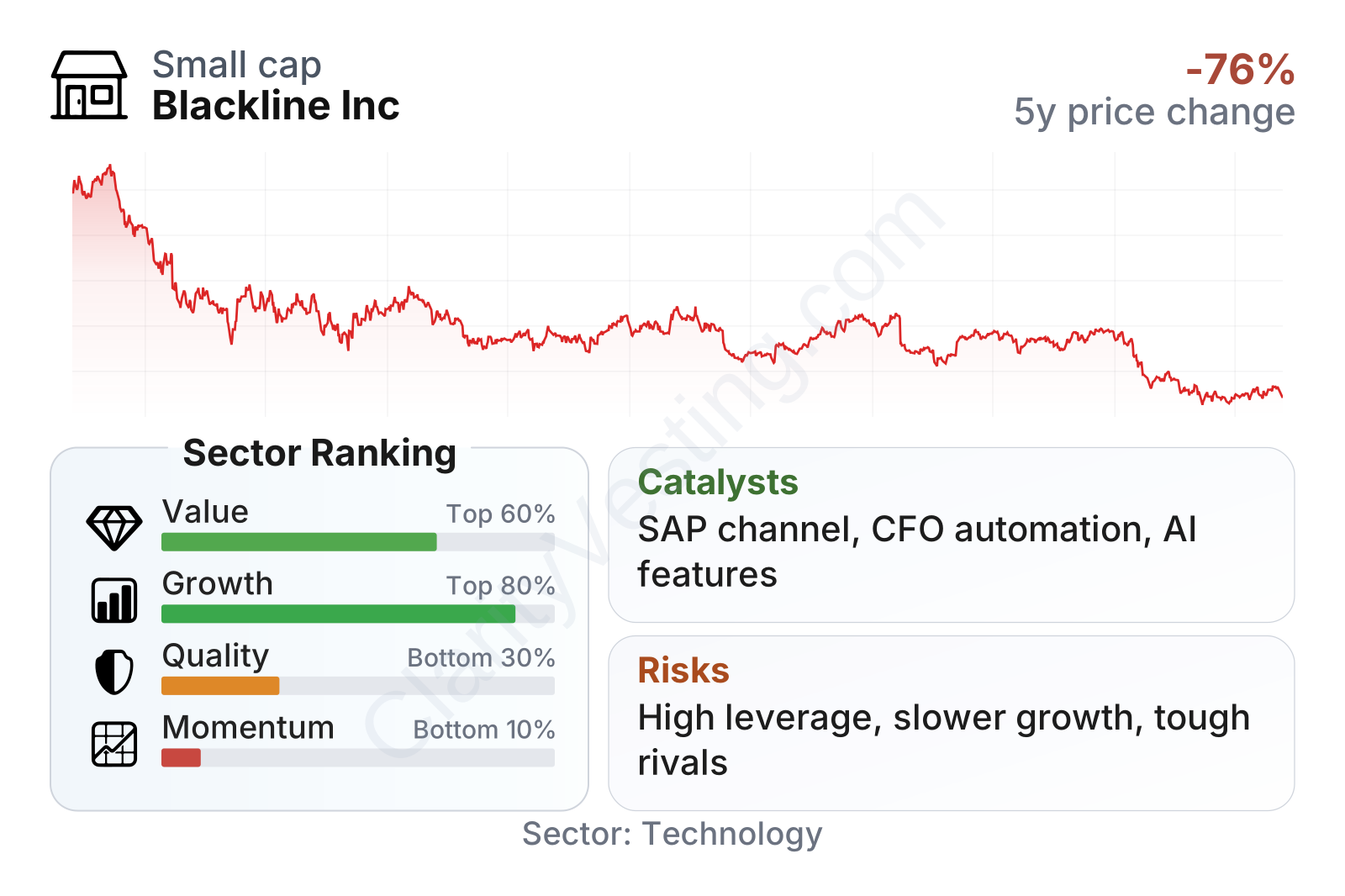
BlackLine is a mid-sized software company with a relatively low beta, which suggests the shares have historically moved less violently than many technology names. The broader picture from the metrics table is mixed. Valuation is not low on earnings, but free cash flow yield looks comparatively strong. Growth is respectable rather than exceptional, quality is held back by leverage and modest returns on invested capital, and recent price momentum has been weak compared with the sector.
Growth
BlackLine operates in a favorable long-term area: finance automation. Companies continue to digitize accounting workflows, reduce manual spreadsheet work, improve compliance, and shorten the financial close process. These needs do not depend on short-lived consumer trends. They are tied to cost control, auditability, and productivity inside large organizations, which gives the sector structural support.
The company’s strategy also makes sense. It is not trying to be a broad enterprise software giant; instead, it focuses on finance operations where software can become deeply embedded in daily processes. That kind of specialization can help customer retention because replacing core accounting workflows is disruptive once a system is in place. BlackLine has also expanded beyond its original close-and-reconciliation niche into adjacent areas such as accounts receivable automation and intercompany accounting, giving it more room to sell additional modules to existing customers.
Revenue growth has slowed from the 20%+ pace seen earlier in the decade to roughly high-single-digit or low-double-digit growth more recently. That is still expansion, but it shows BlackLine is now in a more mature phase. The key question is not whether revenue is growing at all, but whether the company can combine steady growth with stronger margins and cash generation.
Cash generation is one of the more encouraging parts of the picture. Free cash flow rose sharply over the last several years and remains strong, even with some recent moderation from peak levels. That suggests the platform can produce real cash as it scales, which matters more for long-term durability than revenue growth alone.
One relevant opportunity is the continued push by enterprises to modernize ERP-connected finance systems and automate labor-intensive accounting tasks. BlackLine also benefits from partnerships with major enterprise software ecosystems, particularly SAP, which can widen distribution and make BlackLine easier to adopt inside large organizations already running complex finance infrastructure. In recent company communications, management has continued to emphasize platform expansion, AI-enabled capabilities, and go-to-market execution around large enterprise customers. Those themes point to a realistic growth path, even if not a hypergrowth one.
Risks
This article is for informational purposes only and does not constitute financial advice. Some content is AI-generated. See Disclaimer