Stock Analysis · Booking Holdings Inc (BKNG)
Overview
Booking Holdings is one of the world’s largest online travel companies. It operates digital platforms that help people book accommodations, airline tickets, rental cars, restaurant reservations, and other travel-related services. Its best-known brands include Booking.com, Priceline, Agoda, KAYAK, OpenTable, and Rentalcars.com. The group’s business model is mostly built on connecting travelers with travel suppliers and earning fees when bookings happen.
The company’s biggest activity by far is accommodation bookings, especially hotels, apartments, and other short-term stays listed on Booking.com and Agoda. Flights and other travel services have become more important over time, but lodging remains the core earnings engine. Based on company reporting, revenue sources are approximately concentrated as follows:
- Merchant revenue: about 56% of total revenue — Booking collects payment from the traveler and later remits most of it to the travel supplier. This category is heavily tied to accommodations and increasingly includes other travel products.
- Agency revenue: about 27% of total revenue — The traveler pays the hotel or other supplier directly, and Booking earns a commission for sending the customer.
- Advertising and other revenue: about 17% of total revenue — This includes referral and advertising activity, mainly through KAYAK and OpenTable, plus some ancillary travel services.
Geographically, Booking Holdings is highly international, with Europe remaining especially important through Booking.com. That global reach matters because it gives the company exposure to many travel corridors instead of relying on a single country. Another notable feature of the model is that it is asset-light: the company does not own large hotel fleets or airlines, so it can convert a meaningful share of revenue into cash when travel demand is healthy.
Over the last several years, revenue, operating income, and net income have all expanded sharply from post-pandemic recovery levels. The cost structure has also stayed favorable: direct costs remain small relative to revenue, which helps preserve very high gross profitability. At the same time, interest expense has risen, which is worth monitoring, but the overall picture is still one of a platform business with strong earnings power.
The business mix shows why Booking can produce strong profitability: most of its revenue comes from booking platforms and commissions rather than capital-intensive operations. Revenue has climbed materially since 2021, while operating profit has grown even faster, reflecting scale advantages and disciplined expense management.
Key Figures
| Metric | Value | Sector ⓘ |
|---|---|---|
| Date | Sep 12, 2026 | |
| Context | ||
| Sector | Consumer Cyclical | |
| Industry | Travel Services | |
| Market Cap ⓘ | $130.68B | |
| Beta ⓘ | 1.07 | |
Value (Cheapness) | ||
| P/E Ratio ⓘ | 19.39 | 17.10 |
| FCF Yield ⓘ | 7.30% | 8.53% |
| EBIT / EV ⓘ | 7.54% | 6.46% |
| PEG ⓘ | 0.64 | |
Growth (Business expansion) | ||
| Revenue Growth ⓘ | 8.10% | 5.75% |
| RPS Growth (5Y CAGR) ⓘ | 32.83% | 9.14% |
| EPS Growth (5Y CAGR) ⓘ | -43.91% | -18.21% |
| Margin Growth (5Y Trend) ⓘ | 14.97% | -0.23% |
| FCF Growth (5Y CAGR) ⓘ | 37.86% | 4.91% |
Quality (Business durability) | ||
| ROIC (Latest) ⓘ | 70.68% | 12.61% |
| ROIC (5Y Median) ⓘ | 37.38% | 10.72% |
| Net Debt / EBIT (Latest) ⓘ | 0.34 | 2.10 |
| Net Debt / EBIT (5Y Median) ⓘ | 0.19 | 2.32 |
| Operating Margin (Latest) ⓘ | 35.89% | 9.25% |
| Operating Margin (5Y Median) ⓘ | 29.85% | 9.64% |
| Debt to Equity (Latest) ⓘ | -191.91% | 75.78% |
| Profit Margin (Latest) ⓘ | 25.53% | 5.33% |
| Free Cash Flow (Latest) ⓘ | $9.54B | |
Momentum (Price trend) | ||
| 3Y Return ⓘ | +40.26% | +14.53% |
| 12M Return (excl. last month) ⓘ | -2.02% | +3.08% |
| 6M Return ⓘ | +3.60% | +0.55% |
| Price vs. 200-Day MA ⓘ | -5.82% | -0.54% |
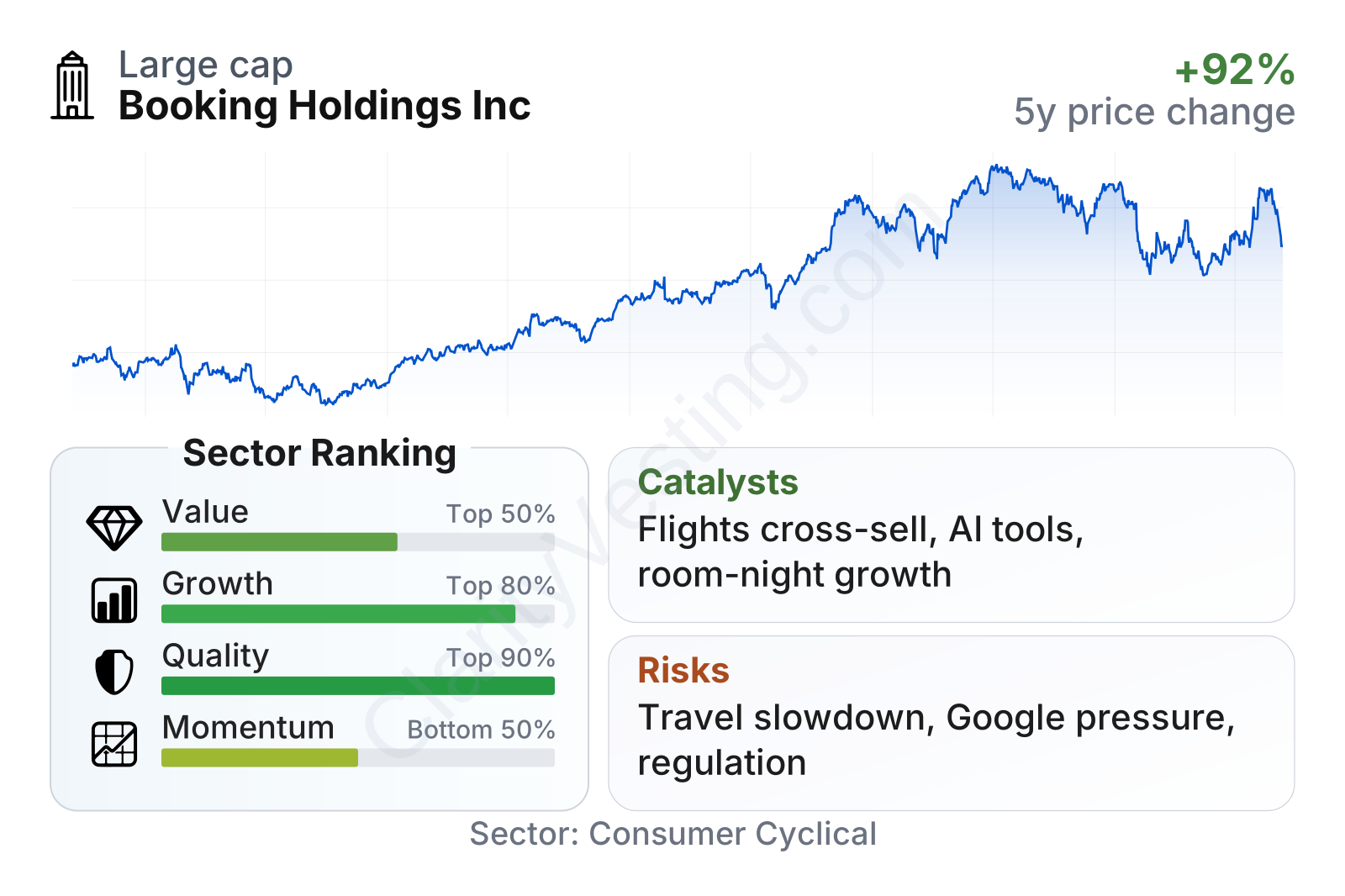
Booking Holdings is a very large company in travel services, with share-price behavior that has been more resilient than much of the sector over the last three years, even if the shorter-term path has been uneven. The overall profile is strongest in quality and growth: returns on invested capital are exceptionally high, operating margin is far above sector norms, and free cash flow generation is substantial. The main softer area is value, where the stock trades above the sector median on earnings multiples and below the sector median on free-cash-flow yield, suggesting the market already recognizes much of the business strength.
Growth
Online travel remains a growing market over the long run. Travel demand has continued to normalize and expand, and the shift from offline to online booking still supports digital platforms with global scale. Booking Holdings is well placed in that environment because it already has a massive accommodation network, deep consumer awareness, and strong relationships with hotels and alternative lodging partners. Those advantages make it easier to add adjacent services such as flights, rental cars, and in-destination offerings.
A central part of the company’s strategy is to build a more connected travel experience. Instead of only helping users reserve a hotel, Booking wants customers to also book flights, local transport, attractions, and restaurants inside the same ecosystem. That matters because cross-selling can raise revenue per traveler and increase repeat usage. The company has also been investing in mobile engagement, loyalty features, and artificial intelligence tools to improve search, trip planning, and conversion.
Growth has clearly slowed from the extraordinary rebound phase after the pandemic, which is normal, but it remains positive. Recent year-over-year revenue growth has been running in the high single digits to mid-teens, which is still a healthy pace for a company of this size and above the sector median. Longer-term revenue-per-share growth has also been unusually strong, helped by both business expansion and share repurchases.
Cash generation is another important part of the growth picture. Free cash flow has moved from roughly the mid-single-digit billions a few years ago to around $9 billion recently. That gives Booking Holdings room to invest in technology, marketing, product expansion, and shareholder returns without stretching the balance sheet. For a platform company in travel, this level of cash generation is a meaningful strategic advantage.
Recent company updates have also pointed to continued momentum in room nights, cross-selling, and direct consumer engagement. The growing contribution from flights is particularly notable because flights can serve as an entry point into the wider trip, creating more opportunities to sell hotels and other services. If that ecosystem strategy continues to work, it could support another leg of durable growth beyond pure hotel booking volume.
Risks
This article is for informational purposes only and does not constitute financial advice. Some content is AI-generated. See Disclaimer


