Stock Analysis · Bill Com Holdings Inc (BILL)
Overview
Bill Com Holdings, better known as BILL, provides software that helps businesses manage back-office financial tasks such as paying bills, sending invoices, tracking expenses, and handling corporate cards. Its main customers are small and midsize businesses, and it also works through accounting firms and financial institution partners. The basic idea is simple: BILL tries to replace slow, manual finance work with cloud-based automation.
The company has expanded beyond bill payment into a broader financial operations platform. Over time, it added expense management through Divvy, accounts receivable tools for invoicing and collections, and tools aimed at helping businesses control spending and cash flow in one place. That wider product set matters because it gives BILL more ways to serve the same customer and makes the platform more embedded in daily operations.
BILL reports revenue in two main categories. Based on recent annual filings, the business mix is roughly the following:
- Transaction fees: about 55% to 60% of revenue. These come from payment transactions, card-related activity, and other usage-driven services on the platform.
- Subscription fees: about 40% to 45% of revenue. These are recurring software fees paid for access to BILL’s products and features.
That revenue mix is important for long-term analysis. Subscription revenue adds recurring visibility, while transaction revenue gives BILL upside when customer activity rises. The trade-off is that a meaningful share of the business is tied to payment volume and spending trends among smaller businesses, which can be cyclical.
The economics of the business show a useful pattern: revenue has scaled quickly, gross profit has remained strong, and operating losses have narrowed materially over the last few years as expense growth slowed relative to sales. The company has moved much closer to break-even and into periods of operating profitability, even though net income remains uneven.
BILL’s revenue base has expanded several times over since 2021, while gross profit has stayed high relative to sales. A notable improvement is that operating losses, once very large, have narrowed sharply as sales and marketing costs became more controlled. That points to a business still maturing rather than one struggling to generate demand.
Key Figures
| Metric | Value | Sector ⓘ |
|---|---|---|
| Date | Jul 18, 2026 | |
| Context | ||
| Sector | Technology | |
| Industry | Software - Application | |
| Market Cap ⓘ | $4.45B | |
| Beta ⓘ | 1.18 | |
Value (Cheapness) | ||
| P/E Ratio ⓘ | N/A | 31.76 |
| FCF Yield ⓘ | 8.61% | 4.18% |
| EBIT / EV ⓘ | 0.66% | 2.56% |
| PEG ⓘ | 0.44 | |
Growth (Business expansion) | ||
| Revenue Growth ⓘ | 13.50% | 13.50% |
| RPS Growth (5Y CAGR) ⓘ | 48.72% | 8.57% |
| EPS Growth (5Y CAGR) ⓘ | N/A | -21.87% |
| Margin Growth (5Y Trend) ⓘ | N/A | 0.41% |
| FCF Growth (5Y CAGR) ⓘ | N/A | 9.76% |
Quality (Business durability) | ||
| ROIC (Latest) ⓘ | 0.41% | 8.54% |
| ROIC (5Y Median) ⓘ | -2.76% | 8.12% |
| Net Debt / EBIT (Latest) ⓘ | 32.29 | 0.38 |
| Net Debt / EBIT (5Y Median) ⓘ | N/A | 0.38 |
| Operating Margin (Latest) ⓘ | 1.72% | 9.58% |
| Operating Margin (5Y Median) ⓘ | -19.62% | 8.25% |
| Debt to Equity (Latest) ⓘ | 49.59% | 33.52% |
| Profit Margin (Latest) ⓘ | 0.01% | 6.96% |
| Free Cash Flow (Latest) ⓘ | $383.06M | |
Momentum (Price trend) | ||
| 3Y Return ⓘ | -67.01% | +30.91% |
| 12M Return (excl. last month) ⓘ | -23.06% | +28.90% |
| 6M Return ⓘ | -7.34% | +5.38% |
| Price vs. 200-Day MA ⓘ | +1.01% | +7.61% |
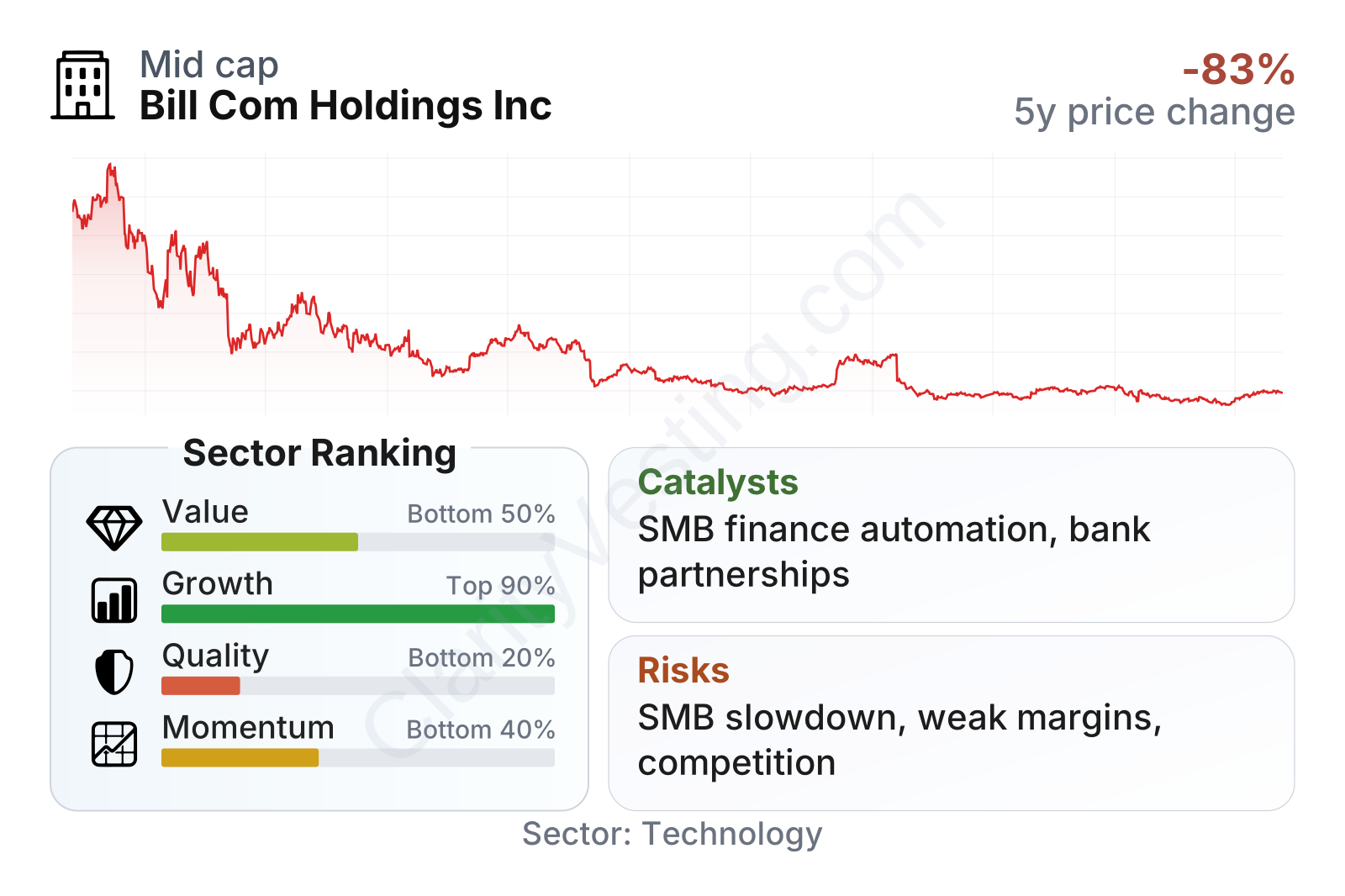
BILL sits in a mixed position. Growth remains one of its strongest characteristics, ranking near the top of its sector, and free cash flow generation looks strong relative to many software peers. At the same time, profitability and capital efficiency remain weak on traditional measures, and share price performance has been poor over the last few years. In other words, the market has shifted from rewarding rapid expansion to demanding more durable earnings.
With a market value around the low single-digit billions and a beta modestly above 1, the stock still carries meaningful volatility. That is not unusual for a mid-cap software company tied to small-business spending, but it helps explain why the share price has moved much more sharply than slower-growing software names.
Growth
BILL operates in a sector with favorable long-term demand. Small and midsize businesses still have plenty of room to digitize payments, invoicing, expense management, and financial workflows. Many companies continue to rely on fragmented tools, spreadsheets, paper checks, or accounting processes that are only partly automated. That leaves a sizable runway for software platforms that can reduce labor, improve visibility, and speed up cash movement.
The company’s strategy is coherent. Instead of offering only one tool, BILL has been building a broader financial operations platform that can manage payables, receivables, expenses, and cards together. This creates cross-selling opportunities and can increase customer retention because the more workflows a customer runs through one platform, the harder it becomes to switch away.
Revenue growth has clearly cooled from the extraordinary post-pandemic surge, but it has stabilized at a still-healthy double-digit pace. That moderation is not surprising: BILL is much larger now, and comparisons have become harder. What matters more is that growth has not collapsed. It remains slightly ahead of the broader software sector median, suggesting the business is still expanding faster than many peers despite a tougher environment.
Cash generation has become a major positive change in the investment case. Free cash flow moved from negative territory a few years ago to a strong positive level, and it has continued to rise. That gives BILL more flexibility to invest in product development, absorb economic volatility, and support acquisitions or balance-sheet needs without relying as heavily on external capital.
Potential catalysts for future growth include deeper adoption of its integrated platform, more monetization of payment volume and card activity, and continued penetration through accounting firms and bank partners. The company has also been emphasizing efficiency and product bundling, which can support both customer expansion and better margins over time.
Recent company updates have also pointed to the growing use of artificial intelligence features within financial workflows, including automation of routine tasks and improved processing efficiency. In a business built around repetitive finance operations, even modest AI-driven improvements can make the platform more useful and sticky for customers.
Risks
The main risk is that BILL serves smaller businesses, which tend to be more sensitive to economic slowdowns than large enterprises. If customers send fewer invoices, make fewer payments, hire less, or cut discretionary spending, transaction-driven revenue can soften quickly. That makes BILL less insulated than software vendors with mostly fixed subscription revenue from large corporate clients.
Competition is another major issue. BILL is not operating alone in digital payments and financial workflow software. It faces large and specialized rivals across different parts of its platform, including Intuit in small-business finance software, AvidXchange in accounts payable automation, Expensify and Ramp in expense management and corporate spend, Brex in cards and spend tools, and payment-oriented firms that can move into adjacent workflow services. Some of these competitors are larger, better capitalized, or more specialized in one category.
BILL does have real competitive advantages, though. Its platform is well known among accountants and small businesses, it benefits from integrations with accounting systems, and it combines software and payments in a way that can deepen customer relationships. Still, it is difficult to call the company the uncontested leader across the entire category because the market is fragmented and several competitors are strong in overlapping niches.
Balance-sheet leverage is not extreme by many non-software standards, but it is above the software sector median and has moved back up after a temporary improvement. That means the company does not have the same margin for error as a debt-light software peer, especially when paired with still-thin earnings.
Profitability has improved dramatically from deep losses, but the margin picture remains fragile. Net margin recently drifted back toward break-even after briefly turning more clearly positive, and it still trails the sector by a wide margin. This suggests BILL has made real progress but has not yet established consistently strong earnings power.
Another risk is execution. BILL expanded through acquisitions and product broadening, which creates integration demands across technology, sales, and customer experience. If the company struggles to unify its platform or if customers do not adopt multiple products as expected, the long-term margin and growth benefits may arrive more slowly than hoped.
No major public scandal or governance event stands out as a defining red flag in the most recent official disclosures, but recent market reactions show that guidance changes, spending trends, and margin expectations can move the stock sharply. The reputational risk here is less about controversy and more about disappointing growth or execution in a market that has become less forgiving.
Valuation
BILL’s valuation is unusual because earnings-based measures are not very helpful at the moment. The trailing P/E ratio is currently not meaningful, reflecting near-break-even profitability and inconsistent net income. That means a simple comparison with the sector’s typical earnings multiple does not say much on its own.
A more useful lens is the contrast between the company’s weak accounting earnings and its solid cash generation. BILL screens attractively on free cash flow yield compared with much of the software sector, while its PEG ratio also suggests the market is not placing an especially rich premium on growth. Those signals indicate that the current share price already reflects a fair amount of caution around profitability, competitive pressure, and slower expansion.
At the same time, valuation cannot be called plainly cheap without qualification. Returns on invested capital remain very low, margins are still thin, and the stock has lost the premium multiple that fast-growing software companies once enjoyed. In effect, the market appears to be valuing BILL more like a company in transition: still capable of healthy growth and cash generation, but not yet proven enough to command a strong quality premium.
That makes the current pricing context highly dependent on whether BILL can turn its operational progress into more durable margins. If profitability strengthens meaningfully while growth stays in the double digits, today’s valuation could look more understandable in hindsight. If margins remain weak, the market’s caution would appear justified.
Conclusion
BILL remains an interesting company because it sits at the intersection of software automation and business payments, two areas with clear long-term relevance. It has built a meaningful position in serving small and midsize businesses, expanded into a broader financial operations platform, and shown that it can convert growth into rising free cash flow. Those are notable strengths for a company whose share price has already undergone a major reset.
The challenge is that BILL is still proving the final stage of its business model. Revenue is growing at a healthy pace, but no longer at the explosive rates that once carried the stock. Profitability has improved a lot, yet it remains delicate by software-sector standards. Add in exposure to small-business spending and a competitive market, and the picture becomes one of a solid but still unfinished platform company rather than a fully established compounder.
Overall, BILL looks more compelling on business relevance, platform breadth, and cash generation than on present-day margins or clear category dominance. The company appears to have moved beyond its most cash-hungry phase, but the next chapter depends on showing that scale can translate into consistently stronger earnings. That creates a profile with genuine long-term promise, though one that still carries a meaningful burden of proof.
Sources:
- U.S. Securities and Exchange Commission (EDGAR) — Bill Holdings, Inc. Quarterly Reports on Form 10-Q filed in 2026
- U.S. Securities and Exchange Commission (EDGAR) — Bill Holdings, Inc. Current Reports on Form 8-K filed in 2026
- BILL Investor Relations — shareholder letters, earnings releases, and company-hosted webcast materials published in 2026
- Bill Holdings, Inc. Annual Report on Form 10-K for fiscal year 2025, used for business model and revenue mix background where later annual filing was not yet available
- Wikipedia — Bill Holdings basic company history and product overview
This article is for informational purposes only and does not constitute financial advice. Some content is AI-generated. See Disclaimer


