Stock Analysis · Biglari Holdings Inc (BH)
Overview
Biglari Holdings Inc. is a small conglomerate built around restaurants, insurance, and investment holdings. The company is best known for owning the Steak n Shake and Western Sizzlin restaurant brands, but it also controls insurance operations and keeps a portfolio of marketable securities and other investments. That makes Biglari Holdings different from a typical restaurant stock: part of its performance comes from operating businesses, and part comes from how management allocates capital across subsidiaries and investments.
The largest recurring revenue source is the restaurant business. Based on recent annual reporting, company revenue is still heavily concentrated in food service, while insurance contributes meaningfully through premiums and investment income, and smaller activities add the rest. A practical way to think about the mix is:
- Restaurants: roughly three-quarters to four-fifths of revenue, mainly from Steak n Shake and related franchise or operating activity.
- Insurance: roughly one-fifth to one-quarter, including insurance premiums and income tied to float and investments.
- Other holdings and investment-related activity: a smaller and more variable portion, but sometimes important for profit even when it is not the biggest source of sales.
This mix matters because revenue and profit do not always move together. In some years, the operating businesses have generated solid cash flow while reported earnings moved around sharply because of investment results, insurance effects, or changes in operating profitability. The long-term case therefore depends less on simple sales growth and more on whether management can improve restaurant economics, preserve insurance strength, and compound capital efficiently across the group.
The business flow shows a company with fairly stable revenue over the past several years, but much more volatile profitability. Gross profit and operating income have swung noticeably, and the latest annual picture points to pressure from higher operating costs and weaker margins rather than a collapse in top-line activity.
Key Figures
| Metric | Value | Sector ⓘ |
|---|---|---|
| Date | Sep 12, 2026 | |
| Context | ||
| Sector | Consumer Cyclical | |
| Industry | Restaurants | |
| Market Cap ⓘ | $1.19B | |
| Beta ⓘ | 0.52 | |
Value (Cheapness) | ||
| P/E Ratio ⓘ | N/A | 17.10 |
| FCF Yield ⓘ | 4.21% | 8.53% |
| EBIT / EV ⓘ | -1.65% | 6.46% |
| PEG ⓘ | -12.63 | |
Growth (Business expansion) | ||
| Revenue Growth ⓘ | 7.90% | 5.75% |
| RPS Growth (5Y CAGR) ⓘ | -7.89% | 9.14% |
| EPS Growth (5Y CAGR) ⓘ | N/A | -18.21% |
| Margin Growth (5Y Trend) ⓘ | -20.72% | -0.23% |
| FCF Growth (5Y CAGR) ⓘ | -17.36% | 4.91% |
Quality (Business durability) | ||
| ROIC (Latest) ⓘ | -1.98% | 12.61% |
| ROIC (5Y Median) ⓘ | 4.72% | 10.72% |
| Net Debt / EBIT (Latest) ⓘ | N/A | 2.10 |
| Net Debt / EBIT (5Y Median) ⓘ | 1.78 | 2.32 |
| Operating Margin (Latest) ⓘ | -4.76% | 9.25% |
| Operating Margin (5Y Median) ⓘ | 10.03% | 9.64% |
| Debt to Equity (Latest) ⓘ | 53.21% | 75.78% |
| Profit Margin (Latest) ⓘ | -7.33% | 5.33% |
| Free Cash Flow (Latest) ⓘ | $49.94M | |
Momentum (Price trend) | ||
| 3Y Return ⓘ | +107.91% | +14.53% |
| 12M Return (excl. last month) ⓘ | +37.69% | +3.08% |
| 6M Return ⓘ | +21.03% | +0.55% |
| Price vs. 200-Day MA ⓘ | +5.91% | -0.54% |
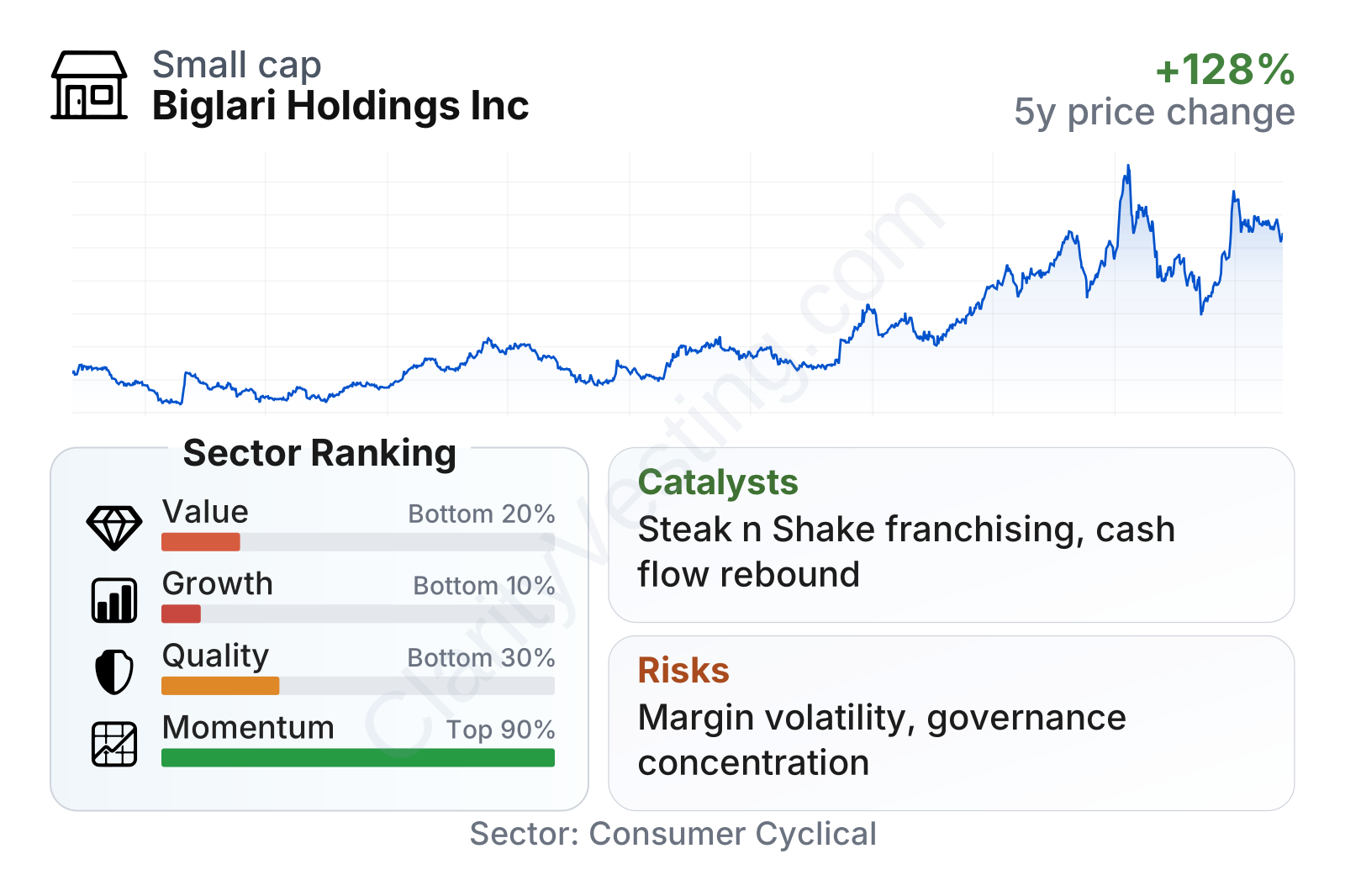
Biglari Holdings currently looks mixed on the surface and weak on several core fundamentals. Its market value is still relatively small, around the low-billion-dollar range, which can make the stock less followed and more affected by company-specific developments. Share price momentum has been strong over the last one-, three-, and six-month periods compared with much of the sector, but the company ranks poorly on growth, quality, and value measures. Revenue growth is positive but modest, margins are currently negative, and returns on invested capital are below the sector norm. One notable offset is cash generation: trailing free cash flow is positive and meaningful for a company of this size, even though that cash flow has been uneven over time.
Growth
Biglari Holdings operates mainly in restaurants, a mature industry rather than a fast-growing one. That does not mean growth is impossible, but it usually comes from sharper execution, better unit economics, franchising, disciplined cost control, and smart capital allocation instead of broad industry tailwinds. In that sense, Biglari’s future depends less on being in a hot sector and more on whether management can turn a collection of assets into better returns over time.
Within the restaurant business, franchising can be a meaningful catalyst because it typically requires less capital than company-operated locations and can improve margins when done well. Steak n Shake has spent years shifting parts of its model, including a stronger emphasis on franchise partners and operating changes meant to improve store-level performance. If that transition gains traction, the business could become lighter on capital and more resilient. Insurance is another potential growth lever because insurance float can provide capital for future investments if underwriting remains sound.
Recent revenue trends suggest some stabilization after several uneven periods. The latest year-over-year growth is positive, but still not particularly strong for a company trying to prove a durable operating turnaround. The bigger issue is consistency: the record shows alternating periods of growth and contraction, which makes it harder to argue that the company has entered a clear new expansion phase.
Cash flow is a more encouraging signal than earnings. Free cash flow has been volatile, but the latest trailing level shows a clear rebound from the prior year. For a conglomerate-like structure, that matters because internally generated cash gives management more flexibility to reinvest in restaurants, support insurance operations, or allocate capital elsewhere without relying heavily on outside financing.
As for recent developments, the most relevant opportunity remains internal rather than external: improvement in Steak n Shake economics, continued franchise development, and disciplined use of capital across subsidiaries. For Biglari Holdings, a major catalyst is less likely to be a sudden industry boom and more likely to be a sustained demonstration that its operating businesses can produce steadier margins and cash flow.
Risks
This article is for informational purposes only and does not constitute financial advice. Some content is AI-generated. See Disclaimer


