Stock Analysis · Biglari Holdings Inc (BH-A)
Overview
Biglari Holdings Inc. is a diversified holding company led by Chairman and Chief Executive Officer Sardar Biglari. Even though it is often associated with restaurants, the business is broader than that. Its main operating assets include the Steak n Shake and Western Sizzlin restaurant brands, an insurance operation, and a collection of equity investments held at the parent-company level. The group is structured more like a small conglomerate than a traditional restaurant chain, which makes it different from most companies in the consumer cyclical sector.
For long-term readers, the key point is that Biglari Holdings combines two very different engines: operating businesses that generate sales every day, and an investment portfolio whose value can move with financial markets. That mix can create unusual swings in reported earnings from one period to another, even when the underlying restaurant activity changes only modestly.
The largest source of revenue is still the restaurant business. Based on recent annual filings, revenue is concentrated roughly as follows:
- Restaurant operations: by far the largest contributor, likely around 85% to 95% of consolidated revenue, mainly from Steak n Shake company-operated restaurants, franchise activities, and related restaurant income.
- Insurance operations: a much smaller share of reported revenue, generally in the low- to mid-single digits, coming from premiums and investment income tied to the insurance subsidiary.
- Other investment and holding-company income: usually a small and more volatile portion, including dividends, gains or losses, and other parent-level activities.
That revenue mix matters because it shows where the cash generation largely starts: the restaurants. At the same time, the final profit picture can be influenced heavily by investment results, which are less predictable than burger and diner sales. Over the last few years, revenue has stayed in a fairly narrow band overall, while profitability has moved around much more sharply. That points to a company whose value depends not just on sales growth, but also on cost control, capital allocation, and management execution.
The business flow highlights a useful pattern: sales have not collapsed, but operating profitability has become much less consistent. Revenue has hovered around a similar level for several years, while gross profit and operating income have been more volatile, suggesting that cost pressure and overhead have had a bigger impact than top-line demand alone.
Key Figures
| Metric | Value | Sector ⓘ |
|---|---|---|
| Date | Sep 05, 2026 | |
| Context | ||
| Sector | Consumer Cyclical | |
| Industry | Restaurants | |
| Market Cap ⓘ | $1.23B | |
| Beta ⓘ | 0.52 | |
Value (Cheapness) | ||
| P/E Ratio ⓘ | N/A | 17.51 |
| FCF Yield ⓘ | 4.07% | 8.30% |
| EBIT / EV ⓘ | -1.53% | 6.34% |
| PEG ⓘ | N/A | |
Growth (Business expansion) | ||
| Revenue Growth ⓘ | 7.90% | 5.90% |
| RPS Growth (5Y CAGR) ⓘ | -48.20% | 9.14% |
| EPS Growth (5Y CAGR) ⓘ | N/A | -17.43% |
| Margin Growth (5Y Trend) ⓘ | -20.72% | -0.30% |
| FCF Growth (5Y CAGR) ⓘ | -17.36% | 4.91% |
Quality (Business durability) | ||
| ROIC (Latest) ⓘ | -1.98% | 12.33% |
| ROIC (5Y Median) ⓘ | 4.72% | 10.68% |
| Net Debt / EBIT (Latest) ⓘ | N/A | 2.11 |
| Net Debt / EBIT (5Y Median) ⓘ | 1.78 | 2.32 |
| Operating Margin (Latest) ⓘ | -4.76% | 9.12% |
| Operating Margin (5Y Median) ⓘ | 10.03% | 9.56% |
| Debt to Equity (Latest) ⓘ | 53.21% | 75.78% |
| Profit Margin (Latest) ⓘ | -7.33% | 5.31% |
| Free Cash Flow (Latest) ⓘ | $49.94M | |
Momentum (Price trend) | ||
| 3Y Return ⓘ | +107.56% | +15.88% |
| 12M Return (excl. last month) ⓘ | +40.83% | +5.17% |
| 6M Return ⓘ | +7.51% | 0.00% |
| Price vs. 200-Day MA ⓘ | +6.59% | +0.59% |
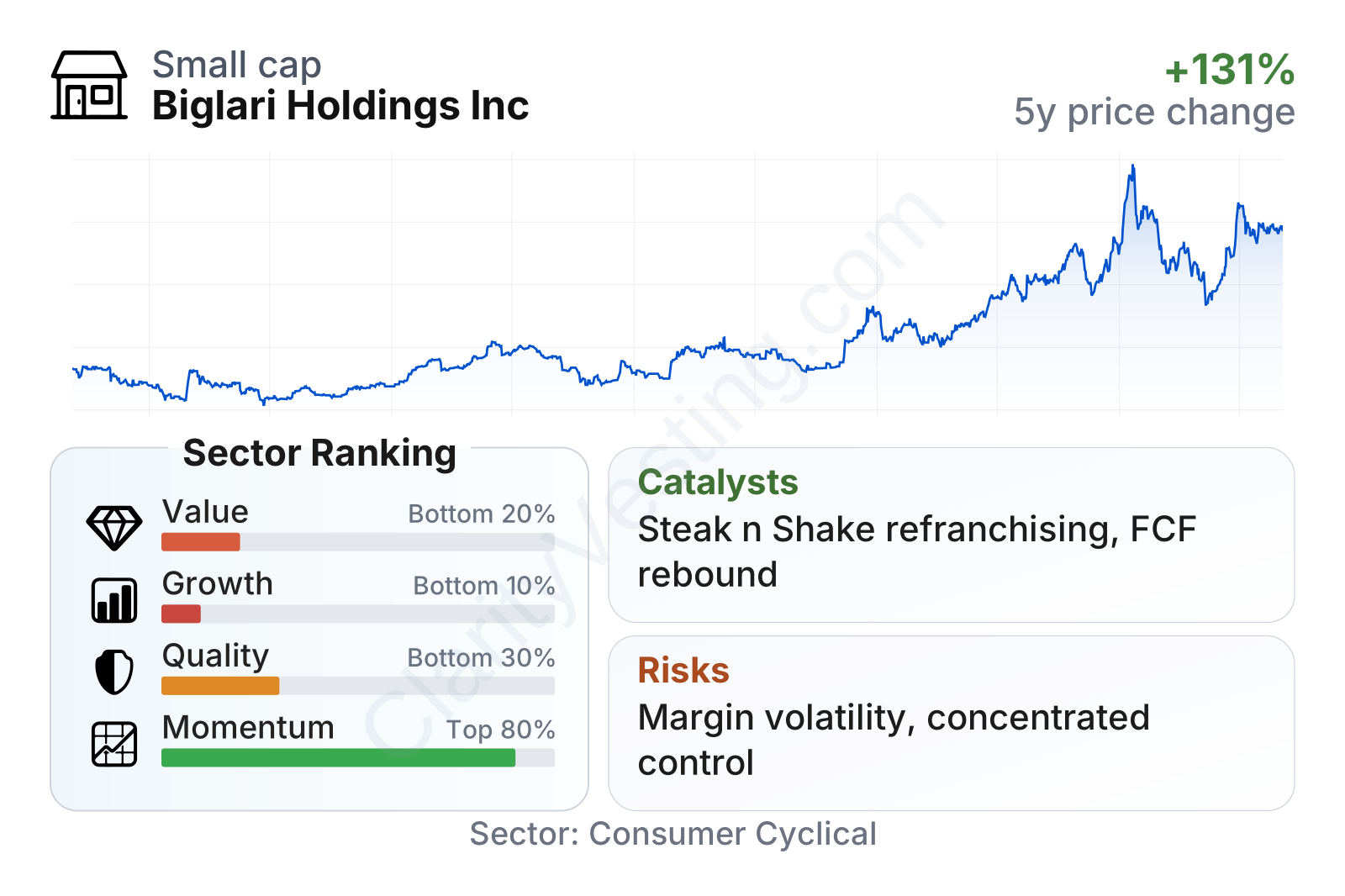
Biglari Holdings stands out as a relatively small public company, with a market value a little above $1 billion and a stock that has historically moved less than the broader market. The share price has risen strongly over the last three years, but the underlying fundamental profile is more mixed. Relative to other consumer cyclical companies, recent growth and profitability measures rank toward the lower end of the sector, while free cash flow remains meaningful. In simple terms, the market performance has been much stronger than the recent operating scorecard.
Growth
Biglari Holdings operates in areas that are mature rather than high-growth. Restaurants, especially casual dining and burger concepts, are not fast-expanding sectors in the way that software or semiconductors can be. Growth usually comes from better operations, franchising, brand repositioning, or disciplined capital allocation. That means the company’s long-term potential depends less on being in a booming industry and more on whether management can improve restaurant economics and put capital to work effectively.
Recent revenue growth has turned positive again, but the pace remains modest and below the sector median. The more encouraging point is that the business has moved from several uneven years into a stretch of positive year-over-year gains. Still, the longer-term record remains weak, which suggests the company has not yet established a durable expansion trend.
The strategy can make sense if viewed through the lens of a holding company. Management has historically emphasized concentrated decision-making, ownership of controlled subsidiaries, and the use of cash flows for redeployment. If the restaurant operations stabilize and the insurance unit continues to provide investable funds, that structure can create optionality. In plain English, the company does not need explosive sales growth to create value; it needs better operating consistency and strong capital allocation.
Free cash flow is one of the more constructive parts of the picture. Although it has been uneven, the latest trailing twelve-month level shows a meaningful rebound from the prior year. For a company with volatile accounting earnings, this is important because cash generation offers a clearer view of financial flexibility. It can support debt service, reinvestment, and opportunistic moves at the holding-company level.
One catalyst is the possibility of improved economics at Steak n Shake if management continues shifting the model toward franchising and tighter cost discipline. A lighter operating model can reduce labor intensity and improve margins if executed well. Another catalyst is the value of the investment and insurance structure, which could become more visible if operating results stop overshadowing it. There is no obvious transformational industry tailwind here, but there is still room for self-help improvement.
Risks
This article is for informational purposes only and does not constitute financial advice. Some content is AI-generated. See Disclaimer