Stock Analysis · Bright Horizons Family Solutions Inc (BFAM)
Overview
Bright Horizons Family Solutions is a provider of education and care services aimed primarily at employers and working families. The company operates child care centers, offers back-up care for children and adults, and provides educational advisory services that help families navigate school selection, tutoring, and related needs. Its model is built around long-term relationships with employers, universities, hospitals, and other institutions that use these services as part of workforce support and retention programs.
Revenue comes from a mix of tuition paid by families, employer-sponsored arrangements, and service fees tied to its care and education platforms. Based on the company’s recent reporting structure, the main sources of revenue are approximately:
- Full-service center-based child care: about 70% to 75%. This includes traditional early education and preschool services delivered through centers operated for employers, institutions, and communities.
- Back-up care: about 20% to 25%. This segment provides short-notice care for children, older adults, and other family members, often funded in part by employer clients.
- Educational advisory and related services: about 3% to 6%. This includes college admissions counseling, tutoring support, and school-related advisory offerings.
The business is labor-intensive, so employee compensation is a major cost item. At the same time, scale matters: as enrollment rises and center utilization improves, more of each revenue dollar can fall through to operating profit. Over the last several years, revenue has climbed from roughly $1.8 billion to nearly $2.9 billion, while operating income and net income have improved more sharply, showing that the company has been recovering margins as utilization and pricing have strengthened.
The broad trend is encouraging: revenue has expanded steadily, gross profit has risen, and profitability has improved meaningfully since 2023. Interest expense remains noticeable, but it has become less of a drag relative to earnings as the business has scaled back up.
Key Figures
| Metric | Value | Sector ⓘ |
|---|---|---|
| Date | Sep 12, 2026 | |
| Context | ||
| Sector | Consumer Cyclical | |
| Industry | Personal Services | |
| Market Cap ⓘ | $3.13B | |
| Beta ⓘ | 1.15 | |
Value (Cheapness) | ||
| P/E Ratio ⓘ | 20.40 | 17.10 |
| FCF Yield ⓘ | 7.48% | 8.53% |
| EBIT / EV ⓘ | 6.20% | 6.46% |
| PEG ⓘ | 1.76 | |
Growth (Business expansion) | ||
| Revenue Growth ⓘ | 6.50% | 5.75% |
| RPS Growth (5Y CAGR) ⓘ | 15.37% | 9.14% |
| EPS Growth (5Y CAGR) ⓘ | -7.20% | -18.21% |
| Margin Growth (5Y Trend) ⓘ | 3.52% | -0.23% |
| FCF Growth (5Y CAGR) ⓘ | 11.86% | 4.91% |
Quality (Business durability) | ||
| ROIC (Latest) ⓘ | 9.14% | 12.61% |
| ROIC (5Y Median) ⓘ | 7.94% | 10.72% |
| Net Debt / EBIT (Latest) ⓘ | 6.08 | 2.10 |
| Net Debt / EBIT (5Y Median) ⓘ | 10.44 | 2.32 |
| Operating Margin (Latest) ⓘ | 10.28% | 9.25% |
| Operating Margin (5Y Median) ⓘ | 7.51% | 9.64% |
| Debt to Equity (Latest) ⓘ | 217.78% | 75.78% |
| Profit Margin (Latest) ⓘ | 5.78% | 5.33% |
| Free Cash Flow (Latest) ⓘ | $233.74M | |
Momentum (Price trend) | ||
| 3Y Return ⓘ | -29.38% | +14.53% |
| 12M Return (excl. last month) ⓘ | -39.47% | +3.08% |
| 6M Return ⓘ | -16.51% | +0.55% |
| Price vs. 200-Day MA ⓘ | -18.73% | -0.54% |
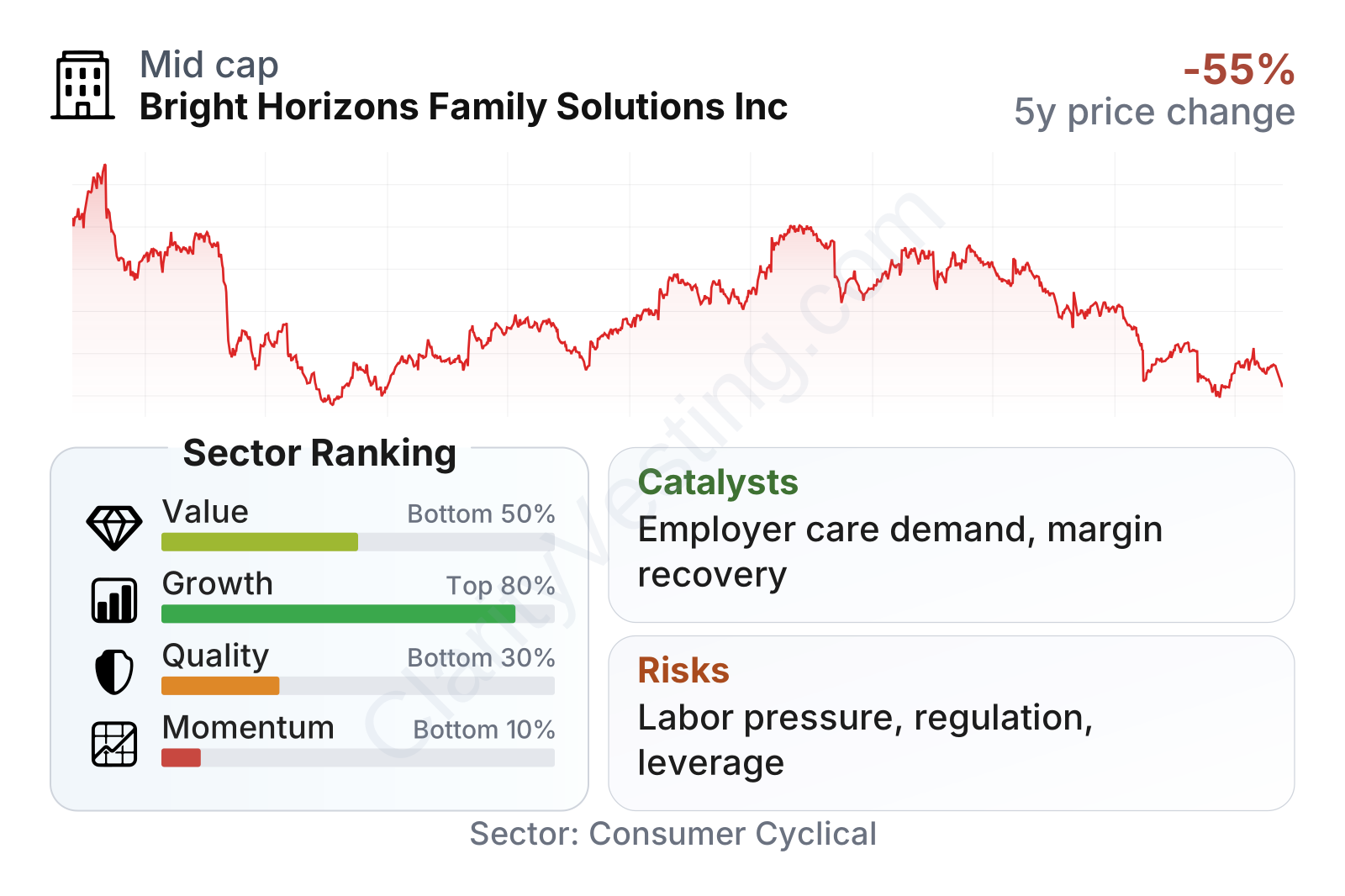
Bright Horizons is a mid-sized public company with a market value around $4 billion and a share price history that has been volatile over the last several years. On the factor table, the clearest strengths are in growth and cash generation, while value, quality, and recent stock momentum are less favorable relative to the broader consumer sector. Revenue growth is modestly above the sector median, five-year revenue-per-share growth is notably stronger, and free cash flow has expanded at a healthy pace. On the other hand, returns on invested capital and leverage metrics still look weaker than many peers, which helps explain why the market has remained cautious even as operating results improved.
Growth
Bright Horizons operates in a sector with durable long-term demand. Child care remains essential for labor-force participation, especially for households with two working adults, while employer-sponsored family benefits have become more important as companies compete for talent, reduce absenteeism, and support return-to-office expectations. That does not make the industry immune to economic slowdowns, but it does give the company exposure to needs that are more recurring than discretionary.
The company’s strategy also makes sense for future growth because it is not relying on a single product. Full-service centers provide a large recurring base, back-up care offers a higher-flexibility solution that is attractive to employers, and educational advisory services create a smaller but complementary revenue stream. This combination gives Bright Horizons several ways to grow: higher enrollment, tuition increases, new center openings, more employer clients, and greater usage of back-up care across its existing network.
Recent growth has slowed from the post-pandemic rebound period, but the business is still expanding. Year-over-year revenue growth moved from very strong double-digit rates earlier in the recovery to mid-single-digit growth more recently. That moderation is not surprising after a normalization phase, and it still compares reasonably well with the sector median. The more important point for long-term analysis is that growth has been accompanied by margin recovery rather than coming at the expense of profitability.
Cash generation has become a more important positive signal. Free cash flow has risen from roughly $160 million in early 2022 to more than $270 million on a trailing basis by early 2026, and the latest trailing figure in the metrics table is above $320 million. That suggests the company is converting a larger share of earnings into usable cash, which supports debt reduction, center investment, and overall financial flexibility.
A meaningful catalyst is the continued expansion of employer-sponsored care benefits. Bright Horizons has a strong position with large organizations that want to improve employee retention and reduce work disruptions caused by caregiving gaps. If companies continue treating child care and back-up care as strategic workforce tools rather than optional perks, the addressable opportunity can keep expanding. Another catalyst is utilization recovery at existing centers: when enrollment improves in a largely fixed-cost setting, profit can rise faster than revenue.
Risks
This article is for informational purposes only and does not constitute financial advice. Some content is AI-generated. See Disclaimer


