Stock Analysis · Brunello Cucinelli SpA (BCUCY)
Overview
Brunello Cucinelli SpA is an Italian luxury fashion house best known for cashmere knitwear, ready-to-wear apparel, accessories, and a broader lifestyle image built around quiet luxury, craftsmanship, and very selective distribution. The company operates in the high-end segment of the luxury goods market, where brand perception, product quality, and store experience matter as much as volume. Its name is closely tied to founder Brunello Cucinelli, and the business has positioned itself as a premium label with a strong identity rather than a mass-market fashion brand.
The company generates most of its revenue from selling luxury clothing and related accessories through a mix of directly operated boutiques, online channels, and selected wholesale partners. Based on the company’s reporting structure and public communications, revenue is mainly driven by apparel, with accessories and other product categories still smaller but strategically important because they broaden the brand beyond knitwear. Channel mix also matters: direct retail has become increasingly important because it gives the group more control over pricing, presentation, and customer relationships.
The broad revenue picture can be summarized as follows:
- Ready-to-wear and apparel: by far the largest contributor, likely the clear majority of sales.
- Accessories and lifestyle items: a smaller but expanding share, including leather goods, footwear, and complementary luxury categories.
- Direct retail: the largest distribution channel, representing more than half of revenue in recent years.
- Wholesale: still meaningful, but smaller than direct retail and more selective than at many broader fashion groups.
- Geographically: Europe, the Americas, and Asia are all important, with international markets driving much of the growth.
Over the last several years, the business has combined rising revenue with solid operating profitability. The overall flow from sales to operating income shows a company that keeps a large gross profit pool, but also spends heavily on stores, brand positioning, and organization to preserve its luxury status. That is typical for a brand competing at the top end of fashion rather than on volume.
The long-term pattern is encouraging: revenue has risen strongly since 2021, while operating income and net income have also moved higher. Margins remain healthy for an apparel company, which suggests the brand still has pricing power even as it continues to invest in expansion.
Key Figures
| Metric | Value | Sector ⓘ |
|---|---|---|
| Date | Sep 12, 2026 | |
| Context | ||
| Sector | Consumer Cyclical | |
| Industry | Luxury Goods | |
| Market Cap ⓘ | $6.06B | |
| Beta ⓘ | 0.89 | |
Value (Cheapness) | ||
| P/E Ratio ⓘ | 0.00 | 17.10 |
| FCF Yield ⓘ | 4.10% | 8.53% |
| EBIT / EV ⓘ | N/A | 6.46% |
| PEG ⓘ | 2.54 | |
Growth (Business expansion) | ||
| Revenue Growth ⓘ | 9.50% | 5.75% |
| RPS Growth (5Y CAGR) ⓘ | 18.59% | 9.14% |
| EPS Growth (5Y CAGR) ⓘ | 11.24% | -18.21% |
| Margin Growth (5Y Trend) ⓘ | 6.28% | -0.23% |
| FCF Growth (5Y CAGR) ⓘ | -8.05% | 4.91% |
Quality (Business durability) | ||
| ROIC (Latest) ⓘ | N/A | 12.61% |
| ROIC (5Y Median) ⓘ | 20.70% | 10.72% |
| Net Debt / EBIT (Latest) ⓘ | 2.77 | 2.10 |
| Net Debt / EBIT (5Y Median) ⓘ | 4.12 | 2.32 |
| Operating Margin (Latest) ⓘ | 14.98% | 9.25% |
| Operating Margin (5Y Median) ⓘ | 16.32% | 9.64% |
| Debt to Equity (Latest) ⓘ | 223.14% | 75.78% |
| Profit Margin (Latest) ⓘ | 9.36% | 5.33% |
| Free Cash Flow (Latest) ⓘ | $248.55M | |
Momentum (Price trend) | ||
| 3Y Return ⓘ | +21.76% | +14.53% |
| 12M Return (excl. last month) ⓘ | -7.81% | +3.08% |
| 6M Return ⓘ | +7.66% | +0.55% |
| Price vs. 200-Day MA ⓘ | -9.80% | -0.54% |
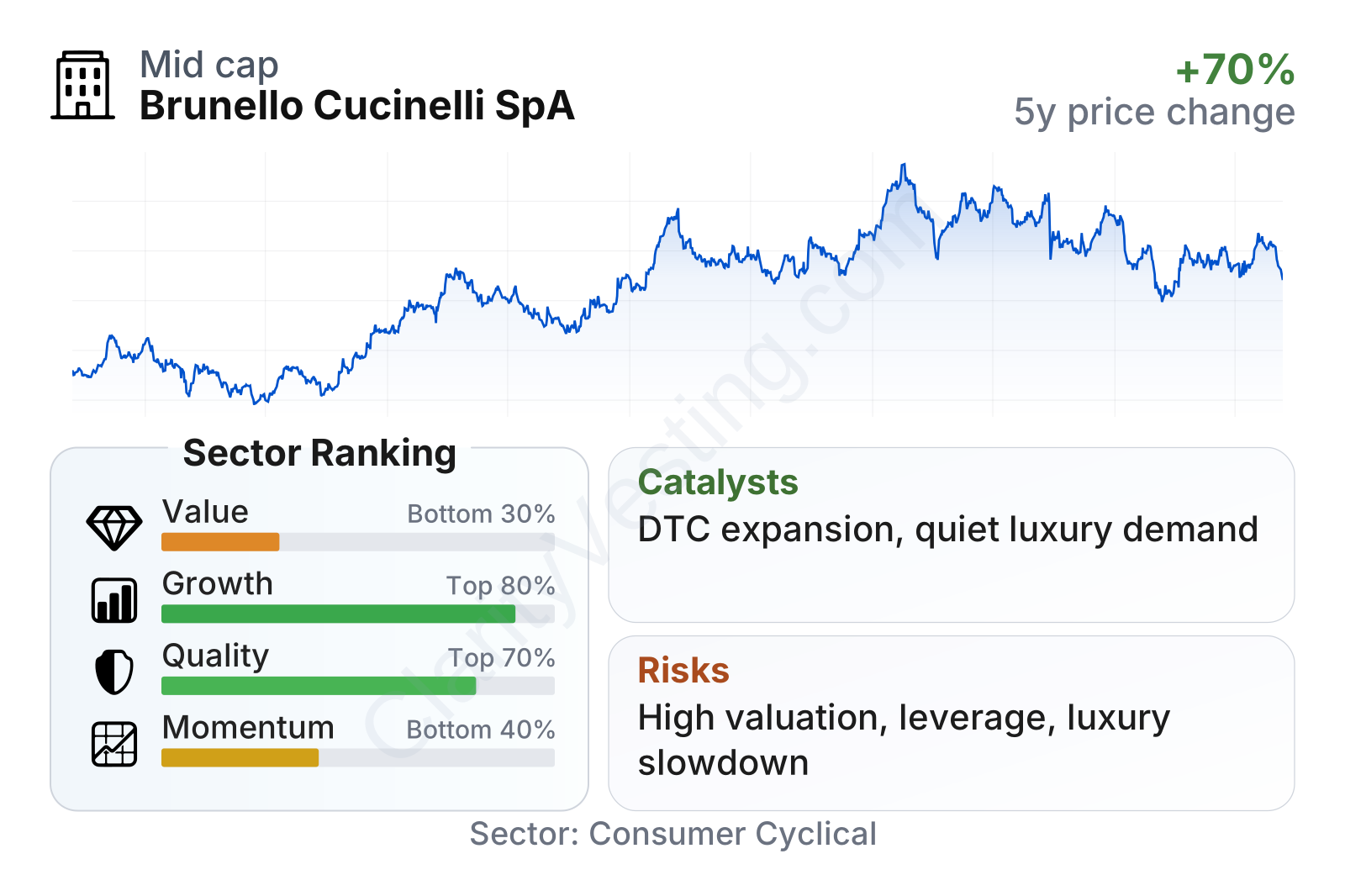
Brunello Cucinelli stands out for business quality more than for cheapness. The company’s profitability metrics are stronger than the sector median, and its multi-year growth record is also above average. Revenue per share and earnings have compounded well over five years, while operating margins have held up better than much of the broader consumer discretionary space. On the other hand, the valuation profile remains demanding, with earnings and cash flow multiples sitting above typical sector levels. Recent share-price momentum has also weakened, which helps explain why valuation has come down from earlier extremes but still does not look obviously low.
The market capitalization places the company in a mid-sized range for listed luxury businesses, and the stock’s beta below 1 suggests it has been somewhat less volatile than the broader market. That lower volatility should not be confused with low risk, however, because premium fashion names can still react sharply to changes in luxury demand, sentiment, and valuation expectations.
Growth
Brunello Cucinelli operates in an attractive part of the market: global luxury goods. Over long periods, this sector has benefited from rising wealth, premiumization, tourism, and expanding demand from high-income consumers across regions. Even when the broader apparel market becomes promotional or cyclical, top-end luxury brands often remain more resilient because their customers are less price-sensitive and because exclusivity itself is part of the product.
The company’s strategy appears coherent for long-term expansion. Management has focused on protecting brand prestige, enlarging the product offering without overextending the label, and carefully expanding the retail network. That measured approach matters. In luxury, growing too quickly can damage desirability, while growing too slowly can leave room for stronger rivals. Brunello Cucinelli has generally tried to stay in the middle: selective but ambitious.
Recent growth has been better than the sector median, and the five-year record is notably strong. That matters because it suggests the brand is not just riding a one-year trend. It has been increasing revenue consistently across multiple years while also improving its business mix. The main engine has been brand elevation combined with direct retail expansion, which usually supports both sales quality and margin discipline.
Cash generation is positive, though less impressive than the revenue trajectory. Free cash flow has remained healthy in absolute terms, but its longer-term growth has been less consistent than sales and earnings. For a luxury group, this can happen when management is investing in stores, inventory, manufacturing capacity, and brand infrastructure. That does not automatically weaken the case for future growth, but it does mean reported expansion has required real capital.
Several catalysts support the medium-term outlook. The first is continued growth in direct-to-consumer sales, which can deepen customer loyalty and improve economics over time. The second is product diversification, especially in categories that can increase wallet share without diluting the brand. The third is international expansion, particularly in regions where affluent customer bases are still developing. In public communications, the company has also emphasized long-term planning, craftsmanship, and controlled capacity growth, which fits the brand’s premium positioning.
Recent company updates have continued to point toward steady sales progression and confidence in ongoing brand demand. In a luxury sector where some names have faced more uneven trends, that relative stability is important. It suggests Brunello Cucinelli has been benefiting from a customer base that values understated luxury and timeless products rather than highly cyclical logo-driven fashion.
Risks
This article is for informational purposes only and does not constitute financial advice. Some content is AI-generated. See Disclaimer


