Stock Analysis · Brunswick Corporation (BC)
Overview
Brunswick Corporation is a marine recreation company centered on boats, marine propulsion, aftermarket parts, and connected marine technology. In simple terms, it sells products used across the boating ecosystem: complete boats, engines that power them, replacement parts and accessories, and digital systems that help owners navigate, control, and manage their vessels. Its portfolio includes well-known brands in outboard engines, boat categories, trolling motors, navigation electronics, and boat club services.
The business is mainly organized around three operating segments. Based on recent annual reporting, revenue is roughly distributed as follows:
- Propulsion – about 44% to 46%: primarily Mercury Marine outboard engines, sterndrives, inboards, propellers, engine parts, controls, and related service items. This is the company’s largest profit driver and one of its most important competitive assets.
- Engine Parts and Accessories – about 30% to 33%: aftermarket and OEM marine parts, electrical systems, trolling motors, batteries, chargers, anchors, and marine electronics sold through brands such as Navico Group. This segment gives Brunswick exposure beyond new boat sales and adds recurring replacement demand.
- Boat – about 23% to 25%: fiberglass and aluminum boats across categories such as pontoons, fishing, and cruisers, sold under brands including Boston Whaler, Sea Ray, Harris, Lund, and others.
That mix matters for long-term analysis. Brunswick is not just a boat manufacturer. A large share of its business comes from engines, parts, accessories, and systems that can be less dependent on new boat purchases than the boat segment itself. This makes the company more diversified than a pure recreational vehicle maker, even though it remains exposed to consumer spending cycles.
The company’s financial structure also shows how the business changed after the post-pandemic boom. Revenue and operating income peaked in 2022, then softened as demand normalized and dealer inventory reset. Gross profit remained sizable, but profitability narrowed sharply by 2024 and turned negative at the operating and net income level in 2025, showing how sensitive earnings are to volume in a cyclical downturn.
Over the last several years, Brunswick expanded strongly through the marine technology and components side of the business, but the earnings bridge also shows that higher costs, weaker volume, and heavier pressure below gross profit have materially reduced the cash earnings power seen at the cycle high.
Key Figures
| Metric | Value | Sector ⓘ |
|---|---|---|
| Date | Sep 12, 2026 | |
| Context | ||
| Sector | Consumer Cyclical | |
| Industry | Recreational Vehicles | |
| Market Cap ⓘ | $4.58B | |
| Beta ⓘ | 1.33 | |
Value (Cheapness) | ||
| P/E Ratio ⓘ | N/A | 17.10 |
| FCF Yield ⓘ | 7.49% | 8.53% |
| EBIT / EV ⓘ | -0.07% | 6.46% |
| PEG ⓘ | 0.72 | |
Growth (Business expansion) | ||
| Revenue Growth ⓘ | 7.70% | 5.75% |
| RPS Growth (5Y CAGR) ⓘ | 2.29% | 9.14% |
| EPS Growth (5Y CAGR) ⓘ | -34.67% | -18.21% |
| Margin Growth (5Y Trend) ⓘ | -14.17% | -0.23% |
| FCF Growth (5Y CAGR) ⓘ | 6.60% | 4.91% |
Quality (Business durability) | ||
| ROIC (Latest) ⓘ | 0.60% | 12.61% |
| ROIC (5Y Median) ⓘ | 14.39% | 10.72% |
| Net Debt / EBIT (Latest) ⓘ | N/A | 2.10 |
| Net Debt / EBIT (5Y Median) ⓘ | 2.52 | 2.32 |
| Operating Margin (Latest) ⓘ | -0.08% | 9.25% |
| Operating Margin (5Y Median) ⓘ | 11.48% | 9.64% |
| Debt to Equity (Latest) ⓘ | 140.29% | 75.78% |
| Profit Margin (Latest) ⓘ | -1.53% | 5.33% |
| Free Cash Flow (Latest) ⓘ | $343.00M | |
Momentum (Price trend) | ||
| 3Y Return ⓘ | -0.83% | +14.53% |
| 12M Return (excl. last month) ⓘ | +36.02% | +3.08% |
| 6M Return ⓘ | +3.65% | +0.55% |
| Price vs. 200-Day MA ⓘ | -9.54% | -0.54% |
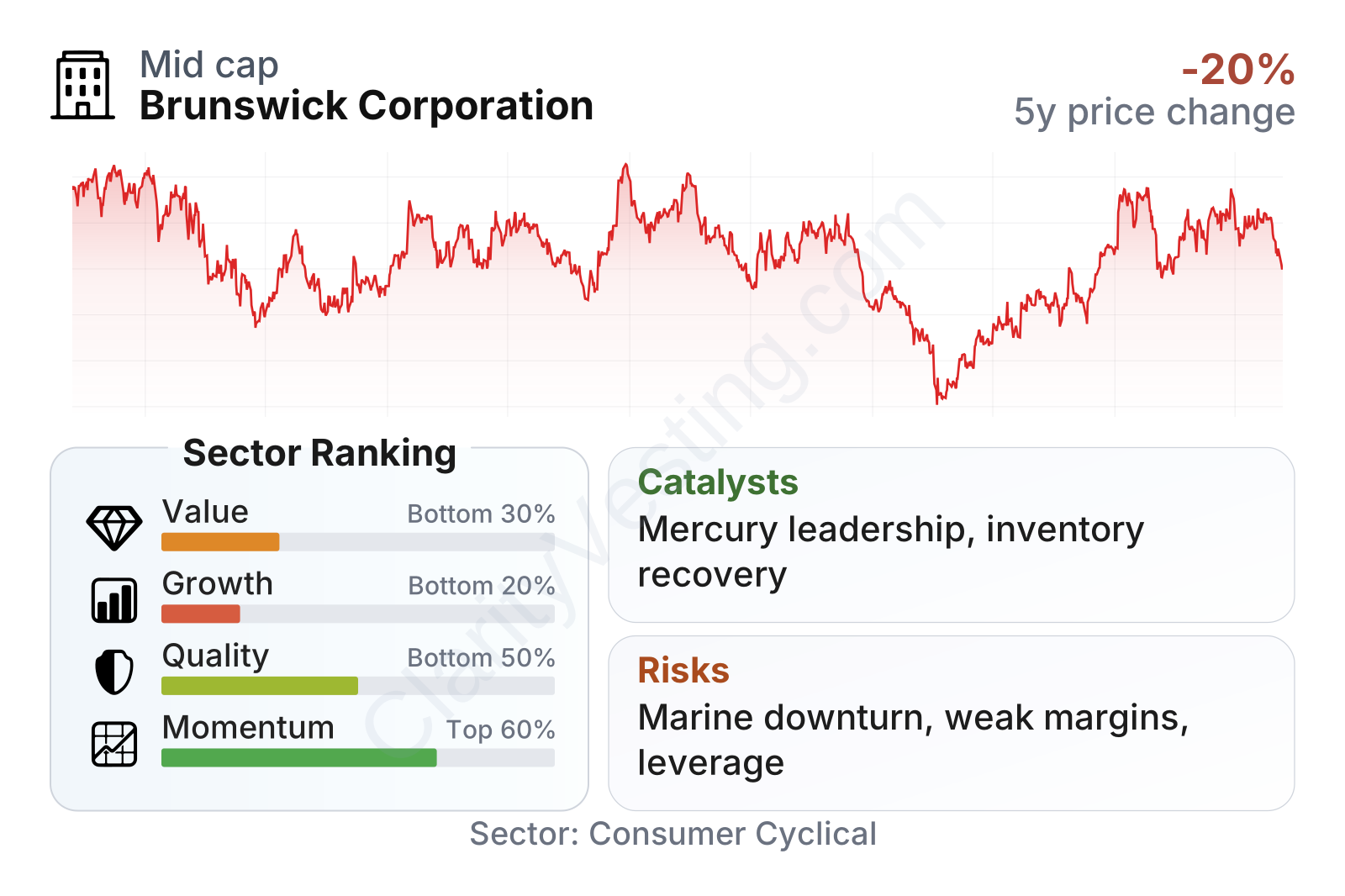
Brunswick is a mid-sized public company with a stock that has been noticeably volatile, which fits the cyclical nature of recreational marine demand. The factor summary points to a mixed profile. Value metrics do not look especially strong versus the broader sector right now, quality has weakened because recent profitability turned negative, and growth rankings are held back by the sharp drop in earnings and margin trends over the last few years. On the more positive side, recent price momentum has improved versus many peers, and free cash flow remains positive even after a difficult earnings period.
The contrast between long-term and current figures is important. Five-year median returns on invested capital and operating margin were solid, which suggests the business can be attractive in healthier demand conditions. However, the latest trailing results look much weaker, so any interpretation of the company depends heavily on whether current results reflect a temporary downturn or a more lasting reset in marine demand and margins.
Growth
Brunswick operates in a sector with attractive long-term characteristics but uneven year-to-year demand. Recreational boating benefits from large installed fleets, aging boats that require replacement parts, and a customer base that values technology, convenience, and premium products. Over time, the marine industry has also been moving toward higher-content boats, more advanced electronics, better propulsion efficiency, and connected services. Those trends support Brunswick’s strategy because it participates not only in boat sales but also in engines, controls, electronics, and aftermarket systems.
Its strategy makes industrial sense. The company has built a broader marine platform where a boat can carry a Brunswick engine, accessories, controls, batteries, navigation products, and software. That creates cross-selling opportunities and can deepen customer relationships with dealers, OEMs, and boat owners. The technology side is especially relevant because connected marine systems and power management products can add content per boat and may create stickier revenue than a one-time hardware sale alone.
Recent growth has been uneven. After very strong expansion in 2021 and 2022, revenue turned negative through much of 2023 and 2024 as the industry worked through slower retail demand and inventory adjustments. More recently, year-over-year growth turned positive again, landing in the high single digits in the latest period. That does not yet erase the prior downturn, but it does suggest the deepest part of the revenue contraction may be over.
Free cash flow has held up much better than accounting earnings. It climbed meaningfully from 2022 through 2025 and remains around the mid-hundreds of millions of dollars on a trailing basis, even after some pullback. For a cyclical manufacturer, that is an important stabilizing feature. It indicates Brunswick has still been able to convert operations into cash despite weaker margins, which can help support debt service, product development, and capital allocation flexibility.
One meaningful catalyst is the company’s emphasis on higher-value marine systems and propulsion, where product innovation matters more than simple unit volume. Another is normalization after dealer inventory reductions. If channel inventories become healthier and retail demand stabilizes, earnings can improve faster than revenue because fixed costs are already in place. Recent company updates in 2026 have also pointed to ongoing operational actions, portfolio discipline, and cost controls meant to protect profitability while positioning the business for an eventual industry rebound.
Risks
This article is for informational purposes only and does not constitute financial advice. Some content is AI-generated. See Disclaimer


