Stock Analysis · Bath & Body Works Inc (BBWI)
Stock Analysis · Bath & Body Works Inc (BBWI)

Overview

Bath & Body Works is a specialty retailer centered on personal care, home fragrance, and soap and sanitizer products. Its best-known categories include fine fragrance mists, body lotion, shower gel, candles, wallflower refills, hand soap, and seasonal gift sets. The company sells primarily through its own retail stores and digital channels, using a brand identity built around frequent product launches, holiday collections, and a strong loyalty-driven repeat purchase model.

The business is much more focused than many broad retailers. Rather than competing across dozens of merchandise categories, Bath & Body Works concentrates on fragrance-led self-care and home scent products where branding, gifting, and customer habit matter. That focus has helped the company maintain relatively strong margins compared with much of specialty retail, even while overall sales have recently been fairly flat to slightly down.

Revenue is mostly generated from a few core product families and from direct sales through company-operated channels. Based on company disclosures and category emphasis, the mix is broadly concentrated as follows:

  • Body care and fragrance: roughly the largest revenue source, likely around 40% to 50% of sales.
  • Home fragrance: candles, wallflowers, and related items, likely around 25% to 35%.
  • Soaps and sanitizers: hand soaps, sanitizers, and adjacent products, likely around 10% to 20%.
  • Other and accessories: gift sets, holders, accessories, and miscellaneous items, a smaller share.

The company’s sales are also heavily concentrated in North America, with the U.S. as the core market. Distribution is primarily split between physical stores and e-commerce, with stores still representing the larger portion of the business. One notable trend in the financial flow over the last several years is that revenue has drifted down from its post-pandemic peak, while gross profit has stayed comparatively resilient. At the same time, operating income has compressed as expenses have absorbed more of the sales base, which helps explain why the market has become more cautious despite the company still producing meaningful cash flow.

Key Figures

MetricValueSector
DateJul 18, 2026
Context
SectorConsumer Cyclical
IndustrySpecialty Retail
Market Cap $4.26B
Beta 1.35
Value
(Cheapness)
P/E Ratio 6.0018.58
FCF Yield 21.35%7.99%
EBIT / EV 14.58%5.91%
PEG 0.80
Growth
(Business expansion)
Revenue Growth -3.20%5.50%
RPS Growth (5Y CAGR) 4.52%9.20%
EPS Growth (5Y CAGR) -51.82%-26.43%
Margin Growth (5Y Trend) -7.09%-0.18%
FCF Growth (5Y CAGR) -8.28%5.02%
Quality
(Business durability)
ROIC (Latest) 39.09%12.03%
ROIC (5Y Median) 30.82%10.82%
Net Debt / EBIT (Latest) 3.312.12
Net Debt / EBIT (5Y Median) 3.292.25
Operating Margin (Latest) 16.22%9.28%
Operating Margin (5Y Median) 18.39%9.64%
Debt to Equity (Latest) -415.98%75.23%
Profit Margin (Latest) 10.04%5.28%
Free Cash Flow (Latest) $909.00M
Momentum
(Price trend)
3Y Return -36.25%+10.68%
12M Return (excl. last month) -21.50%+5.26%
6M Return -9.05%-2.41%
Price vs. 200-Day MA +1.21%+1.55%
Better than sector median
Slightly worse than sector median
More than 20% worse than sector median

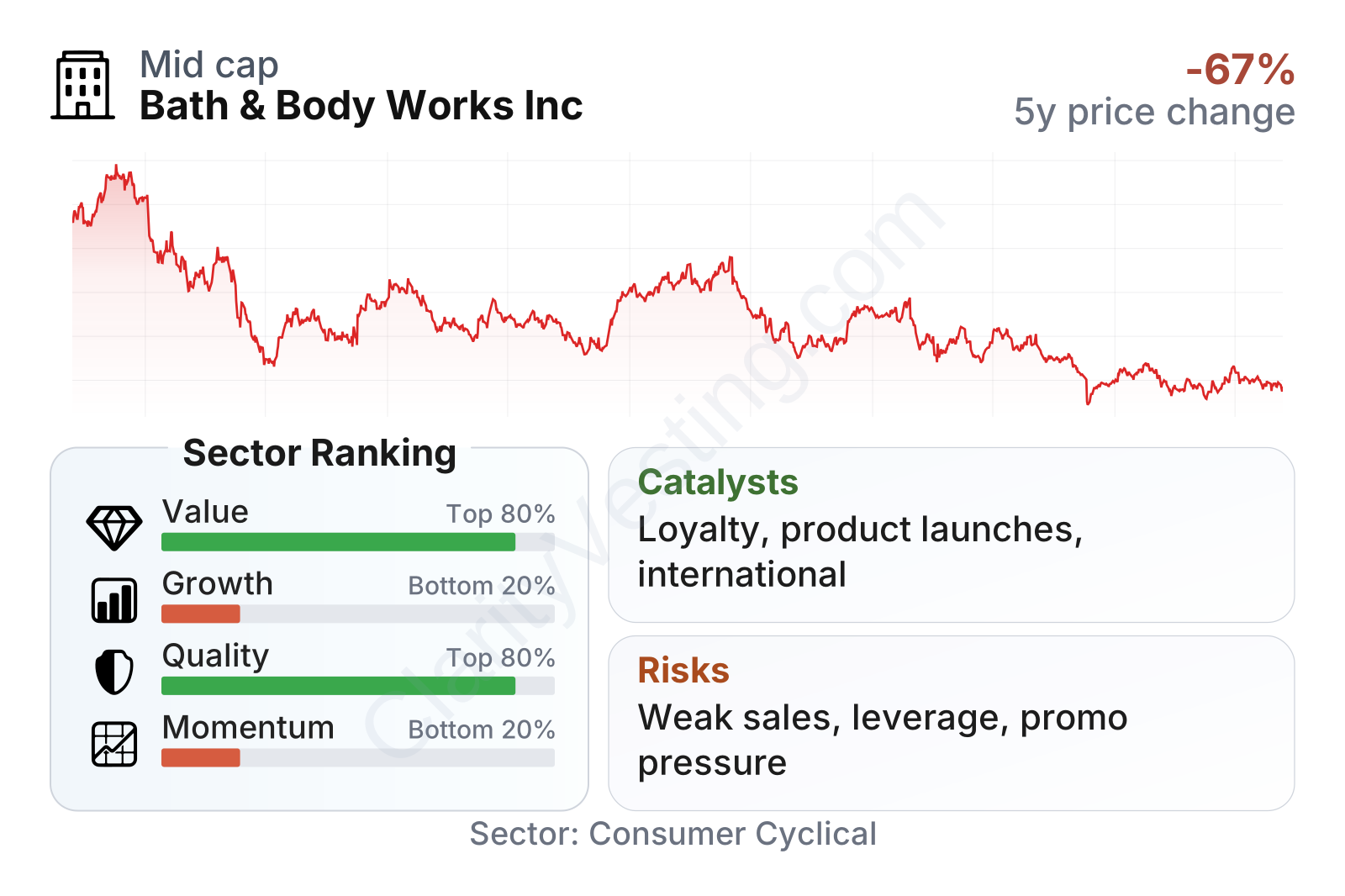
Bath & Body Works stands out as a smaller large-brand retailer, with a market value around the low single-digit billions and a stock that has been more volatile than the broader market. The most striking contrast in the current profile is between quality and growth. Profitability and returns on invested capital remain well above many peers in consumer retail, while recent revenue and earnings growth rank near the bottom of the sector. The value profile looks unusually strong, with a very low earnings multiple and a free cash flow yield far above the sector median, but weak share-price momentum shows that the market is discounting the possibility that current earnings power may be difficult to expand.

Growth

Bath & Body Works operates in a category that is not a high-growth frontier, but it is still supported by durable demand drivers. Fragrance, self-care, gifting, and home ambiance have proven resilient because they sit in an affordable “small indulgence” space. That makes the sector more stable than many discretionary categories, even if it does not deliver rapid structural expansion.

The company’s challenge is less about whether the category exists and more about whether it can restart consistent same-store sales and digital growth. Management has been focusing on product innovation, loyalty engagement, store optimization, and a broader fragrance push. Those priorities make strategic sense because Bath & Body Works already has a recognizable brand, a large store footprint, and repeat-purchase behavior. If execution improves, growth does not need to be dramatic to support better operating performance.

Recent revenue trends still show a business that has struggled to put together sustained top-line acceleration. Over the last several years, year-over-year sales changes have often been slightly negative, with only brief returns to modest growth. That places the company behind the median consumer cyclical name on growth and suggests that the brand has been defending its position more than expanding it.

Even so, free cash flow has improved from the recent low point and has recovered back toward the upper hundreds of millions of dollars over the trailing twelve months. That matters because it shows the business can still translate sales into cash at a meaningful rate despite sluggish revenue. In a mature retail model, steady cash generation can be an important internal growth engine, funding store updates, technology, debt service, and shareholder returns without requiring aggressive expansion.

A notable catalyst in the current period is the company’s effort to strengthen category relevance through new product launches and broader fragrance positioning, including premium and cross-category scent extensions. Another helpful factor is international development through licensing and partnerships, which offers a way to extend the brand with less capital intensity than building a large owned-store network abroad. Recent company communications have also emphasized operational discipline and inventory management, which can support margins if demand remains uneven.

Risks

The main risk is that Bath & Body Works may remain a strong brand in a business that is no longer growing much. The company’s categories are popular, but they are also easy to shop around in, highly promotional, and sensitive to consumer mood. If customers pull back on discretionary purchases, trade down, or reduce seasonal buying, revenue can soften quickly.

Competition is intense. The company has a leadership position in specialty body care and home fragrance in North America, but it does not operate in a vacuum. Its main rivals include mass retailers such as Walmart and Target, beauty specialists such as Ulta Beauty and Sephora, e-commerce platforms led by Amazon, and branded consumer goods groups including The Estée Lauder Companies, Coty, and L’Oréal in adjacent fragrance and personal care segments. It also faces niche and fast-moving fragrance brands that can capture trend-driven demand. Bath & Body Works is strongest where assortment breadth, seasonality, and store experience matter, but weaker where scale price competition or prestige beauty positioning dominates.

The company does have competitive advantages. Brand recognition is high, gifting behavior is entrenched, and its merchandising calendar creates repeat store visits. It also earns margins above much of retail, which suggests real pricing power and efficient category management. However, those advantages are not unassailable enough to guarantee steady growth, especially when promotional pressure rises.

Leverage is another area that deserves attention, although the headline debt-to-equity figure is distorted by negative book equity and should not be read in the usual way. A more useful measure is net debt relative to EBIT, which sits above the sector median and points to a balance sheet that carries meaningful financial obligations. The debt burden is not extreme for a cash-generative retailer, but it reduces flexibility if operating results weaken for an extended period.

Profit margin trends show both strength and pressure. The company still earns around a 10% net margin, which is comfortably above the sector median, but profitability has come down from earlier peaks. That pattern is important: Bath & Body Works remains more profitable than many peers, yet the direction has been less favorable. If costs continue rising faster than sales, margins could narrow further.

Other risks include product concentration, dependence on holiday and promotional periods, sourcing and tariff exposure, and reputational sensitivity around product safety or marketing missteps. No major scandal appears to define the current situation, but the broader operational risk is clear: in a focused consumer brand, execution errors tend to show up quickly in traffic, inventory balance, and markdown intensity.

Valuation

Bath & Body Works currently trades at a notably low earnings multiple relative to the sector, and that discount has persisted for some time rather than appearing as a brief anomaly.

On headline valuation, the stock looks inexpensive. Its P/E is far below the sector median, and the free cash flow yield is unusually high. On a purely numerical basis, the market is assigning a low price to a business that still posts above-average margins and strong returns on invested capital.

The reason for that discount is visible in the operating backdrop. Revenue growth has been weak, earnings have come off prior highs, leverage is above average, and recent stock performance has been poor. In other words, the low valuation does not reflect a broken business so much as a market that doubts the durability of current profitability and the path back to growth.

That makes the valuation context fairly straightforward: the present price implies skepticism, but not without basis. If margins stabilize and sales return to even modest, consistent growth, the current multiple looks compressed compared with the company’s cash generation. If sales remain flat to negative and margins keep slipping, the discount becomes easier to justify. The stock therefore sits in a zone where valuation appears cheap relative to present earnings, but more debatable relative to the quality of future growth.

Conclusion

Bath & Body Works remains a recognizable specialty retail brand with real economic strengths: high returns on capital, solid margins versus peers, and a demonstrated ability to produce substantial free cash flow. Those are meaningful qualities in a consumer business, especially one built on repeat purchases, gifting occasions, and a distinct product niche.

The difficulty is that the company currently looks stronger in profitability than in expansion. Sales growth has been inconsistent, earnings power has softened from earlier levels, and leverage limits some room for error. That combination helps explain why the stock trades at such a low earnings multiple despite still respectable operating performance.

Overall, Bath & Body Works appears less like a broad growth retailer and more like a mature branded cash generator trying to prove that its best days are not entirely behind it. The financial profile remains sturdier than the share-price trend suggests, but the central question is whether management can convert brand strength and category relevance into renewed top-line momentum before margin pressure becomes the more important narrative.

Sources:

  • Bath & Body Works, Inc. — Annual Report on Form 10-K for fiscal year ended February 1, 2025
  • Bath & Body Works, Inc. — Quarterly Report on Form 10-Q for the quarter ended May 3, 2025
  • Bath & Body Works, Inc. — Quarterly Report on Form 10-Q for the quarter ended August 2, 2025
  • Bath & Body Works, Inc. — Quarterly Report on Form 10-Q for the quarter ended November 1, 2025
  • Bath & Body Works Investor Relations — earnings releases and investor presentations published in 2025 and 2026
  • SEC EDGAR — Bath & Body Works, Inc. filings database
  • Bath & Body Works Investor Relations — company overview and brand information
  • Wikipedia — Bath & Body Works

This article is for informational purposes only and does not constitute financial advice. Some content is AI-generated. See Disclaimer
Sign up for exclusive research and insights.

Unsubscribe anytime.