Stock Analysis · BigBearai Holdings Inc (BBAI)
Overview
BigBear.ai Holdings Inc. is a small technology company focused on artificial intelligence, data analytics, and decision-support software for organizations that handle complex operations. Its work is concentrated in government and defense, but it also serves customers in areas such as logistics, manufacturing, travel, and critical infrastructure. In simple terms, the company helps clients combine large amounts of information, turn it into usable insights, and support faster operational decisions.
Its business is built around AI-enabled software, analytics services, and engineering work delivered through contracts. BigBear.ai has emphasized national security, border security, autonomous systems, and operational intelligence as key themes. The company has also highlighted offerings such as computer vision, predictive analytics, digital identity, and mission-focused software platforms.
Based on the company’s recent annual reporting structure, revenue is mainly organized in one operating business rather than a large number of separately disclosed segments. That makes precise source percentages limited, but the main revenue streams can still be described as follows:
- Government and defense contracts: the largest source of revenue. This includes analytics, AI applications, cyber-related work, mission support, logistics, and intelligence-focused solutions for U.S. federal agencies and defense customers.
- Commercial and other enterprise work: a smaller source of revenue. This includes AI and analytics tools for supply chains, operations, asset monitoring, identity, and process optimization.
- Services and implementation: an important part of delivery. This covers engineering, integration, consulting, and support tied to customer deployments.
- Software and platform-related revenue: a smaller but strategically important layer. This includes proprietary tools and recurring software-based offerings, although the company still appears more services-heavy than a pure software vendor.
For long-term analysis, the key point is that BigBear.ai operates in an attractive theme, but its revenue mix still looks more contract-driven and less scalable than the largest AI software companies. The business has shown modest top-line expansion over time, while profitability has remained weak.
The cost structure shows a recurring pattern: revenue has stayed in a relatively narrow range for several years, while gross profit has been inconsistent and operating expenses have often consumed more than the company generates. Selling, general, and administrative costs have remained a major burden, and losses widened sharply in 2024 and 2025 even before the business returned to better year-over-year growth in mid-2026.
Key Figures
| Metric | Value | Sector ⓘ |
|---|---|---|
| Date | Sep 12, 2026 | |
| Context | ||
| Sector | Technology | |
| Industry | Information Technology Services | |
| Market Cap ⓘ | $1.35B | |
| Beta ⓘ | 3.18 | |
Value (Cheapness) | ||
| P/E Ratio ⓘ | N/A | 29.51 |
| FCF Yield ⓘ | -5.46% | 4.25% |
| EBIT / EV ⓘ | -7.23% | 2.85% |
| PEG ⓘ | N/A | |
Growth (Business expansion) | ||
| Revenue Growth ⓘ | 13.20% | 15.40% |
| RPS Growth (5Y CAGR) ⓘ | -28.49% | 8.56% |
| EPS Growth (5Y CAGR) ⓘ | -26.52% | -11.88% |
| Margin Growth (5Y Trend) ⓘ | N/A | 0.46% |
| FCF Growth (5Y CAGR) ⓘ | N/A | 9.80% |
Quality (Business durability) | ||
| ROIC (Latest) ⓘ | -7.70% | 9.44% |
| ROIC (5Y Median) ⓘ | -23.35% | 8.30% |
| Net Debt / EBIT (Latest) ⓘ | N/A | 0.54 |
| Net Debt / EBIT (5Y Median) ⓘ | N/A | 0.44 |
| Operating Margin (Latest) ⓘ | -58.22% | 9.58% |
| Operating Margin (5Y Median) ⓘ | -53.90% | 8.25% |
| Debt to Equity (Latest) ⓘ | 2.95% | 33.33% |
| Profit Margin (Latest) ⓘ | -65.20% | 7.14% |
| Free Cash Flow (Latest) ⓘ | -$73.84M | |
Momentum (Price trend) | ||
| 3Y Return ⓘ | +67.84% | +45.48% |
| 12M Return (excl. last month) ⓘ | -45.39% | +23.48% |
| 6M Return ⓘ | -28.78% | +20.93% |
| Price vs. 200-Day MA ⓘ | -32.27% | +7.43% |
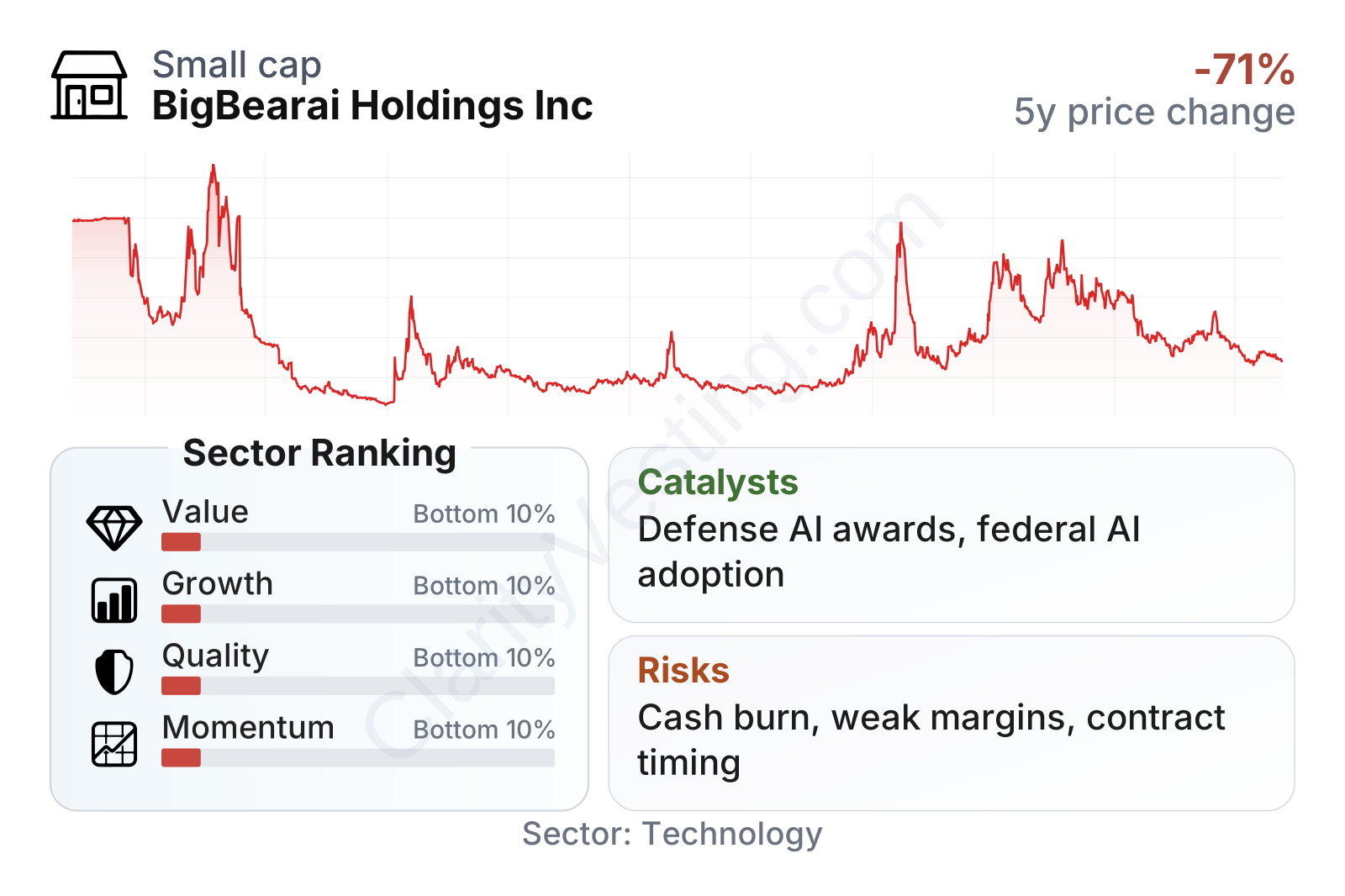
The overall profile remains weak relative to most technology peers. Value metrics rank near the bottom because earnings and free cash flow are negative, quality is held back by deeply negative margins and returns on capital, and growth is below the sector median despite a recent rebound. Balance-sheet leverage is one area that now looks better, with debt to equity close to 3% versus roughly 30% for the sector median. The stock has also been highly volatile, with a beta above 3 and recent price momentum far below the broader technology group.
The share-price history reflects a company that has gone through repeated re-rating cycles rather than steady compounding. The stock moved from much higher levels after its public listing to a long period of weakness, followed by sharp rebounds and pullbacks. That pattern usually signals a business where expectations are driven more by contract wins, AI enthusiasm, and financing concerns than by stable earnings power.
Growth
BigBear.ai operates in a sector with genuine long-term expansion potential. Artificial intelligence, automation, computer vision, and data-driven decision systems are all areas expected to grow over the coming years, especially in defense, intelligence, border technology, and industrial operations. Governments and large organizations increasingly want software that can process fragmented information quickly and support real-time action. That broader backdrop is favorable.
The company’s strategy also makes sense on paper. Rather than competing head-on with hyperscale cloud providers in general-purpose AI, BigBear.ai is trying to position itself in specialized, mission-critical use cases where domain expertise matters. That can be a sensible approach for a smaller company because it reduces direct exposure to the largest platform players and plays to procurement-heavy markets where relationships and certifications matter.
Revenue growth, however, has not been consistently strong. The record shows alternating periods of expansion and contraction, which is common for businesses tied to contract timing and government awards. The latest year-over-year pace has improved back into the low-teens range, close to but still slightly below the sector median. That is encouraging, but it does not yet establish a durable high-growth pattern.
Cash generation remains a major issue. Free cash flow has stayed negative for years and has recently deteriorated again, which matters because long-term growth is much more valuable when it starts translating into self-funded operations. Until cash burn improves meaningfully, revenue growth alone does not fully change the financial picture.
A major catalyst for the company is the continued modernization of U.S. defense and homeland security systems. BigBear.ai has publicly emphasized work connected to national security, digital identity, computer vision, and autonomous or mission-support applications. If federal agencies keep accelerating AI adoption, smaller specialists with existing procurement relationships can still find room to expand.
Another important catalyst is contract momentum. For a company of this size, a few meaningful awards, renewals, or task orders can noticeably affect growth visibility. Recent company communications have continued to highlight new awards and partnerships tied to government and operational AI programs. That does not remove execution risk, but it reinforces that demand for its niche capabilities remains real.
Risks
This article is for informational purposes only and does not constitute financial advice. Some content is AI-generated. See Disclaimer


