Stock Analysis · BlackBerry Ltd (BB)
Overview
BlackBerry Ltd is no longer the smartphone company many people remember. Today, it is a software company focused mainly on secure communications, endpoint security, and software used in embedded systems, especially in vehicles and other mission-critical devices. Its business has been reshaped over the past several years, with management narrowing the company around cybersecurity and the QNX operating system, which is widely used in automotive and industrial applications where reliability matters more than consumer-facing features.
The company’s revenue is mainly generated from subscription and licensing-type software activities rather than hardware. Based on recent company reporting, the business is centered around two main operating segments, with a smaller contribution from legacy and licensing activities.
- Secure Communications: roughly half of revenue. This includes cybersecurity products, secure productivity software, and related services for enterprises and governments.
- QNX: roughly 40% to 45% of revenue. This segment provides embedded software and platforms used in cars, industrial systems, medical devices, and other connected equipment.
- Licensing and other: a smaller residual share, generally in the low-to-mid single digits depending on the period.
What stands out in the current business mix is that BlackBerry has become much more dependent on software that supports regulated, safety-focused, and security-sensitive environments. That makes the company more specialized than many broad software vendors, but it also means growth depends on execution in narrower markets rather than on mass-market consumer demand.
The longer-term financial picture also shows a business that has been through a difficult transition. Revenue has moved around meaningfully in recent years, but the cost structure has become leaner. Gross profit remains sizable relative to sales, and operating income turned positive again in the latest fiscal year, suggesting that restructuring efforts are starting to show up in results.
Over the last several fiscal years, BlackBerry’s revenue base has been uneven, but profitability has improved materially. Operating expenses have come down from earlier peaks, while research and development has remained meaningful, reflecting the company’s need to keep investing in specialized software. The most notable recent shift is the return to positive operating income and net income after a period of losses.
Key Figures
| Metric | Value | Sector ⓘ |
|---|---|---|
| Date | Sep 12, 2026 | |
| Context | ||
| Sector | Technology | |
| Industry | Software - Infrastructure | |
| Market Cap ⓘ | $4.47B | |
| Beta ⓘ | 1.44 | |
Value (Cheapness) | ||
| P/E Ratio ⓘ | 76.25 | 29.51 |
| FCF Yield ⓘ | 1.48% | 4.25% |
| EBIT / EV ⓘ | 1.81% | 2.85% |
| PEG ⓘ | 1.47 | |
Growth (Business expansion) | ||
| Revenue Growth ⓘ | 25.60% | 15.40% |
| RPS Growth (5Y CAGR) ⓘ | -5.19% | 8.56% |
| EPS Growth (5Y CAGR) ⓘ | N/A | -11.88% |
| Margin Growth (5Y Trend) ⓘ | 41.64% | 0.46% |
| FCF Growth (5Y CAGR) ⓘ | N/A | 9.80% |
Quality (Business durability) | ||
| ROIC (Latest) ⓘ | 7.35% | 9.44% |
| ROIC (5Y Median) ⓘ | -1.54% | 8.30% |
| Net Debt / EBIT (Latest) ⓘ | -0.63 | 0.54 |
| Net Debt / EBIT (5Y Median) ⓘ | -0.91 | 0.44 |
| Operating Margin (Latest) ⓘ | 13.73% | 9.58% |
| Operating Margin (5Y Median) ⓘ | 2.71% | 8.25% |
| Debt to Equity (Latest) ⓘ | 29.45% | 33.33% |
| Profit Margin (Latest) ⓘ | 10.31% | 7.14% |
| Free Cash Flow (Latest) ⓘ | $66.31M | |
Momentum (Price trend) | ||
| 3Y Return ⓘ | +44.17% | +45.48% |
| 12M Return (excl. last month) ⓘ | +138.96% | +23.48% |
| 6M Return ⓘ | +124.27% | +20.93% |
| Price vs. 200-Day MA ⓘ | +26.58% | +7.43% |
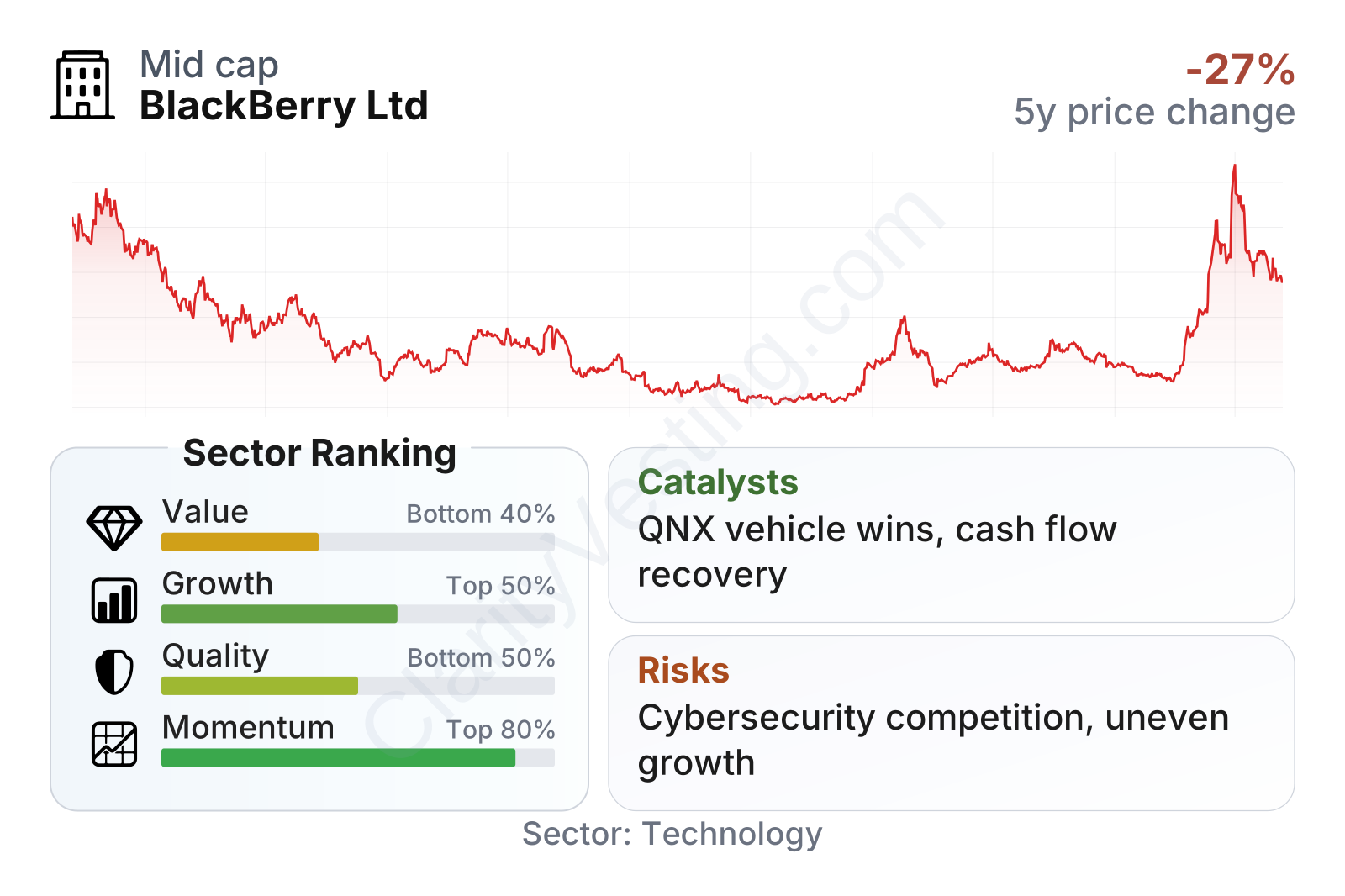
BlackBerry currently sits in an unusual position. Its market value is in the mid-single-digit billions, making it a much smaller player than the largest infrastructure software companies. The table points to a mixed profile: growth and price momentum rank relatively well versus the broader technology sector, while value and quality are less convincing. The balance sheet is a bright spot, with very low debt relative to equity and net cash characteristics, but returns on invested capital still trail stronger software peers. In short, the company looks financially safer than before, yet still not fully mature in its turnaround.
The stock chart also reflects this transition. After a steep decline from 2021 into 2024, the shares stabilized and then recovered somewhat, but they remain far below earlier levels. That pattern usually signals that the market has become more open to the turnaround, while still reserving judgment on whether BlackBerry can deliver sustained growth.
Growth
BlackBerry operates in sectors that have real long-term demand behind them. Cybersecurity remains a structural growth market because companies, governments, and operators of critical systems need better protection as devices and networks become more connected. Embedded software for vehicles and industrial systems also has favorable tailwinds. Modern cars increasingly depend on software for infotainment, safety, telematics, and advanced driver assistance, and QNX is already present in a large installed base of vehicles.
The strategic logic therefore makes sense. BlackBerry is focusing on areas where security, certification, and reliability are hard to replicate quickly. In QNX especially, design wins can create long revenue tails because software chosen early in a vehicle platform may remain embedded for years. That can make the business slower-moving than consumer tech, but also potentially more durable once contracts are in place.
Recent revenue growth has improved after several weak periods. The latest year-over-year growth rate moved clearly back into positive territory and now sits above the sector median. That is encouraging, but it should be read in context: BlackBerry’s five-year revenue trend still reflects a business that has been shrinking overall. The current rebound is important because it suggests the company may be moving from restructuring mode toward a more stable operating phase, yet it still needs to prove that growth can persist across multiple reporting periods.
Cash generation has also turned in a better direction. Free cash flow was negative for several years, then crossed back into positive territory and has continued improving. That matters because for a company rebuilding credibility, positive cash flow is often more persuasive than accounting profit alone. It suggests BlackBerry’s recent progress is not only about cost cutting on paper, but also about better business quality.
Recent company communications have highlighted continued traction in QNX, including progress tied to automotive software development and broader embedded use cases. The company has also emphasized secure communications offerings designed for regulated organizations and government-grade environments. The most meaningful catalyst is not one product launch alone, but the combination of a large installed QNX base, software-defined vehicle trends, and a cleaner financial profile that gives management more room to execute.
Risks
This article is for informational purposes only and does not constitute financial advice. Some content is AI-generated. See Disclaimer