Stock Analysis · Bandwidth Inc (BAND)
Overview
Bandwidth Inc. is a cloud communications infrastructure company. In simple terms, it provides the software connections and telecom network services that let businesses embed phone calls, text messaging, emergency calling, and authentication into their own apps and customer workflows. Its customers are typically software companies, enterprises, and communications platforms that want to control communications inside their products rather than rely only on traditional phone carriers.
The business sits in a part of the market often called CPaaS, or communications platform as a service, but Bandwidth is more infrastructure-heavy than many software peers because it also operates parts of the underlying voice network. That matters because it gives the company more control over service quality, routing, and pricing, but it also makes the business more operationally complex and lower-margin than pure software companies.
Based on company filings, revenue is mainly generated from communications services delivered over Bandwidth’s platform and network. The broad revenue mix can be summarized as follows:
- Messaging services: approximately 45% to 55% of revenue. This includes application-to-person text messaging, one-time passcodes, alerts, and other business messaging traffic.
- Voice services: approximately 35% to 45% of revenue. This includes inbound and outbound calling, phone number usage, call routing, and related voice connectivity.
- Other communications services: approximately 5% to 15% of revenue. This generally includes emergency services, toll-free and local number products, and other platform-related communications capabilities.
Over the last several years, revenue has grown meaningfully, from roughly $491 million in 2021 to about $754 million in 2025. At the same time, the cost structure shows a business with a large direct network and service delivery expense base: gross profit rose from about $219 million to roughly $295 million over that period, while research and development spending also increased steadily as the company invested in its platform.
The overall picture is of a mid-sized communications infrastructure provider that has expanded revenue and gross profit, but still converts only a small portion of that activity into bottom-line earnings. The key long-term question is whether scale and product depth can turn that larger revenue base into more durable profitability.
Key Figures
| Metric | Value | Sector ⓘ |
|---|---|---|
| Date | Sep 12, 2026 | |
| Context | ||
| Sector | Technology | |
| Industry | Software - Infrastructure | |
| Market Cap ⓘ | $1.79B | |
| Beta ⓘ | 3.03 | |
Value (Cheapness) | ||
| P/E Ratio ⓘ | N/A | 29.51 |
| FCF Yield ⓘ | 4.06% | 4.25% |
| EBIT / EV ⓘ | -0.54% | 2.85% |
| PEG ⓘ | N/A | |
Growth (Business expansion) | ||
| Revenue Growth ⓘ | 22.20% | 15.40% |
| RPS Growth (5Y CAGR) ⓘ | 6.46% | 8.56% |
| EPS Growth (5Y CAGR) ⓘ | -7.39% | -11.88% |
| Margin Growth (5Y Trend) ⓘ | N/A | 0.46% |
| FCF Growth (5Y CAGR) ⓘ | N/A | 9.80% |
Quality (Business durability) | ||
| ROIC (Latest) ⓘ | -1.89% | 9.44% |
| ROIC (5Y Median) ⓘ | -0.84% | 8.30% |
| Net Debt / EBIT (Latest) ⓘ | N/A | 0.54 |
| Net Debt / EBIT (5Y Median) ⓘ | N/A | 0.44 |
| Operating Margin (Latest) ⓘ | -1.33% | 9.58% |
| Operating Margin (5Y Median) ⓘ | -0.95% | 8.25% |
| Debt to Equity (Latest) ⓘ | 146.61% | 33.33% |
| Profit Margin (Latest) ⓘ | 0.27% | 7.14% |
| Free Cash Flow (Latest) ⓘ | $72.51M | |
Momentum (Price trend) | ||
| 3Y Return ⓘ | +319.70% | +45.48% |
| 12M Return (excl. last month) ⓘ | +277.41% | +23.48% |
| 6M Return ⓘ | +270.97% | +20.93% |
| Price vs. 200-Day MA ⓘ | +65.42% | +7.43% |
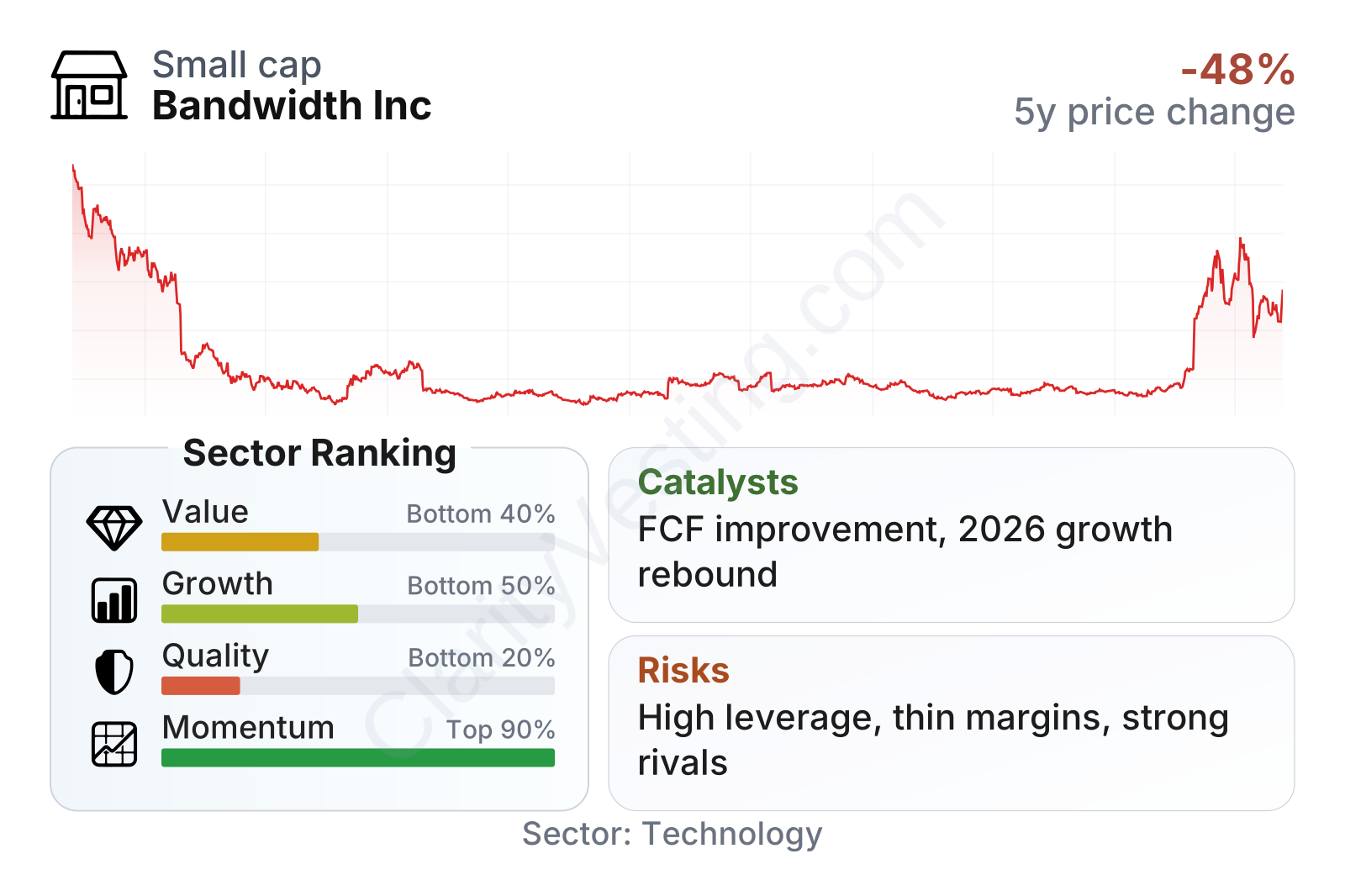
Bandwidth stands out for strong recent revenue momentum and unusually strong share-price performance versus the broader software infrastructure group. However, the table also points to weaker business quality metrics than many sector peers, with returns on capital still negative, operating margins still below industry norms, and leverage noticeably higher than the sector median. In other words, the market has recently rewarded improving business trends, but the financial profile still looks like a company in transition rather than a fully mature, high-margin software operator.
The stock’s history has been volatile. After trading above $120 in 2021, it fell sharply during the 2022–2023 reset in growth stocks and then rebounded dramatically by mid-2026. That kind of move fits a company whose outlook can change quickly when investors see evidence of either renewed growth or improving profitability. The beta around 3 also signals that the shares have tended to move much more aggressively than the broader market.
Growth
Bandwidth operates in a sector with durable long-term demand drivers. Businesses increasingly want communications features built directly into software, customer support tools, identity verification flows, and automated notifications. That supports ongoing demand for messaging APIs, voice connectivity, number management, and emergency communications. The rise of digital customer engagement and the use of one-time password messaging for account security also continue to support usage growth.
The company’s strategy is logical for that environment. Instead of being only a software layer, Bandwidth combines APIs with ownership and operation of network assets. This can help it serve larger customers that want reliability, regulatory compliance, direct carrier relationships, and better economics at scale. It also puts Bandwidth in a useful position with enterprises and software platforms that want fewer intermediaries in communications delivery.
Growth has not been perfectly smooth, but the recent trend improved materially. Revenue growth slowed in 2023, accelerated through much of 2024, weakened again in late 2025, and then re-accelerated to roughly 20% to 22% in the first half of 2026. That latest pace is above the sector median shown in the metrics table, suggesting that current operating momentum is stronger than what investors often associate with a telecom-infrastructure hybrid business.
Another positive sign is cash generation. Free cash flow moved from negative territory in 2022 and 2023 to clearly positive levels in 2024, 2025, and 2026, reaching roughly $70 million to $80 million on a trailing basis. That matters because it suggests the business is not only growing revenue but doing so with improving financial discipline. For a company that has spent years balancing expansion with cost control, that shift is one of the more important long-term developments.
A notable catalyst is Bandwidth’s exposure to large-scale messaging and voice traffic from software platforms and enterprise customers. If enterprise digital communications, authentication messaging, and AI-enabled customer service workflows continue to expand, Bandwidth can benefit from higher usage over its existing platform. Recent company communications have also emphasized execution around enterprise demand, product innovation, and efficiency, which aligns with the recent improvement in revenue growth and free cash flow.
Risks
This article is for informational purposes only and does not constitute financial advice. Some content is AI-generated. See Disclaimer


