Stock Analysis · Ball Corporation (BALL)
Overview
Ball Corporation is a global packaging company best known for making aluminum beverage cans and related packaging. The company supplies major drink categories such as beer, soft drinks, energy drinks, sparkling water, and other ready-to-drink beverages. Ball also produces aluminum aerosol containers and extruded aluminum packaging for personal care, household, and other consumer products. After reshaping its portfolio in recent years, Ball is now much more focused on metal packaging, especially beverage cans.
That focus matters because beverage cans are a large-scale, repeat-purchase business. Demand does not depend on a single product cycle or a one-time sale. Instead, Ball sells into high-volume consumer categories where customers need constant replenishment. This creates a business model tied to long production runs, customer contracts, global manufacturing networks, and close relationships with major beverage brands.
Based on the company’s recent reporting structure, Ball’s revenue sources are concentrated in a few operating segments.
- Beverage packaging, North and Central America: approximately 45% to 50% of revenue. This includes aluminum cans and ends sold to beverage customers across the region.
- Beverage packaging, EMEA: approximately 20% to 25% of revenue. This covers Europe, the Middle East, and Africa, where Ball serves multinational and regional beverage producers.
- Beverage packaging, South America: approximately 15% to 20% of revenue. This business benefits from can adoption trends and local beverage demand.
- Beverage packaging, Asia Pacific: approximately 5% to 10% of revenue. This segment is smaller, but it gives Ball exposure to expanding beverage markets.
- Aerosol and aluminum packaging: approximately 5% to 10% of revenue. This includes packaging for personal care, household, and other specialty applications.
Recent years show a business that has become simpler but also more concentrated. Revenue stepped down after portfolio changes, yet operating income recovered strongly in 2025. At the same time, the path from revenue to net income has been uneven because one-time items and changing financing costs have had a noticeable impact on reported earnings.
Key Figures
| Metric | Value | Sector ⓘ |
|---|---|---|
| Date | Sep 12, 2026 | |
| Context | ||
| Sector | Consumer Cyclical | |
| Industry | Packaging & Containers | |
| Market Cap ⓘ | $15.91B | |
| Beta ⓘ | 0.95 | |
Value (Cheapness) | ||
| P/E Ratio ⓘ | 17.12 | 17.10 |
| FCF Yield ⓘ | 5.20% | 8.53% |
| EBIT / EV ⓘ | 6.62% | 6.46% |
| PEG ⓘ | 1.02 | |
Growth (Business expansion) | ||
| Revenue Growth ⓘ | 19.70% | 5.75% |
| RPS Growth (5Y CAGR) ⓘ | 3.22% | 9.14% |
| EPS Growth (5Y CAGR) ⓘ | -9.38% | -18.21% |
| Margin Growth (5Y Trend) ⓘ | 2.00% | -0.23% |
| FCF Growth (5Y CAGR) ⓘ | 119.41% | 4.91% |
Quality (Business durability) | ||
| ROIC (Latest) ⓘ | 9.18% | 12.61% |
| ROIC (5Y Median) ⓘ | 8.51% | 10.72% |
| Net Debt / EBIT (Latest) ⓘ | 4.48 | 2.10 |
| Net Debt / EBIT (5Y Median) ⓘ | 6.11 | 2.32 |
| Operating Margin (Latest) ⓘ | 10.48% | 9.25% |
| Operating Margin (5Y Median) ⓘ | 9.07% | 9.64% |
| Debt to Equity (Latest) ⓘ | 125.65% | 75.78% |
| Profit Margin (Latest) ⓘ | 6.61% | 5.33% |
| Free Cash Flow (Latest) ⓘ | $827.00M | |
Momentum (Price trend) | ||
| 3Y Return ⓘ | +20.34% | +14.53% |
| 12M Return (excl. last month) ⓘ | +17.86% | +3.08% |
| 6M Return ⓘ | -2.23% | +0.55% |
| Price vs. 200-Day MA ⓘ | +1.59% | -0.54% |
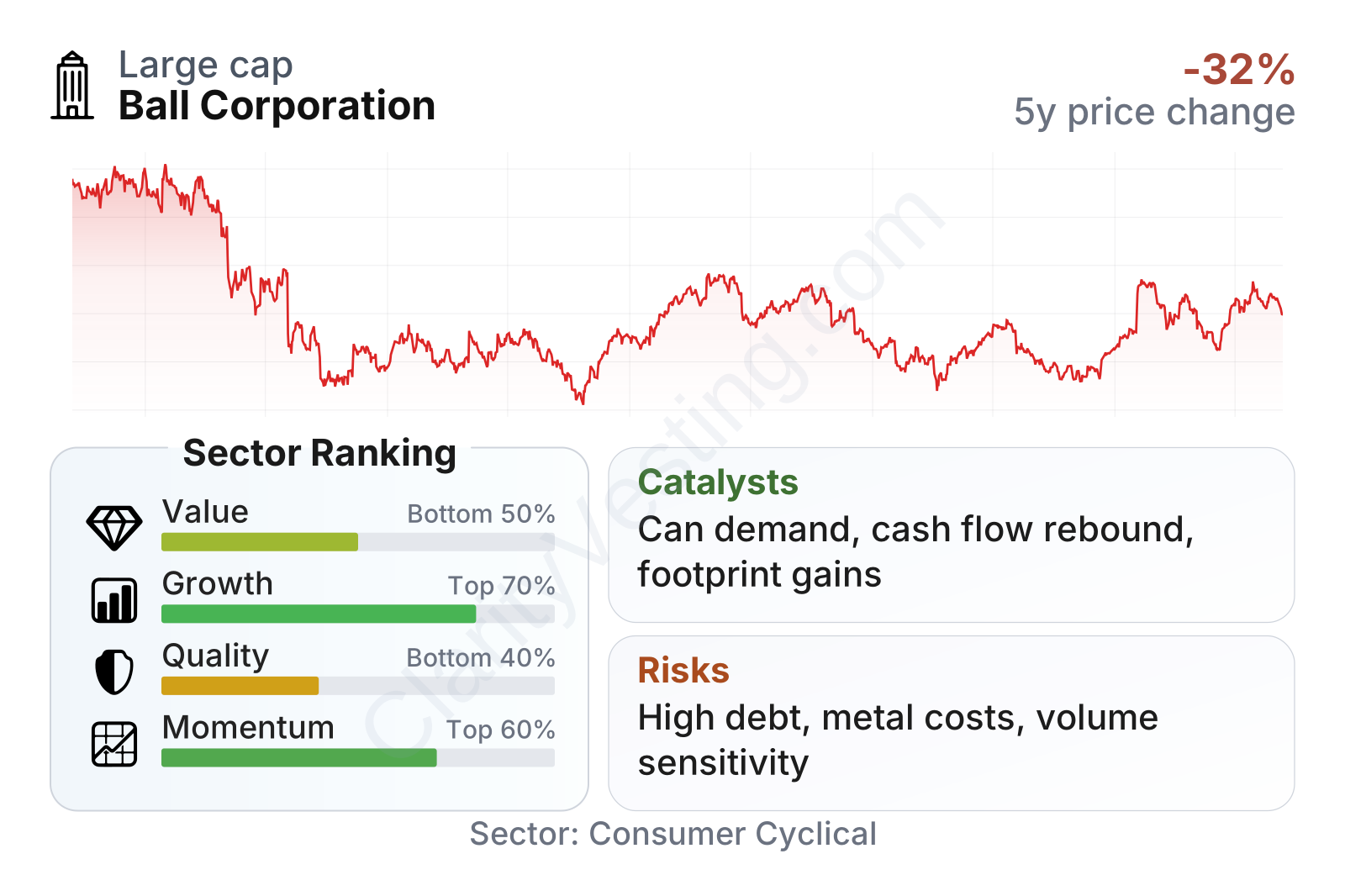
Ball sits in the large-cap range and its share-price volatility is close to the broader market, with a beta near 1. The overall metric profile is mixed. Growth and recent trading performance look better than much of the sector, while balance-sheet quality and some cash-based valuation measures are less favorable. Profitability is respectable, but leverage remains a visible constraint.
The share-price history also shows that Ball has not traded like a steady defensive stock. The stock fell sharply from 2021 to 2022, spent time rebuilding through 2024, weakened again in 2025, and then rebounded before another pullback. That pattern suggests the market has been reassessing both the company’s operating outlook and the proper valuation multiple for a more focused packaging business.
Growth
Ball operates in a sector with durable long-term demand rather than explosive expansion. Beverage packaging is mature in many developed markets, but aluminum cans continue to benefit from substitution away from other packaging formats in some categories and geographies. Cans are lightweight, stack efficiently, protect product quality well, and fit with recycling-focused brand messaging. Those traits support steady demand over time, even if growth is rarely dramatic.
The company’s strategy is sensible for that environment. Ball has spent the last several years simplifying its business and concentrating on aluminum packaging where it has scale, customer relationships, and manufacturing know-how. A narrower focus can improve execution, reduce distractions, and make capital allocation easier to judge. For a packaging manufacturer, this matters because returns often depend more on plant utilization, cost discipline, and contract quality than on breakthrough innovation.
Recent revenue trends are clearly better than the weak period seen in 2023 and early 2024. Growth turned negative for several quarters, then recovered and moved back into double digits by 2025 and 2026. That rebound places Ball ahead of the sector median on the latest year-over-year growth measure. It suggests end-market demand, pricing, mix, or portfolio effects have recently moved in a more favorable direction.
Cash generation is another encouraging point. Free cash flow was negative in 2022 and 2023, then turned positive and improved substantially through 2025 and into 2026. That kind of swing is important for a capital-intensive company because it gives management more room to reduce debt, invest in capacity, repurchase shares, or support shareholder returns without stretching the balance sheet further.
A meaningful catalyst is Ball’s positioning in aluminum packaging at a time when major beverage brands continue to emphasize recyclability and circular packaging systems. Another is operational recovery: if volume growth and plant utilization remain healthy, small improvements in costs can have an outsized effect on profits. The company has also shown better operating-margin direction over the past five years than the sector median, which indicates that efficiency gains are not just theoretical.
Recent company communications have also highlighted ongoing optimization of its packaging footprint and continued emphasis on disciplined capital allocation. For a long-term view, that combination of stronger cash generation, more focused operations, and exposure to recurring consumer demand is more important than any single quarter.
Risks
This article is for informational purposes only and does not constitute financial advice. Some content is AI-generated. See Disclaimer


