Stock Analysis · AutoZone Inc (AZO)
Overview
AutoZone is one of the largest specialty retailers of automotive replacement parts and accessories in the United States, with additional operations in Mexico and Brazil. Its business is built around a simple idea: helping customers keep vehicles on the road for longer. The company serves both do-it-yourself consumers, who repair or maintain their own cars, and professional repair shops that need fast parts delivery and broad inventory availability.
That business model matters because the demand drivers are relatively practical rather than discretionary. When cars age, they need more maintenance, and when repair costs rise, consumers often look for reliable parts suppliers with convenient store locations and same-day availability. AutoZone has developed a dense store network, a large distribution system, and commercial delivery capabilities that support both retail traffic and professional accounts.
Revenue is mainly generated by selling replacement parts, maintenance items, and accessories. AutoZone does not break out every category in a way that allows precise product-level percentages, but its business mix is clearly centered on parts sales, with the U.S. market still representing the overwhelming majority of sales.
- Auto parts and maintenance products: the largest source of revenue by far, including categories such as engine management, batteries, brakes, filters, fluids, and other replacement parts.
- Accessories and appearance products: a smaller share, including items for car care, interior, and add-on accessories.
- Commercial sales to repair shops: a major channel that has been gaining importance over time, though still smaller than the core retail do-it-yourself business.
- Geographic mix: the United States accounts for the large majority of revenue, with Mexico and Brazil contributing a smaller but expanding share.
Over the last several years, the company has expanded revenue steadily while maintaining unusually strong profitability for a retailer. At the same time, interest expense has risen as borrowing increased, which is an important detail for understanding both the strength and the limits of the current business profile.
Key Figures
| Metric | Value | Sector ⓘ |
|---|---|---|
| Date | Sep 12, 2026 | |
| Context | ||
| Sector | Consumer Cyclical | |
| Industry | Auto Parts | |
| Market Cap ⓘ | $48.42B | |
| Beta ⓘ | 0.34 | |
Value (Cheapness) | ||
| P/E Ratio ⓘ | 19.77 | 17.10 |
| FCF Yield ⓘ | 3.37% | 8.53% |
| EBIT / EV ⓘ | 6.03% | 6.46% |
| PEG ⓘ | 1.32 | |
Growth (Business expansion) | ||
| Revenue Growth ⓘ | 8.40% | 5.75% |
| RPS Growth (5Y CAGR) ⓘ | 14.38% | 9.14% |
| EPS Growth (5Y CAGR) ⓘ | -2.28% | -18.21% |
| Margin Growth (5Y Trend) ⓘ | -1.06% | -0.23% |
| FCF Growth (5Y CAGR) ⓘ | -11.34% | 4.91% |
Quality (Business durability) | ||
| ROIC (Latest) ⓘ | N/A | 12.61% |
| ROIC (5Y Median) ⓘ | 79.85% | 10.72% |
| Net Debt / EBIT (Latest) ⓘ | 3.44 | 2.10 |
| Net Debt / EBIT (5Y Median) ⓘ | 3.07 | 2.32 |
| Operating Margin (Latest) ⓘ | 18.02% | 9.25% |
| Operating Margin (5Y Median) ⓘ | 20.12% | 9.64% |
| Debt to Equity (Latest) ⓘ | -453.62% | 75.78% |
| Profit Margin (Latest) ⓘ | 12.40% | 5.33% |
| Free Cash Flow (Latest) ⓘ | $1.63B | |
Momentum (Price trend) | ||
| 3Y Return ⓘ | +13.84% | +14.53% |
| 12M Return (excl. last month) ⓘ | -23.87% | +3.08% |
| 6M Return ⓘ | -20.41% | +0.55% |
| Price vs. 200-Day MA ⓘ | -14.45% | -0.54% |
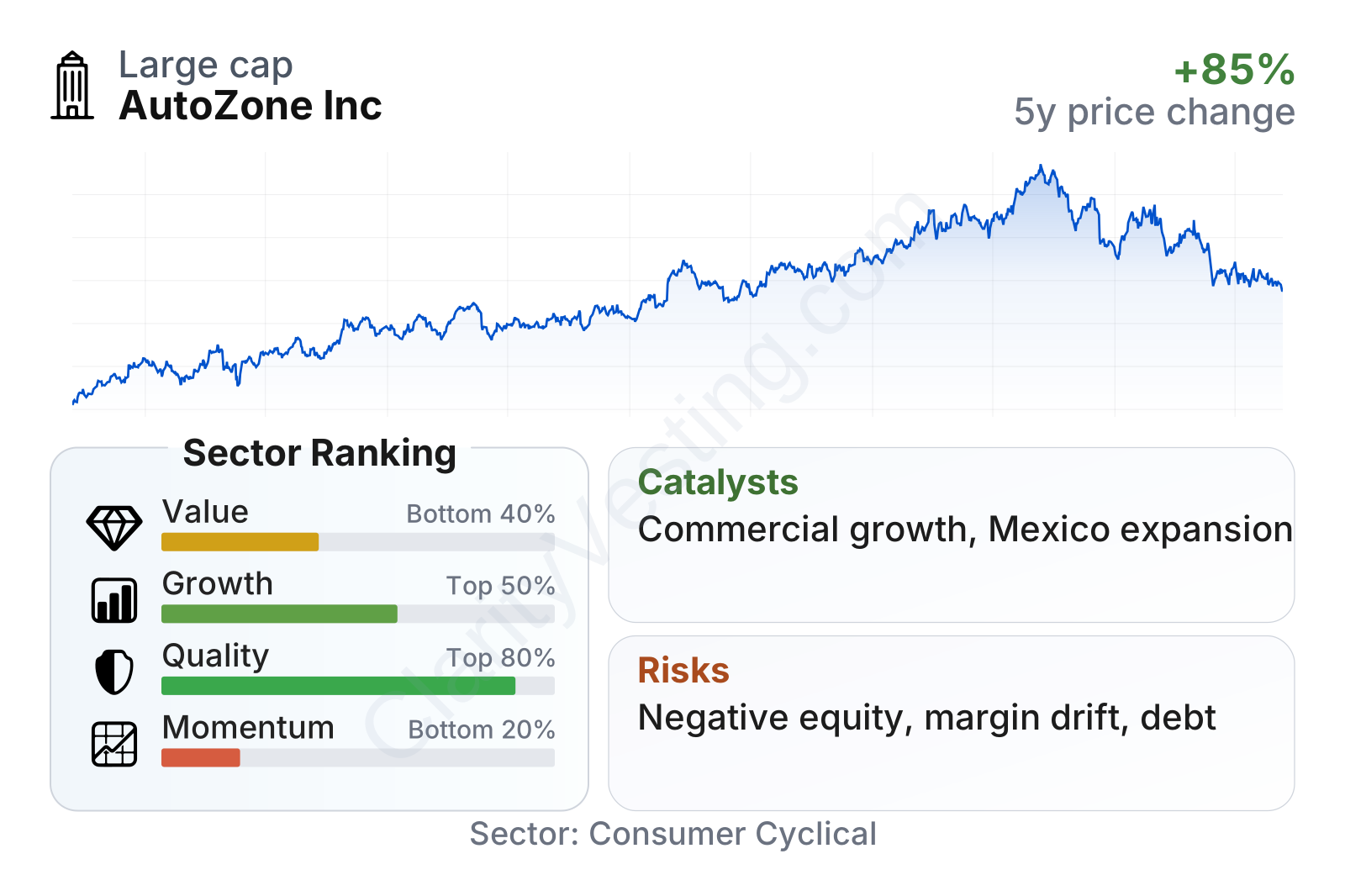
AutoZone stands out on business quality more than on conventional cheapness. Profitability remains well above the sector median, with operating and net margins that are unusually strong for auto parts retail. Growth is respectable rather than explosive, and recent price performance has softened after a long multiyear climb. The value profile looks less attractive on simple multiples and cash flow yield, which means the market is still assigning a premium to the company’s resilience and execution.
Its market capitalization is around $50 billion, making it one of the largest companies in its niche. The stock’s low beta suggests trading has historically been less volatile than much of the broader consumer discretionary universe, which fits the company’s more defensive operating profile compared with many other retail names.
Growth
AutoZone operates in a part of the market that is not glamorous, but it is structurally durable. The long-term backdrop is helped by an aging vehicle fleet, the continued need for maintenance on internal combustion vehicles, and the tendency of consumers to repair rather than replace cars when budgets are tight. That does not create hypergrowth, but it does support steady demand over long periods.
The company’s strategy for future growth is coherent. Management has continued investing in distribution, inventory availability, store expansion, and especially the commercial business that serves repair professionals. That commercial segment is important because it can raise order frequency, deepen relationships, and make the logistics network more productive. International growth also adds another layer, particularly in Mexico, where AutoZone has built a meaningful footprint over time.
Recent revenue growth has remained positive and generally ahead of the sector median, even if the pace has moved around from quarter to quarter. The broader picture is one of consistent expansion rather than a one-time jump. Over a five-year view, revenue per share growth has also been solid, showing that the business has been able to compound even as the operating environment changed.
One area to watch more carefully is cash generation. Free cash flow remains substantial in absolute terms, still around the $1.6 billion range on a trailing basis, but it has come down meaningfully from earlier peaks above $3 billion. That decline does not erase the company’s strong economics, but it does suggest growth is becoming more capital- and working-capital-intensive, or that recent conditions have been less favorable for cash conversion than in prior years.
As for catalysts, the clearest ones are operational rather than speculative. Continued growth in commercial sales, further penetration in Mexico and Brazil, and execution in supply chain speed can all support market share gains. The company’s own store expansion and hub strategy also create a practical path to growth because availability and delivery speed matter a great deal in this industry. In recent company communications, management has continued to emphasize these areas, which points to a strategy focused on share capture rather than relying on a booming economy.
Risks
This article is for informational purposes only and does not constitute financial advice. Some content is AI-generated. See Disclaimer


