Stock Analysis · AXT Inc (AXTI)
Overview
AXT Inc. is a semiconductor materials company. Instead of designing chips, it makes the specialized raw materials that other companies use to manufacture electronic and optoelectronic components. Its core products are compound semiconductor substrates, mainly made from gallium arsenide, indium phosphide, and germanium. These wafers are used in devices for fiber-optic communications, wireless infrastructure, data center connectivity, consumer electronics, and certain solar and sensing applications.
The business is relatively concentrated around substrate sales, with the mix shifting depending on demand in communications, industrial, and consumer end markets. Based on recent company filings, revenue is primarily generated from substrate products, while a smaller portion comes from raw materials and other related sales. AXT also has partial ownership interests in several supply-chain entities in China that support raw material availability and processing.
Main revenue sources can be summarized as follows:
- Indium phosphide substrates: a major contributor, used in high-speed optical communications, data center optics, and telecom components.
- Gallium arsenide substrates: another major contributor, used in RF chips, LEDs, lasers, and some consumer and infrastructure applications.
- Germanium substrates: a smaller but meaningful category, used in solar cells and certain photonics applications.
- Raw materials and other sales: a lower-share contribution tied to materials processing and supply-chain activities.
Exact percentages by product line are not consistently disclosed in enough detail to present a reliable current breakdown, but the company’s filings make clear that indium phosphide and gallium arsenide are the central earnings drivers, with germanium and other activities forming a secondary layer.
Over the last several years, the business has shown how sensitive it is to swings in semiconductor demand. Revenue climbed above $140 million in 2022, fell sharply in 2023, recovered partway in 2024, and then softened again in 2025. That pattern highlights a company with useful technology and niche positioning, but one still exposed to cyclical order patterns and uneven utilization.
The operating picture shows a clear contrast between earlier profitable years and the later downturn. Gross profit contracted sharply after 2022, while operating expenses stayed fairly sticky, which pushed operating results into losses. That matters because AXT’s long-term case depends not only on demand returning, but on restoring margins as volumes improve.
Key Figures
| Metric | Value | Sector ⓘ |
|---|---|---|
| Date | Sep 12, 2026 | |
| Context | ||
| Sector | Technology | |
| Industry | Semiconductor Equipment & Materials | |
| Market Cap ⓘ | $4.25B | |
| Beta ⓘ | 1.92 | |
Value (Cheapness) | ||
| P/E Ratio ⓘ | N/A | 29.51 |
| FCF Yield ⓘ | -0.46% | 4.25% |
| EBIT / EV ⓘ | 0.13% | 2.85% |
| PEG ⓘ | 12.09 | |
Growth (Business expansion) | ||
| Revenue Growth ⓘ | 164.80% | 15.40% |
| RPS Growth (5Y CAGR) ⓘ | -11.08% | 8.56% |
| EPS Growth (5Y CAGR) ⓘ | -22.50% | -11.88% |
| Margin Growth (5Y Trend) ⓘ | N/A | 0.46% |
| FCF Growth (5Y CAGR) ⓘ | -13.11% | 9.80% |
Quality (Business durability) | ||
| ROIC (Latest) ⓘ | 1.03% | 9.44% |
| ROIC (5Y Median) ⓘ | -2.97% | 8.30% |
| Net Debt / EBIT (Latest) ⓘ | -63.86 | 0.54 |
| Net Debt / EBIT (5Y Median) ⓘ | N/A | 0.44 |
| Operating Margin (Latest) ⓘ | 4.08% | 9.58% |
| Operating Margin (5Y Median) ⓘ | -9.38% | 8.25% |
| Debt to Equity (Latest) ⓘ | 9.62% | 33.33% |
| Profit Margin (Latest) ⓘ | 3.23% | 7.14% |
| Free Cash Flow (Latest) ⓘ | -$19.57M | |
Momentum (Price trend) | ||
| 3Y Return ⓘ | +2598.75% | +45.48% |
| 12M Return (excl. last month) ⓘ | +3418.83% | +23.48% |
| 6M Return ⓘ | +38.60% | +20.93% |
| Price vs. 200-Day MA ⓘ | +16.14% | +7.43% |
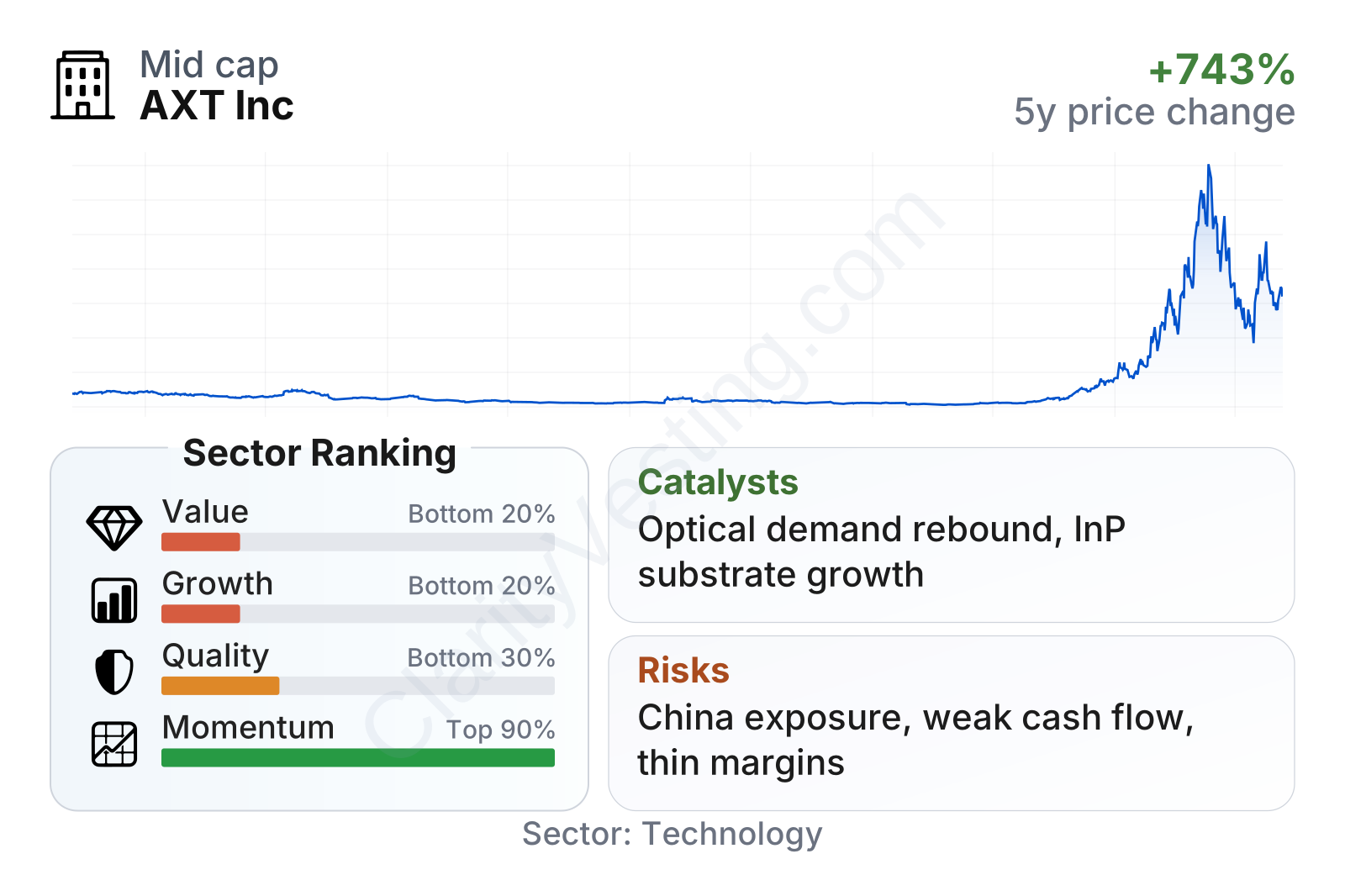
AXT now sits in an unusual position: market momentum has been extremely strong, but most fundamental factors still rank near the bottom of its sector. Growth has improved dramatically in the latest period, yet profitability, cash generation, and returns on capital remain weak. The balance sheet is lighter than many peers, which offers some resilience, but the overall profile is still that of a company in recovery rather than one already operating at full strength.
The stock’s price history also shows very high volatility. After trading in low single digits for much of 2023 through 2025, the shares moved sharply higher into 2026. That kind of move often reflects changing expectations around future demand rather than a fully proven earnings rebound.
Growth
AXT operates in parts of the semiconductor market that have real long-term relevance. Compound semiconductor materials are used where traditional silicon is not always the best fit, especially in high-speed optical communications, radio-frequency performance, and photonics. Those areas can benefit from trends such as AI-related network traffic, rising data center interconnect needs, fiber expansion, and more advanced sensing and communications equipment.
The strategic logic is understandable. If bandwidth demand keeps rising, the need for optical components and related materials can also rise, and indium phosphide is one of AXT’s most important products for that market. Gallium arsenide also remains relevant in RF and optoelectronic uses. In simple terms, AXT is positioned upstream in categories that can benefit when customers build faster, more specialized electronics.
Recent revenue growth has turned sharply positive, with the latest year-over-year increase far above the broader sector median. That looks encouraging on the surface, but context matters: AXT is growing off a depressed base after a difficult period. The recent rebound is therefore meaningful, but it does not yet erase the company’s weaker five-year growth record, which remains below sector norms.
Cash generation is the key area to watch. Free cash flow has been negative for several years and worsened again in the latest trailing period after earlier improvement. That suggests the business has not yet converted the revenue rebound into durable financial strength. For long-term analysis, this is one of the most important open questions: whether higher sales can eventually produce steady positive cash flow rather than only temporary top-line recovery.
Recent company updates have also pointed to improving demand in some end markets tied to optical networking and advanced semiconductor applications. In addition, geopolitical focus on supply chains and strategic materials has increased attention on non-standard semiconductor inputs. For AXT, that can create opportunity if customers want reliable substrate capacity outside of the largest mainstream silicon supply chains.
Risks
This article is for informational purposes only and does not constitute financial advice. Some content is AI-generated. See Disclaimer


