Stock Analysis · Avery Dennison Corp (AVY)
Overview
Avery Dennison is a materials science and manufacturing company best known for pressure-sensitive labels, packaging materials, retail branding products, and identification technologies. In simple terms, it makes the labels, stickers, tags, and specialized materials that help consumer goods companies package products, retailers manage inventory, and brands track goods through supply chains. It also has a growing presence in radio-frequency identification, or RFID, which allows items to be identified and tracked wirelessly.
The business is organized into two main segments, and the larger one is still the traditional labeling and packaging franchise. Based on the company’s recent annual reporting, revenue is approximately split as follows:
- Materials Group: about 73% of revenue. This segment includes pressure-sensitive label materials, graphics and reflective products, tapes, and industrial adhesives used in packaging, logistics, automotive, construction, and other applications.
- Solutions Group: about 27% of revenue. This includes apparel and general retail branding, price tickets and tags, external embellishments, and intelligent labels such as RFID inlays and related software and services.
Within those activities, Avery Dennison’s end markets are diversified across food, beverages, personal care, pharmaceuticals, apparel, logistics, and general retail. That diversity matters because it reduces dependence on any single customer category, even though overall demand still follows broader industrial and consumer activity.
The business model is relatively straightforward: Avery Dennison develops proprietary materials and identification solutions, sells them at very large scale through a global manufacturing network, and aims to protect margins through product mix, technical know-how, and customer relationships. Over time, the company has been trying to move beyond basic labeling materials toward higher-value products such as RFID-enabled solutions and connected packaging.
The long-term picture from the income structure is fairly stable. Revenue has moved within a relatively narrow range in recent years, while gross profit has recovered after the 2023 downturn. Operating profit has also rebounded from that weaker period, suggesting that cost control and mix improvement have been important drivers even when top-line growth has not been consistently strong.
Key Figures
| Metric | Value | Sector ⓘ |
|---|---|---|
| Date | Sep 12, 2026 | |
| Context | ||
| Sector | Consumer Cyclical | |
| Industry | Packaging & Containers | |
| Market Cap ⓘ | $12.84B | |
| Beta ⓘ | 0.81 | |
Value (Cheapness) | ||
| P/E Ratio ⓘ | 18.45 | 17.10 |
| FCF Yield ⓘ | 8.28% | 8.53% |
| EBIT / EV ⓘ | 7.00% | 6.46% |
| PEG ⓘ | 1.76 | |
Growth (Business expansion) | ||
| Revenue Growth ⓘ | 10.90% | 5.75% |
| RPS Growth (5Y CAGR) ⓘ | 3.34% | 9.14% |
| EPS Growth (5Y CAGR) ⓘ | -14.18% | -18.21% |
| Margin Growth (5Y Trend) ⓘ | -0.66% | -0.23% |
| FCF Growth (5Y CAGR) ⓘ | -2.07% | 4.91% |
Quality (Business durability) | ||
| ROIC (Latest) ⓘ | 13.33% | 12.61% |
| ROIC (5Y Median) ⓘ | 14.61% | 10.72% |
| Net Debt / EBIT (Latest) ⓘ | 3.28 | 2.10 |
| Net Debt / EBIT (5Y Median) ⓘ | 2.77 | 2.32 |
| Operating Margin (Latest) ⓘ | 11.98% | 9.25% |
| Operating Margin (5Y Median) ⓘ | 11.99% | 9.64% |
| Debt to Equity (Latest) ⓘ | 158.35% | 75.78% |
| Profit Margin (Latest) ⓘ | 7.62% | 5.33% |
| Free Cash Flow (Latest) ⓘ | $1.06B | |
Momentum (Price trend) | ||
| 3Y Return ⓘ | -1.28% | +14.53% |
| 12M Return (excl. last month) ⓘ | +5.99% | +3.08% |
| 6M Return ⓘ | +0.26% | +0.55% |
| Price vs. 200-Day MA ⓘ | -1.00% | -0.54% |
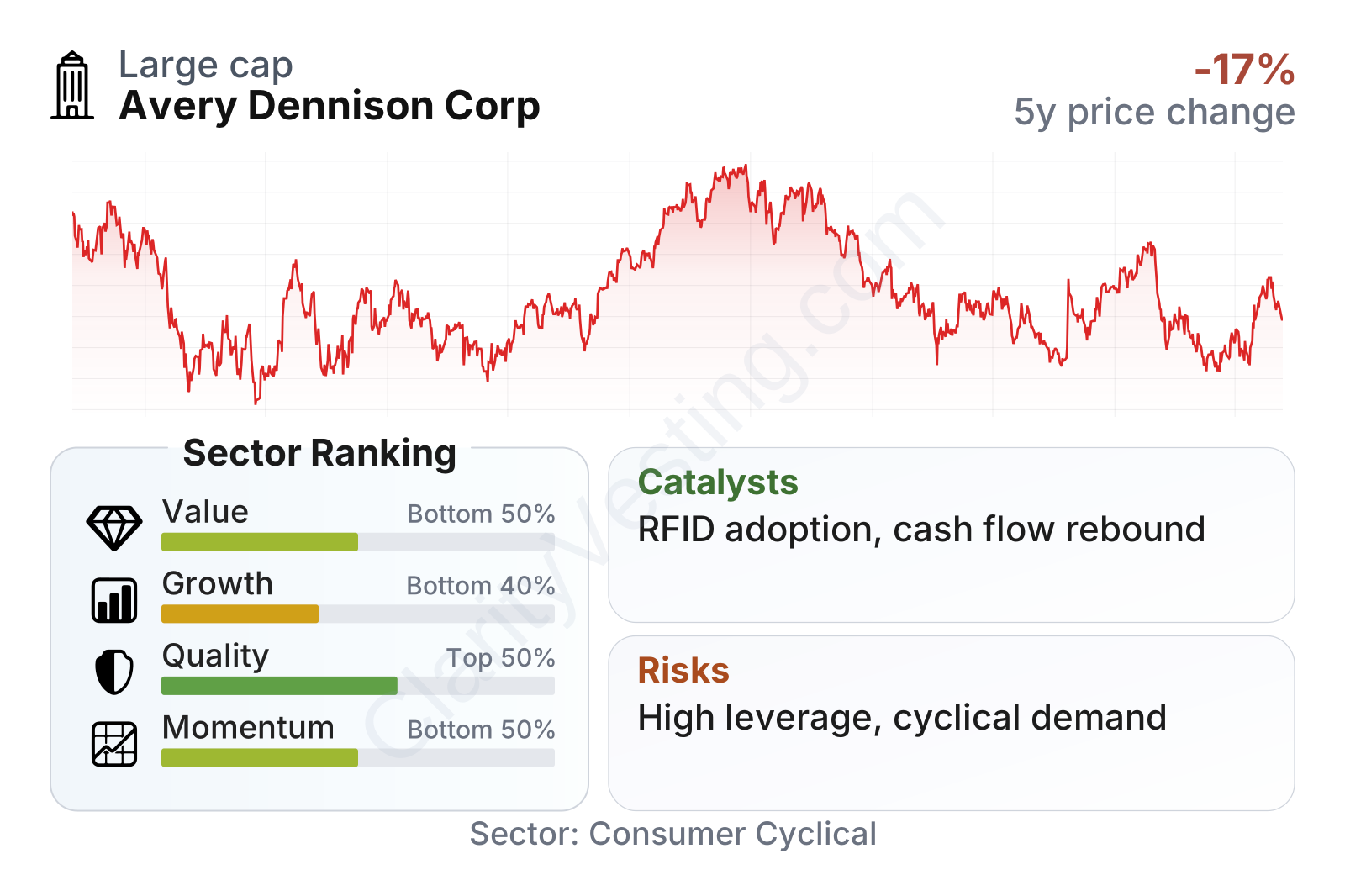
Avery Dennison is a large established company with a market value in the low tens of billions of dollars and a stock volatility that has been lower than the broader market. The overall profile is mixed but understandable: profitability and capital efficiency look solid relative to much of the sector, while growth and recent share-price momentum have been less impressive. The company’s return on invested capital is above the sector median, and operating profitability is also stronger than average. On the other hand, leverage is clearly heavier than the sector norm, and the longer-term growth record is not as strong as the recent rebound in revenue might suggest.
The stock price history also shows a pattern of resilience rather than a steady upward climb. Shares recovered well during parts of 2024, then weakened again into 2025 and 2026. That behavior fits a business that is fundamentally profitable but exposed to changing industrial demand, raw-material dynamics, and investor caution around cyclical names.
Growth
Avery Dennison operates in a sector that is mature overall, but not stagnant. Traditional labeling and packaging tend to grow roughly in line with consumer goods volumes, product launches, premium packaging demand, and geographic expansion. The more interesting growth angle is intelligent labeling, especially RFID, where adoption is still expanding across apparel, logistics, healthcare, food, and broader retail operations. That gives the company a way to combine a mature core business with a technology-driven layer that can grow faster than the base market.
The strategy makes sense for long-term expansion because it builds on existing customer relationships rather than requiring a completely new business model. Avery Dennison already supplies materials and identification products to many large brands and retailers, so RFID and connected product solutions can be sold into an established global network. That is often more efficient than trying to create demand from scratch.
Recent revenue growth has improved meaningfully after the contraction seen in 2023. The latest year-over-year pace is running around 11%, which is ahead of the sector median. That said, the longer record is less dynamic: five-year revenue-per-share growth remains well below the sector median. In other words, the company has regained momentum, but it has not yet established a long stretch of high growth across a full cycle.
Cash generation has strengthened as well. Trailing free cash flow is above $1 billion, and the recent trend shows a notable recovery from earlier lower levels. That matters because it gives the company flexibility to fund dividends, repurchases, bolt-on acquisitions, and internal investment without relying entirely on new borrowing. Stronger cash flow is also a useful sign that earnings quality remains sound.
One of the clearest catalysts is wider RFID adoption. Avery Dennison has repeatedly highlighted intelligent labels as a strategic growth engine, and this area benefits from several durable trends: retailers want better inventory accuracy, logistics operators want improved visibility, and brands increasingly want item-level traceability. In addition, regulations and sustainability efforts can support demand for smarter packaging, product authentication, and digital product identification.
Another supportive factor is the company’s global manufacturing and innovation footprint. Large customers often prefer suppliers that can serve multiple regions consistently, and that can be an advantage when product lines or supply chains become more complex. Recent company updates have also emphasized productivity actions and portfolio shaping, which suggests management is focused not only on growth but on protecting margins while growing.
Risks
This article is for informational purposes only and does not constitute financial advice. Some content is AI-generated. See Disclaimer


