Stock Analysis · Avnet Inc (AVT)
Overview
Avnet is a large electronics distributor and solutions provider. In simple terms, it sits between chip makers and equipment makers: it buys semiconductors, connectors, embedded boards, and other electronic parts from manufacturers, then helps business customers source, design, and integrate those products into industrial equipment, communications systems, data center hardware, automotive applications, and many other devices. The company also offers design-chain support, supply-chain services, logistics, and some assembly-related services, which makes it more than a basic reseller.
Avnet reports revenue through two main operating segments. Based on recent annual reporting, the business mix is concentrated in electronic components, with a smaller but still meaningful embedded solutions operation.
- Electronic Components: about 85% to 90% of revenue. This segment distributes semiconductors, interconnect, passive, electromechanical, and other components, while also providing engineering support, demand creation, and supply-chain services.
- Farnell: about 10% to 15% of revenue. Farnell focuses on smaller-quantity distribution, including components, tools, test equipment, and maintenance-related products, serving engineers, small manufacturers, and development teams through digital and catalog-based channels.
Geographically, Avnet is broadly diversified across the Americas, EMEA, and Asia-Pacific, which helps reduce reliance on any one country, although it remains tied to the overall global electronics cycle. The company’s economics are typical for distribution: very large sales volume, relatively thin margins, and a strong dependence on execution, inventory control, and working-capital discipline. Over the last several years, revenue and gross profit have moved sharply with the semiconductor cycle, while operating income has proven more volatile than sales.
Recent profit flow also shows the structure of the business clearly: most revenue is passed through as product cost, gross margins are modest, and financing costs matter. Revenue rebounded strongly in the latest period, but net income remains well below the peak reached earlier in the cycle, showing that higher sales alone do not automatically translate into strong bottom-line expansion.
Key Figures
| Metric | Value | Sector ⓘ |
|---|---|---|
| Date | Sep 12, 2026 | |
| Context | ||
| Sector | Technology | |
| Industry | Electronics & Computer Distribution | |
| Market Cap ⓘ | $8.18B | |
| Beta ⓘ | 1.11 | |
Value (Cheapness) | ||
| P/E Ratio ⓘ | 24.85 | 29.51 |
| FCF Yield ⓘ | -4.34% | 4.25% |
| EBIT / EV ⓘ | 6.64% | 2.85% |
| PEG ⓘ | 2.65 | |
Growth (Business expansion) | ||
| Revenue Growth ⓘ | 47.70% | 15.40% |
| RPS Growth (5Y CAGR) ⓘ | 7.99% | 8.56% |
| EPS Growth (5Y CAGR) ⓘ | -5.05% | -11.88% |
| Margin Growth (5Y Trend) ⓘ | -1.23% | 0.46% |
| FCF Growth (5Y CAGR) ⓘ | 94.18% | 9.80% |
Quality (Business durability) | ||
| ROIC (Latest) ⓘ | 6.45% | 9.44% |
| ROIC (5Y Median) ⓘ | 13.26% | 8.30% |
| Net Debt / EBIT (Latest) ⓘ | 4.61 | 0.54 |
| Net Debt / EBIT (5Y Median) ⓘ | 3.14 | 0.44 |
| Operating Margin (Latest) ⓘ | 2.61% | 9.58% |
| Operating Margin (5Y Median) ⓘ | 3.84% | 8.25% |
| Debt to Equity (Latest) ⓘ | 69.20% | 33.33% |
| Profit Margin (Latest) ⓘ | 1.21% | 7.14% |
| Free Cash Flow (Latest) ⓘ | -$354.50M | |
Momentum (Price trend) | ||
| 3Y Return ⓘ | +123.13% | +45.48% |
| 12M Return (excl. last month) ⓘ | +86.70% | +23.48% |
| 6M Return ⓘ | +66.68% | +20.93% |
| Price vs. 200-Day MA ⓘ | +38.02% | +7.43% |
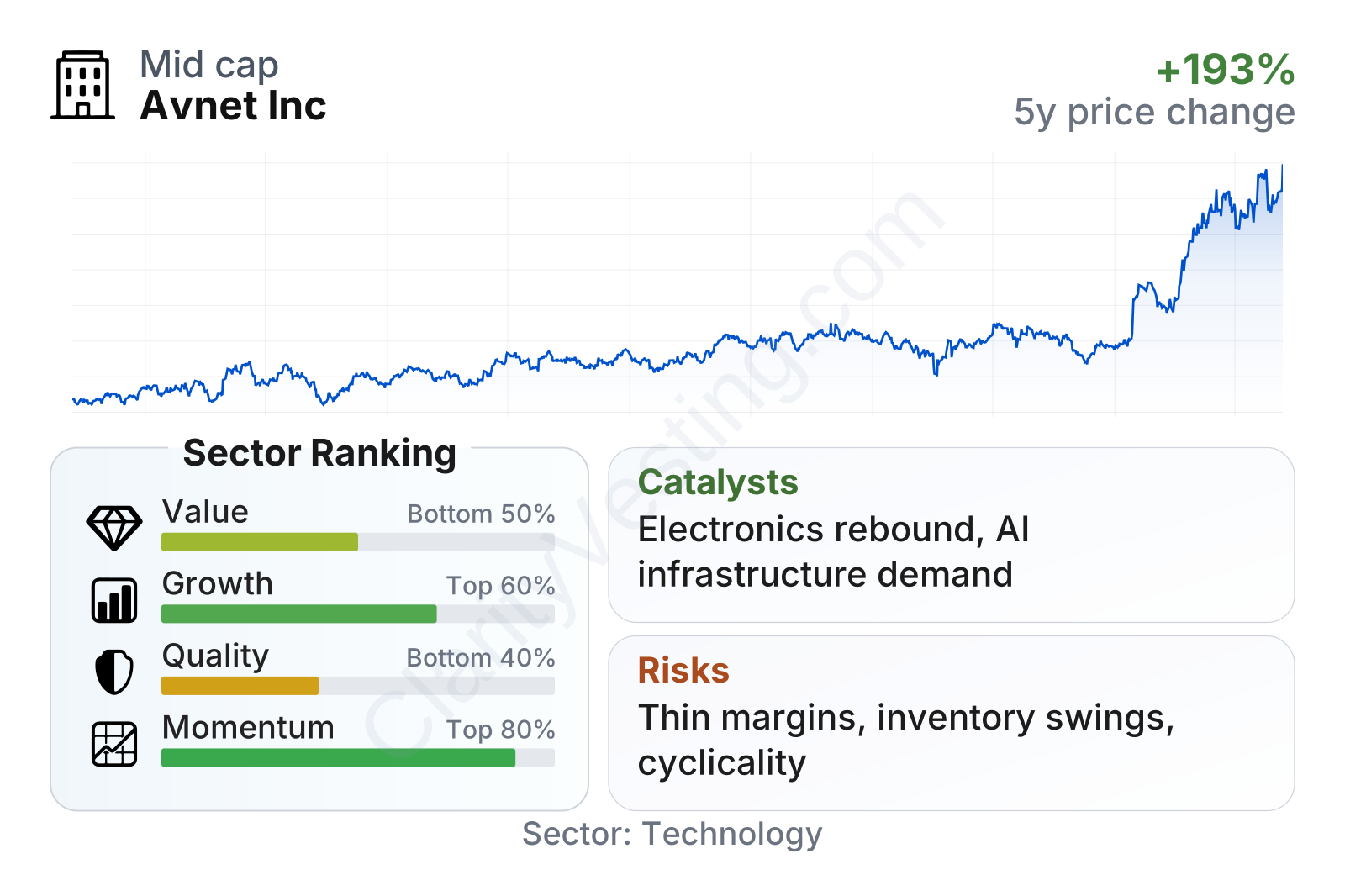
Avnet is a mid-to-large-cap technology distributor with share-price momentum that has recently been stronger than much of the sector. On valuation, the earnings multiple sits below the sector median, which gives the stock a less demanding headline valuation than many technology names. At the same time, the quality profile is weaker than the sector on current profitability and leverage-adjusted measures, while growth indicators look mixed: recent revenue acceleration is strong, but longer-term per-share growth has been more modest and margins have not trended in the right direction.
Growth
Avnet operates in a sector with durable long-term demand drivers. Electronics content continues to rise across industrial automation, power systems, aerospace, defense, automotive electronics, edge computing, data infrastructure, and connected devices. Even when the chip cycle weakens, the broader direction remains favorable because more products require more semiconductors, sensors, power management, and embedded computing over time.
Avnet’s strategy fits that environment reasonably well. The company is not trying to win by inventing chips; it is trying to become a critical commercial and logistics partner in a fragmented and complex supply chain. That can be attractive in an industry where product availability, lead times, compliance requirements, and engineering support all matter. Its combination of large enterprise distribution and Farnell’s digital and smaller-batch reach gives it access to both production demand and early-stage design activity.
Growth has been highly cyclical rather than smooth. After a period of declining year-over-year sales as the semiconductor market normalized, recent revenue growth turned sharply positive again. That suggests Avnet is benefiting from easier comparisons, improving demand in parts of the component market, or both. However, because distribution revenue can swing quickly with pricing, customer inventory adjustments, and timing, one very strong growth reading should be treated as a sign of recovery, not proof of a permanently faster growth rate.
Cash generation also deserves close attention. Avnet produced very strong free cash flow in some recent periods, then that figure cooled significantly and the latest trailing figure in the factor table is negative. For a distributor, this usually reflects working-capital swings more than a broken business model, especially changes in inventory and receivables. In practice, this means that cash flow can look much better or worse than earnings for stretches of time, so the direction across a full cycle matters more than any single quarter.
One recent opportunity is the broader recovery in electronics demand tied to industrial markets and AI-related infrastructure buildout. Avnet is not an AI platform company, but it can still participate through higher component demand, embedded solutions, power products, connectivity hardware, and design-chain activity. Another useful catalyst is supplier and customer complexity: when supply chains become harder to manage, large distributors with global reach often become more valuable.
Risks
This article is for informational purposes only and does not constitute financial advice. Some content is AI-generated. See Disclaimer


