Stock Analysis · Avepoint Inc (AVPT)
Overview
AvePoint is a software company focused on helping organizations manage, protect, and optimize their data across cloud platforms. Its core strength is in the Microsoft ecosystem, especially Microsoft 365, where it provides tools for backup, disaster recovery, governance, compliance, records management, migration, and workspace administration. In simple terms, AvePoint helps companies keep business data safe, organized, and usable as more work moves to the cloud.
The business is largely built around recurring software revenue. Based on the company’s recent filings, most sales come from software-as-a-service and term subscriptions, with a smaller contribution from services tied to deployment, migration, and customer support work. AvePoint also benefits from selling through partners, including managed service providers and channel relationships connected to Microsoft.
Main revenue sources are broadly structured as follows:
- Subscription revenue: approximately 85% to 90% of total revenue. This includes SaaS offerings and term-based software subscriptions for data protection, governance, resilience, and cloud management.
- Services revenue: approximately 10% to 15% of total revenue. This generally includes implementation, migration, training, and other professional services that help customers deploy and use the platform.
Within that mix, the strategic center of the company is clearly the recurring software layer rather than one-time project work. That matters for long-term analysis because subscription revenue is usually more predictable, easier to scale, and often carries better margins than labor-heavy services.
The company has also shown a notable improvement in how revenue turns into profit. Over the last several years, sales have expanded steadily, gross profit has grown even faster in absolute dollars, and operating results have moved from losses to positive operating income by 2025. That shift suggests AvePoint is no longer just pursuing growth, but is increasingly proving it can do so with financial discipline.
The business model has become more attractive over time: revenue has climbed from under $200 million in 2021 to above $400 million in 2025, while profitability has improved materially. The most important change is not only higher sales, but the move from negative operating income to positive earnings, showing that scale is starting to matter.
Key Figures
| Metric | Value | Sector ⓘ |
|---|---|---|
| Date | Sep 12, 2026 | |
| Context | ||
| Sector | Technology | |
| Industry | Software - Infrastructure | |
| Market Cap ⓘ | $2.70B | |
| Beta ⓘ | 1.19 | |
Value (Cheapness) | ||
| P/E Ratio ⓘ | 41.23 | 29.51 |
| FCF Yield ⓘ | 3.72% | 4.25% |
| EBIT / EV ⓘ | 2.51% | 2.85% |
| PEG ⓘ | N/A | |
Growth (Business expansion) | ||
| Revenue Growth ⓘ | 22.00% | 15.40% |
| RPS Growth (5Y CAGR) ⓘ | 7.79% | 8.56% |
| EPS Growth (5Y CAGR) ⓘ | N/A | -11.88% |
| Margin Growth (5Y Trend) ⓘ | N/A | 0.46% |
| FCF Growth (5Y CAGR) ⓘ | 137.38% | 9.80% |
Quality (Business durability) | ||
| ROIC (Latest) ⓘ | 16.45% | 9.44% |
| ROIC (5Y Median) ⓘ | -7.27% | 8.30% |
| Net Debt / EBIT (Latest) ⓘ | -6.82 | 0.54 |
| Net Debt / EBIT (5Y Median) ⓘ | N/A | 0.44 |
| Operating Margin (Latest) ⓘ | 12.62% | 9.58% |
| Operating Margin (5Y Median) ⓘ | -7.38% | 8.25% |
| Debt to Equity (Latest) ⓘ | 3.73% | 33.33% |
| Profit Margin (Latest) ⓘ | 15.33% | 7.14% |
| Free Cash Flow (Latest) ⓘ | $100.66M | |
Momentum (Price trend) | ||
| 3Y Return ⓘ | +90.95% | +45.48% |
| 12M Return (excl. last month) ⓘ | -12.62% | +23.48% |
| 6M Return ⓘ | +21.03% | +20.93% |
| Price vs. 200-Day MA ⓘ | +8.30% | +7.43% |
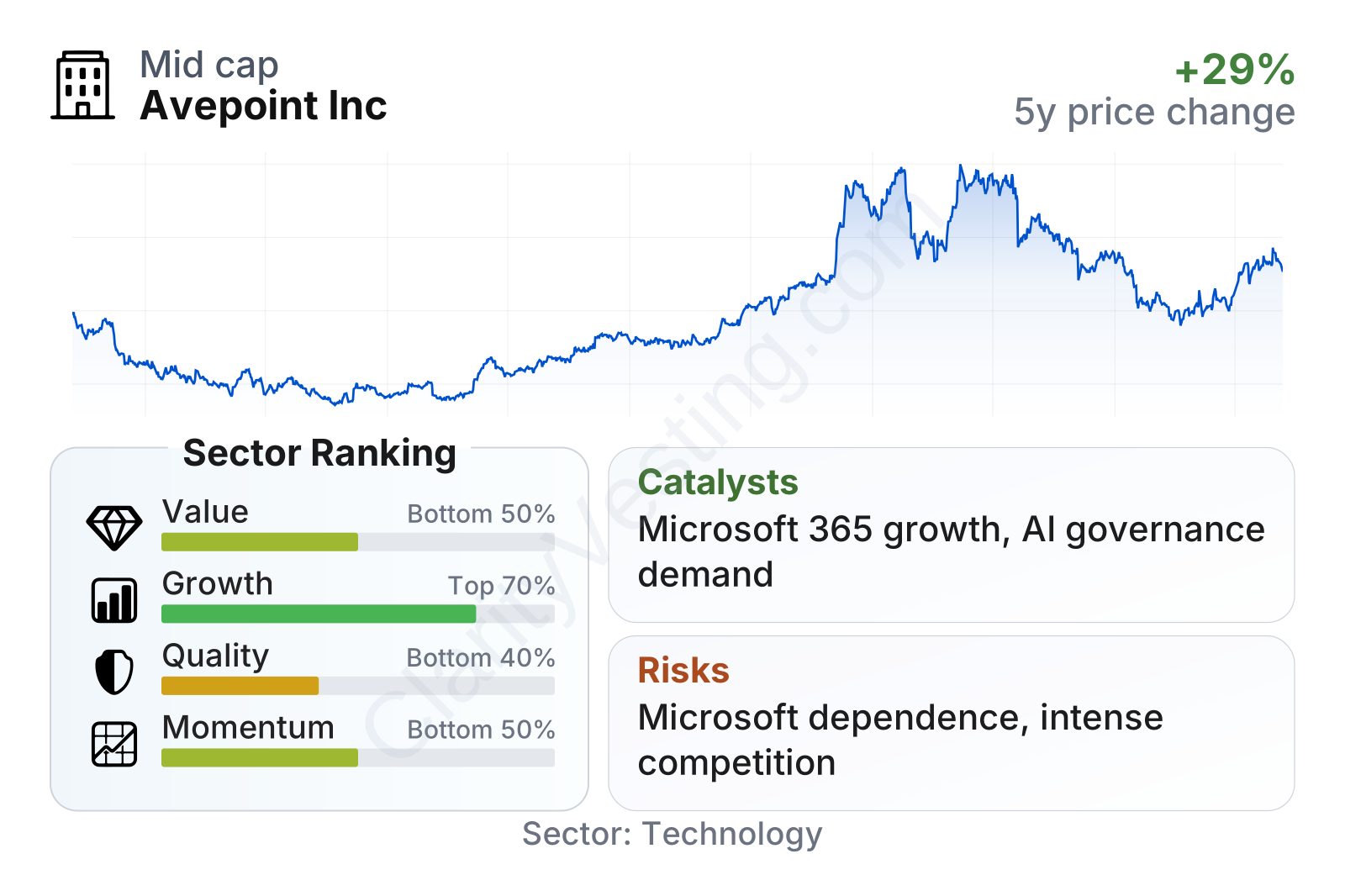
AvePoint sits in the mid-sized range for listed software companies, with share-price behavior that has been more volatile than the broad market. The factor profile is mixed but informative: growth is stronger than much of the sector, value metrics are less favorable because the earnings multiple is above the sector median, and quality looks uneven on a long historical view even though current profitability and balance-sheet strength are clearly better than before. Momentum is also mixed, reflecting a strong multiyear gain but a weaker performance over the more recent 12-month stretch.
Growth
AvePoint operates in a sector with durable long-term demand. As companies store more information in Microsoft 365, Google Workspace, and other cloud environments, the need to protect that information and control how it is used continues to rise. Data loss prevention, backup, cyber resilience, governance, and compliance are not niche needs anymore; they are becoming standard operating requirements for enterprises, governments, schools, and small businesses alike.
The company’s strategy makes sense in that context. Rather than competing head-on in every part of enterprise software, AvePoint focuses on a clear pain point: organizations are generating more cloud data, facing stricter compliance demands, and dealing with greater cybersecurity risk. Its platform approach tries to solve several related problems in one place, which can make the offering more useful and harder to replace once adopted.
Revenue growth has remained strong for a company that is already profitable. Recent year-over-year expansion has generally stayed in the low-20% to low-30% range, which is above the sector median. That is a healthy signal because it shows AvePoint is still growing faster than many software peers even after reaching a much larger revenue base than it had a few years ago.
Cash generation has improved sharply. Free cash flow moved from near break-even a few years ago to more than $100 million on a trailing basis, which is a major milestone. This matters because cash flow gives the company more flexibility to invest in product development, partnerships, and expansion without depending heavily on external financing.
Several catalysts can support future growth. Microsoft 365 remains the biggest one: the broader that ecosystem becomes, the larger the addressable market for backup, governance, and lifecycle management. AvePoint has also emphasized AI readiness, helping customers prepare, organize, and secure the data that artificial intelligence tools rely on. As businesses adopt Microsoft Copilot and similar products, demand may rise for better control over content sprawl, permissions, records, and policy enforcement. In that sense, AI is not only a technology trend but a practical trigger that can increase the need for AvePoint’s software.
Recent company updates have also pointed to continued partner-led expansion and deeper work with managed service providers. That channel matters because it can widen distribution without requiring AvePoint to build the same level of direct sales capacity in every market. If that model keeps scaling, it could support growth while preserving margins better than a purely direct-sales strategy.
Risks
This article is for informational purposes only and does not constitute financial advice. Some content is AI-generated. See Disclaimer


