Stock Analysis · Broadcom Inc (AVGO)
Stock Analysis · Broadcom Inc (AVGO)

Overview

Broadcom is a large technology company that sells the building blocks used inside modern digital infrastructure. Its business has two main sides. The first is semiconductors: chips used in data centers, networking equipment, broadband, wireless devices, storage systems, and custom computing platforms. The second is infrastructure software: software tools that help large organizations manage mainframes, enterprise operations, cybersecurity, and virtualization.

For a long-term reader, the important point is that Broadcom is not a single-product company. It sits in several critical layers of the technology stack. Its chips are deeply tied to network traffic, cloud expansion, and AI-related computing demand, while its software operations add recurring revenue and can smooth some of the ups and downs that are common in semiconductors.

Based on recent company reporting, revenue is mainly split between semiconductor solutions and infrastructure software, with semiconductors still the larger contributor. A simple way to think about the business mix is:

  • Semiconductor solutions: roughly 55% to 60% of revenue. This includes networking chips, custom AI accelerators and connectivity products, broadband chips, server storage connectivity, and wireless components.
  • Infrastructure software: roughly 40% to 45% of revenue. This segment includes VMware-related virtualization and private cloud software, mainframe software, and enterprise security and operations tools.

Within semiconductors, the most strategically important areas today appear to be networking and AI-related custom silicon, while software has become much more significant after the VMware acquisition. That combination gives Broadcom unusual breadth: it participates both in the hardware demand created by AI and cloud build-outs, and in the software layer enterprises use to run those environments.

The company’s income structure has also become much larger over the last few years. Revenue expanded strongly from the high-$20 billion range a few years ago to more than $60 billion recently, while gross profit and operating income also scaled meaningfully. A temporary dip in net income around the VMware integration period stands out, but more recent results show a sharp recovery as the acquired software assets were absorbed and repriced.

The broad trend is clear: Broadcom has grown into a much larger business, with a richer mix of software and a very high gross profit base. That helps explain why the market often treats it differently from a typical cyclical chip company.

Key Figures

MetricValueSector
DateJul 18, 2026
Context
SectorTechnology
IndustrySemiconductors
Market Cap $1.76T
Beta 1.46
Value
(Cheapness)
P/E Ratio 61.5031.76
FCF Yield 1.86%4.18%
EBIT / EV 1.82%2.56%
PEG 0.42
Growth
(Business expansion)
Revenue Growth 47.90%13.50%
RPS Growth (5Y CAGR) 19.76%8.57%
EPS Growth (5Y CAGR) 5.17%-21.87%
Margin Growth (5Y Trend) 9.09%0.41%
FCF Growth (5Y CAGR) 19.22%9.76%
Quality
(Business durability)
ROIC (Latest) 22.00%8.54%
ROIC (5Y Median) 18.74%8.12%
Net Debt / EBIT (Latest) 1.360.38
Net Debt / EBIT (5Y Median) 1.910.38
Operating Margin (Latest) 44.09%9.58%
Operating Margin (5Y Median) 40.60%8.25%
Debt to Equity (Latest) 74.02%33.52%
Profit Margin (Latest) 38.85%6.96%
Free Cash Flow (Latest) $32.76B
Momentum
(Price trend)
3Y Return +325.58%+30.91%
12M Return (excl. last month) +58.84%+28.90%
6M Return +8.51%+5.38%
Price vs. 200-Day MA +2.31%+7.61%
Better than sector median
Slightly worse than sector median
More than 20% worse than sector median

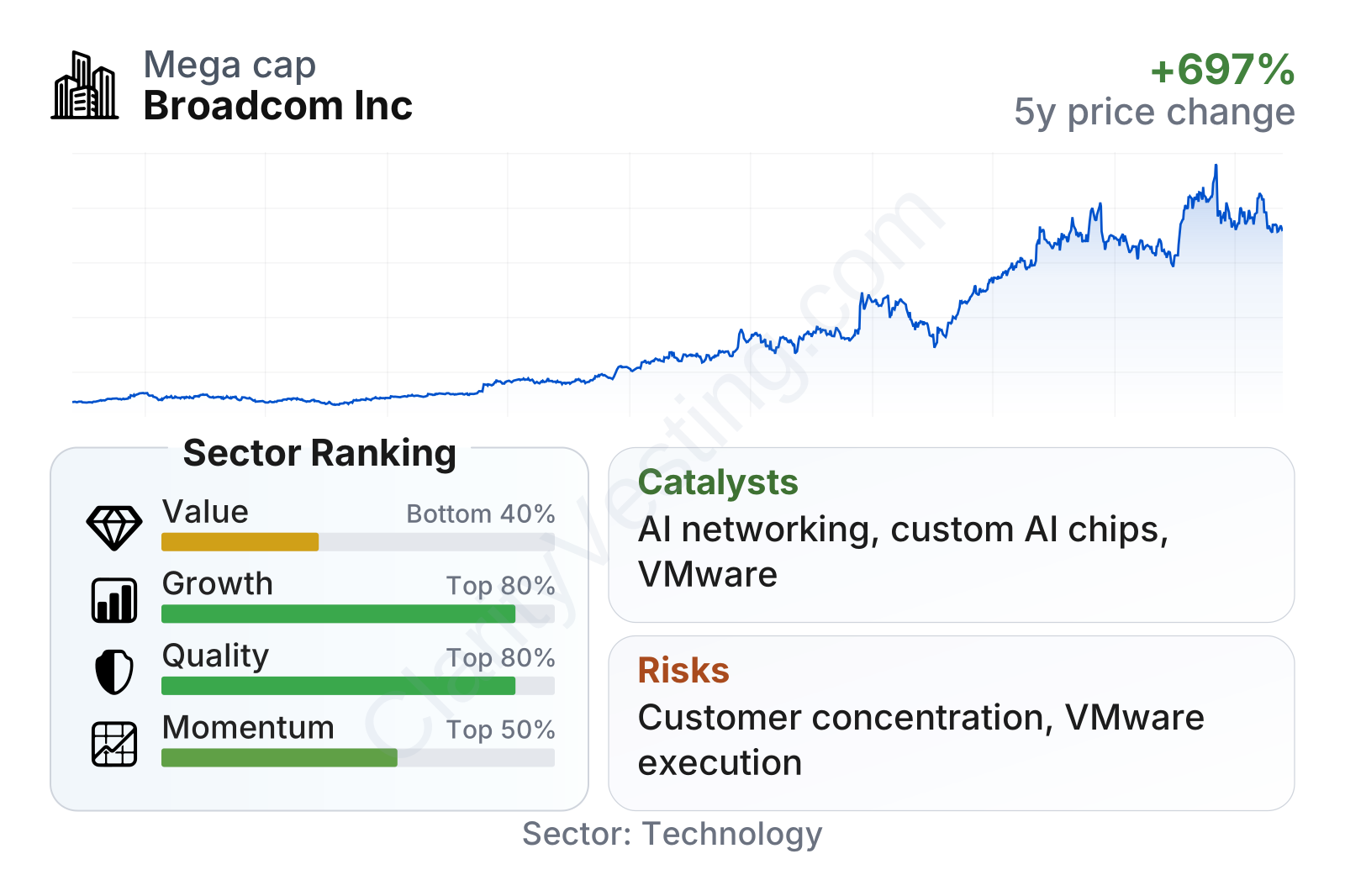
Broadcom stands out for scale, profitability, and growth. Its market value is now near the top tier of global technology companies, and the stock has delivered a very strong multiyear move, although with noticeable swings along the way. The latest profile shows a company that ranks well above much of the sector on growth and quality measures, especially operating margins, returns on invested capital, and cash generation. The weaker area is valuation, where Broadcom screens as expensive relative to the typical technology peer. Debt is also higher than the sector median, though leverage has been moving down from much higher levels.

Growth

Broadcom operates in markets that are benefiting from several durable trends: cloud computing, data center traffic, enterprise software consolidation, and above all the rapid build-out of AI infrastructure. This is an attractive backdrop because AI does not only require advanced processors; it also needs fast networking, connectivity, storage movement, and software tools to run complex computing environments. Broadcom has exposure to many of those pieces.

The company’s strategy also has a clear internal logic. Management has spent years building a portfolio of mission-critical chip franchises, then adding software businesses with sticky enterprise customers. That approach can look aggressive from the outside, but it has produced a business with very high margins and strong free cash flow. In semiconductors, Broadcom focuses less on consumer gadgets and more on complex infrastructure markets where performance, reliability, and customer relationships matter a great deal. In software, it has concentrated on products that are deeply embedded in customer operations and difficult to replace quickly.

Revenue growth has accelerated sharply compared with Broadcom’s own earlier pace and also versus the sector median. The recent pattern suggests that AI-related demand and the larger software footprint are both playing important roles. There were slower periods in 2023, but the rebound after that was strong enough to move the company back into a much faster growth category.

Cash generation reinforces the growth story. Free cash flow has risen from the low-teens billions a few years ago to roughly the low-$30 billion range on a trailing basis. That matters because it gives Broadcom room to reduce debt, invest in product development, support acquisitions, and continue capital returns without relying too heavily on external financing.

One of the strongest catalysts is Broadcom’s position in AI networking and custom silicon. As hyperscale customers build larger AI clusters, networking becomes a bigger bottleneck, not a side issue. Broadcom’s switching, connectivity, and custom chip capabilities place it in a favorable spot if AI spending remains broad-based. Another important catalyst is the VMware integration. If Broadcom continues to simplify the product portfolio, deepen large customer relationships, and raise software efficiency, infrastructure software could remain a major engine of profit growth rather than just a diversification move.

Recent company communications have continued to emphasize robust demand tied to AI infrastructure and custom accelerators, along with the expansion of software offerings around private cloud environments. In practical terms, that suggests Broadcom is not just riding a short-lived headline trend; it is positioned where spending is becoming foundational for large enterprises and cloud operators.

Risks

Broadcom’s main risk is that a great deal of optimism is now attached to the company’s AI and infrastructure narrative. When expectations become elevated, even strong results can disappoint if growth slows or customer spending becomes more concentrated. That does not mean the business is weak; it means the bar has moved higher.

Another major risk is customer concentration. Parts of Broadcom’s semiconductor business depend on a relatively small number of very large customers. In custom silicon and wireless, a handful of relationships can drive a meaningful share of revenue. That can be powerful when demand is strong, but it can also create volatility if a major customer changes design plans, timing, or suppliers.

Integration risk remains relevant as well. Broadcom has a long history of acquisitions, and the VMware deal was especially large. The company has a track record of improving margins in acquired businesses, but large integrations always carry execution risk. Changes in pricing, product packaging, or customer support can improve economics while also creating friction with customers and partners if not handled carefully.

Leverage is another point to monitor. Debt to equity has improved significantly from very elevated levels, dropping from well above 150% in earlier years to roughly 74% more recently. That is a meaningful improvement, but it is still above the sector norm. Broadcom’s cash flow makes this more manageable than it would be for many firms, yet debt remains part of the investment case and not just a background detail.

Profitability is one of Broadcom’s biggest strengths. Profit margins recovered strongly and now sit far above the typical company in the sector, approaching 40% recently versus a much lower industry norm. That suggests real competitive advantages: pricing power, efficient operations, sticky enterprise products, and a business mix tilted toward high-value infrastructure. This margin profile is an important defense against cyclical pressure.

Competitive positioning is strong, although leadership depends on the category. Broadcom is not the universal leader across all semiconductors, but it is a major force in networking chips, connectivity, and custom infrastructure silicon, and it has become highly influential in enterprise infrastructure software through VMware. Its competitive advantages include deep engineering relationships, broad intellectual property, scale, long product cycles, and products that are often embedded in customer systems for years.

Main competitors vary by segment. In semiconductors, the comparison set includes NVIDIA in AI infrastructure, Marvell in data center and networking silicon, AMD and Intel in broader compute and data center markets, and Qualcomm in connectivity and wireless-related areas. In infrastructure software and virtualization, Broadcom competes with large platform vendors such as Microsoft, Red Hat within IBM, and other cloud and enterprise software providers. Broadcom’s place in this landscape is distinctive because it combines specialized chip leadership with a large software base; few direct peers have that mix.

Regulatory and geopolitical risks also matter. Semiconductor supply chains are global, and export controls or trade restrictions can affect end markets, manufacturing partners, or customer demand. On the software side, enterprise customers may react negatively if product changes are seen as too aggressive after acquisitions. There have been public debates around VMware licensing and customer transitions, which do not amount to scandal or mismanagement on their own, but they are relevant reputation and execution issues to watch.

Valuation

Broadcom’s valuation reflects a company that the market views as both a high-quality operator and an AI-related beneficiary. That shows up clearly in earnings multiples. The stock’s price-to-earnings ratio is well above the sector median, and free cash flow yield is below the typical peer level, which usually signals a richer valuation.

The longer-term pattern is useful here. Broadcom did not always trade at such a premium. Earlier in the cycle, its earnings multiple was often closer to or even below the sector median. More recently, that premium widened dramatically as the market began to price in stronger AI demand, the enlarged software platform, and unusually high profitability. Even after coming down from extreme levels, the multiple still remains materially above the sector norm.

Whether that valuation looks stretched or justified depends on what part of Broadcom matters most. On a traditional value screen, the shares look expensive. On a growth-and-quality basis, the picture is more nuanced. Revenue growth has been far above the sector median, margins are exceptional, returns on capital are strong, and free cash flow is substantial. The PEG ratio being below 1 points to a business whose earnings growth may offset part of the headline richness in the P/E multiple. In other words, the stock is not cheap in an absolute sense, but the premium is anchored in real business performance rather than in speculation alone.

The central valuation question is therefore less about whether Broadcom is low-priced and more about how durable its current growth and profitability will be. If AI networking, custom silicon, and software monetization remain strong, the current premium has a visible foundation. If those drivers cool materially, the valuation leaves less room for error than many peers.

Conclusion

Broadcom currently looks like a powerful infrastructure technology franchise rather than a conventional chip maker. It has combined strong positions in networking and custom silicon with a large, profitable software business, producing a company with exceptional margins, heavy cash generation, and growth that has recently outpaced much of the sector. Those are meaningful strengths for a long-term view.

The main challenge is that the market already recognizes much of this progress. Expectations tied to AI, software integration, and ongoing efficiency are high, and the company still carries above-average leverage compared with many technology peers. Customer concentration and post-acquisition execution also remain important watchpoints.

Even so, Broadcom’s overall profile is hard to dismiss. The business appears unusually well placed at the intersection of AI infrastructure, enterprise software, and mission-critical connectivity. The valuation is clearly demanding, but it is being supported by strong fundamentals rather than by a thin narrative. The broad direction is that of a high-quality company with real structural advantages, offset by a premium price and a narrower margin for disappointment.

Sources:

  • Broadcom Inc. — Annual Report on Form 10-K for fiscal year ended November 3, 2025
  • Broadcom Inc. — Quarterly Report on Form 10-Q for fiscal quarter ended February 1, 2026
  • Broadcom Inc. — Investor Relations earnings materials and press releases published in 2026
  • SEC EDGAR — Broadcom Inc. filings database
  • Broadcom Inc. — VMware-related company presentations and public product materials
  • Wikipedia — Broadcom Inc.

This article is for informational purposes only and does not constitute financial advice. Some content is AI-generated. See Disclaimer


Sign up for exclusive research and insights.

Unsubscribe anytime.
