Stock Analysis · Aurora Innovation Inc (AUR)
Overview
Aurora Innovation is developing self-driving technology for heavy-duty trucks. Its core product is the Aurora Driver, a system that combines software, sensors, computing hardware, and remote support tools to enable trucks to operate with high levels of automation. The company’s near-term focus is long-haul freight, where labor shortages, fuel efficiency, and the need for around-the-clock vehicle utilization make autonomy economically attractive if the technology works reliably at scale.
Aurora is still in the pre-scale commercialization phase, which means the business case depends much more on future deployment than on current income. Based on recent company filings, revenue remains very limited and has not yet become a stable indicator of the underlying opportunity. Historically, Aurora has generated revenue mainly from collaboration and development arrangements rather than from broad commercial driverless operations.
Its revenue sources can be summarized as follows:
- Collaboration and development revenue: the large majority of reported revenue in recent periods, tied to work with strategic partners, technology integration, and related services.
- Other revenue: a very small remainder, with no meaningful recurring contribution yet from large-scale autonomous trucking operations.
For long-term analysis, the more important point is not the current mix, but the fact that Aurora has not yet built a mature recurring revenue base. The company is essentially being valued on the prospect that it can turn technical progress and partner relationships into commercial freight miles and, later, fleetwide software economics.
The financial flow over recent years shows a business spending heavily on research and development while producing little revenue. That pattern is normal for a frontier technology company, but it also means the investment case depends on whether commercialization starts to close the gap between operating costs and revenue over time.
Key Figures
| Metric | Value | Sector ⓘ |
|---|---|---|
| Date | Sep 12, 2026 | |
| Context | ||
| Sector | Consumer Cyclical | |
| Industry | Auto Parts | |
| Market Cap ⓘ | $12.69B | |
| Beta ⓘ | 2.63 | |
Value (Cheapness) | ||
| P/E Ratio ⓘ | N/A | 17.10 |
| FCF Yield ⓘ | -5.92% | 8.53% |
| EBIT / EV ⓘ | -7.53% | 6.46% |
| PEG ⓘ | N/A | |
Growth (Business expansion) | ||
| Revenue Growth ⓘ | 100.00% | 5.75% |
| RPS Growth (5Y CAGR) ⓘ | -61.34% | 9.14% |
| EPS Growth (5Y CAGR) ⓘ | -40.21% | -18.21% |
| Margin Growth (5Y Trend) ⓘ | N/A | -0.23% |
| FCF Growth (5Y CAGR) ⓘ | N/A | 4.91% |
Quality (Business durability) | ||
| ROIC (Latest) ⓘ | -33.49% | 12.61% |
| ROIC (5Y Median) ⓘ | -30.97% | 10.72% |
| Net Debt / EBIT (Latest) ⓘ | N/A | 2.10 |
| Net Debt / EBIT (5Y Median) ⓘ | N/A | 2.32 |
| Operating Margin (Latest) ⓘ | -17920.00% | 9.25% |
| Operating Margin (5Y Median) ⓘ | -1085.29% | 9.64% |
| Debt to Equity (Latest) ⓘ | 4.20% | 75.78% |
| Profit Margin (Latest) ⓘ | N/A | 5.33% |
| Free Cash Flow (Latest) ⓘ | -$751.00M | |
Momentum (Price trend) | ||
| 3Y Return ⓘ | +94.85% | +14.53% |
| 12M Return (excl. last month) ⓘ | +8.02% | +3.08% |
| 6M Return ⓘ | +51.29% | +0.55% |
| Price vs. 200-Day MA ⓘ | +18.97% | -0.54% |
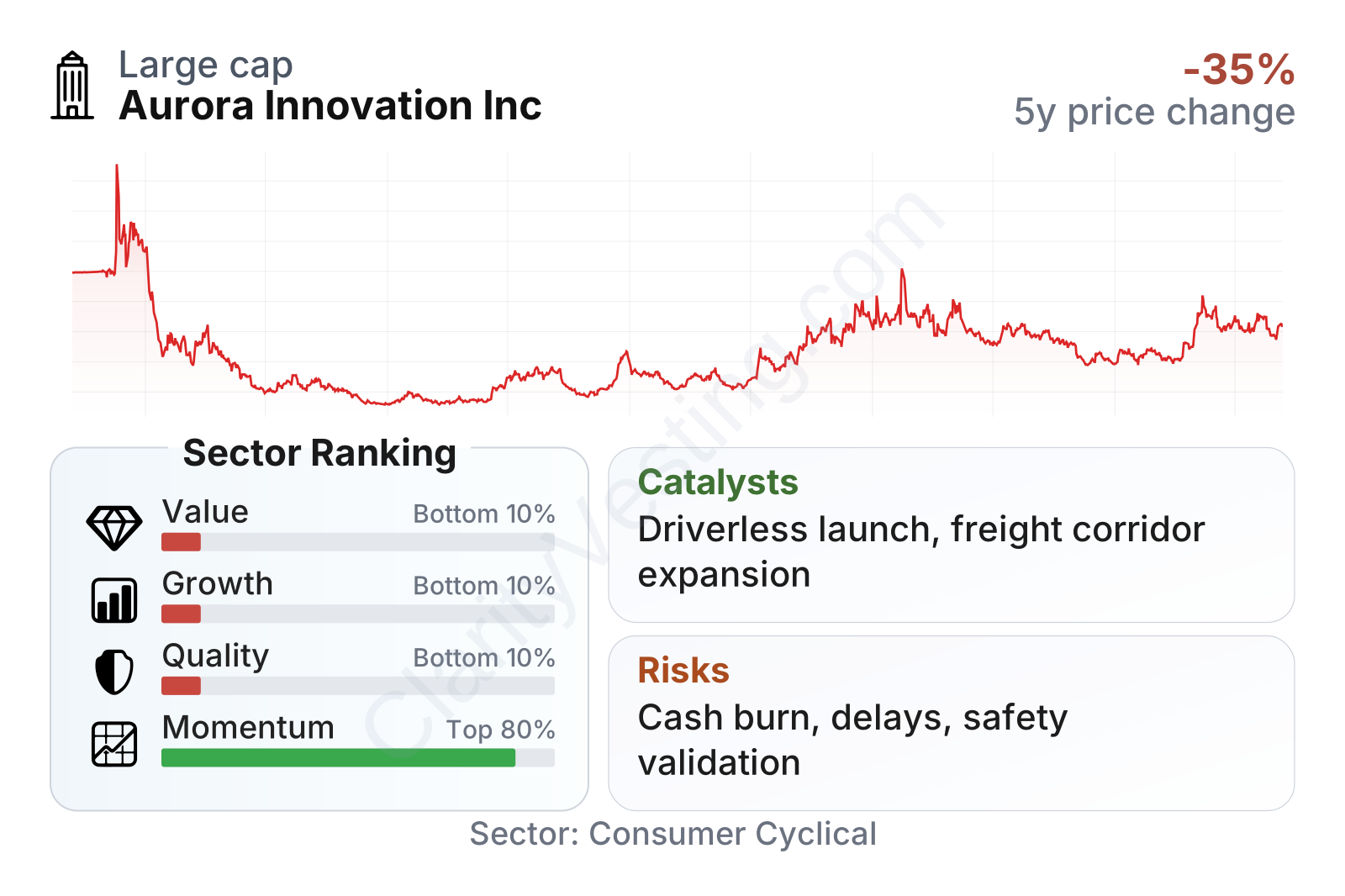
Aurora’s profile is unusual compared with most auto-related companies. It has a large market value for a business with minimal current revenue, very low leverage, and deeply negative profitability and cash generation. On factor rankings, value, growth, and quality sit near the bottom of the sector, while price momentum is much stronger. In plain terms, the market has recently become more optimistic, but the operating fundamentals still look like those of an early-stage company rather than an established industrial business.
Growth
The company operates in a sector with genuine long-term potential. Autonomous trucking addresses a large freight market, and if the technology becomes dependable and cost-effective, customers could benefit from lower operating costs, improved asset utilization, and relief from driver availability constraints. That makes the addressable market substantial, especially on highway routes that are more structured than urban driving.
Aurora’s strategy is broadly logical for this opportunity. Instead of trying to do everything alone, it has built partnerships across the trucking and automotive ecosystem, including vehicle manufacturing, freight networks, and logistics operations. This partner-based approach can reduce go-to-market friction because large fleets typically want autonomy integrated into trucks and supported by established industry participants rather than sold as a stand-alone experimental tool.
A major catalyst is the shift from testing to commercial launch. Aurora has publicly centered its roadmap on driverless trucking deployment, beginning with specific freight corridors and then expanding lane by lane. If that rollout progresses safely and on schedule, the market could begin to evaluate the business less as a research project and more as an operating platform with scalable unit economics.
Recent year-over-year revenue growth rates can look dramatic, but they should be interpreted carefully because they come off a very small base. For a company at Aurora’s stage, contract timing can create sharp percentage moves that do not necessarily mean the commercial model has fully arrived.
Free cash flow remains strongly negative, which is a reminder that growth today is still being financed rather than self-funded. Even so, the strategic opportunity remains significant because the autonomous trucking market is still early, and a successful first mover in highway freight could gain real advantages through route data, safety validation, operational experience, and customer trust.
Recent company updates have reinforced that Aurora is moving closer to commercial operations rather than stepping back from the market. For a long-term view, that transition matters more than near-term accounting revenue because the key question is whether the company can prove repeatable autonomous trucking in the real world.
Risks
This article is for informational purposes only and does not constitute financial advice. Some content is AI-generated. See Disclaimer


