Stock Analysis · A10 Network (ATEN)
Overview
A10 Networks develops cybersecurity and networking software and appliances that help businesses, telecom operators, cloud providers, and public-sector organizations keep applications available, secure digital traffic, and manage increasingly complex networks. In simple terms, the company sits between users and critical online services, helping customers block attacks, balance traffic, and maintain performance.
Its business is built around a few core product families. The largest revenue stream comes from secure application services and related infrastructure products, including load balancing and application delivery. A second major source comes from security offerings such as DDoS protection, web application and API protection, and secure access tools. A third layer comes from support, maintenance, and other recurring service revenue tied to installed products.
Based on recent company disclosures, A10’s revenue mix can be summarized approximately as follows:
- Product revenue: about 60% to 65% — hardware appliances, perpetual or term software, and solutions for application delivery, security, and network traffic management.
- Service revenue: about 35% to 40% — maintenance, support, training, and other services attached to customer deployments.
Within products and services, the business is also increasingly oriented around a few end markets: enterprises, service providers, and government customers. The company has been emphasizing cybersecurity, 5G infrastructure, and AI-related traffic protection as strategic areas, especially where customers need to secure high-performance networks and APIs.
A10 is still a relatively small company by technology-sector standards, which matters because it gives the business room to grow, but it also means customer concentration and deal timing can have a more visible impact on results than at larger rivals. One encouraging feature is that gross profit has remained high over time, which is typical of software-heavy infrastructure businesses and gives management flexibility to keep investing in research and development.
The flow of revenue into profit also shows a business that has preserved healthy gross margins while continuing to spend meaningfully on product development. Research and development has remained a major use of operating dollars, which fits a company trying to stay relevant in fast-moving security and network markets.
Key Figures
| Metric | Value | Sector ⓘ |
|---|---|---|
| Date | Sep 12, 2026 | |
| Context | ||
| Sector | Technology | |
| Industry | Software - Infrastructure | |
| Market Cap ⓘ | $1.80B | |
| Beta ⓘ | 1.12 | |
Value (Cheapness) | ||
| P/E Ratio ⓘ | 41.93 | 29.51 |
| FCF Yield ⓘ | 3.39% | 4.25% |
| EBIT / EV ⓘ | 3.40% | 2.85% |
| PEG ⓘ | 14.76 | |
Growth (Business expansion) | ||
| Revenue Growth ⓘ | 15.50% | 15.40% |
| RPS Growth (5Y CAGR) ⓘ | 6.03% | 8.56% |
| EPS Growth (5Y CAGR) ⓘ | -16.74% | -11.88% |
| Margin Growth (5Y Trend) ⓘ | 4.53% | 0.46% |
| FCF Growth (5Y CAGR) ⓘ | 9.58% | 9.80% |
Quality (Business durability) | ||
| ROIC (Latest) ⓘ | 10.12% | 9.44% |
| ROIC (5Y Median) ⓘ | 24.82% | 8.30% |
| Net Debt / EBIT (Latest) ⓘ | 2.96 | 0.54 |
| Net Debt / EBIT (5Y Median) ⓘ | -1.27 | 0.44 |
| Operating Margin (Latest) ⓘ | 17.95% | 9.58% |
| Operating Margin (5Y Median) ⓘ | 18.04% | 8.25% |
| Debt to Equity (Latest) ⓘ | 92.25% | 33.33% |
| Profit Margin (Latest) ⓘ | 13.85% | 7.14% |
| Free Cash Flow (Latest) ⓘ | $60.94M | |
Momentum (Price trend) | ||
| 3Y Return ⓘ | +72.60% | +45.48% |
| 12M Return (excl. last month) ⓘ | +56.13% | +23.48% |
| 6M Return ⓘ | +17.98% | +20.93% |
| Price vs. 200-Day MA ⓘ | -0.59% | +7.43% |
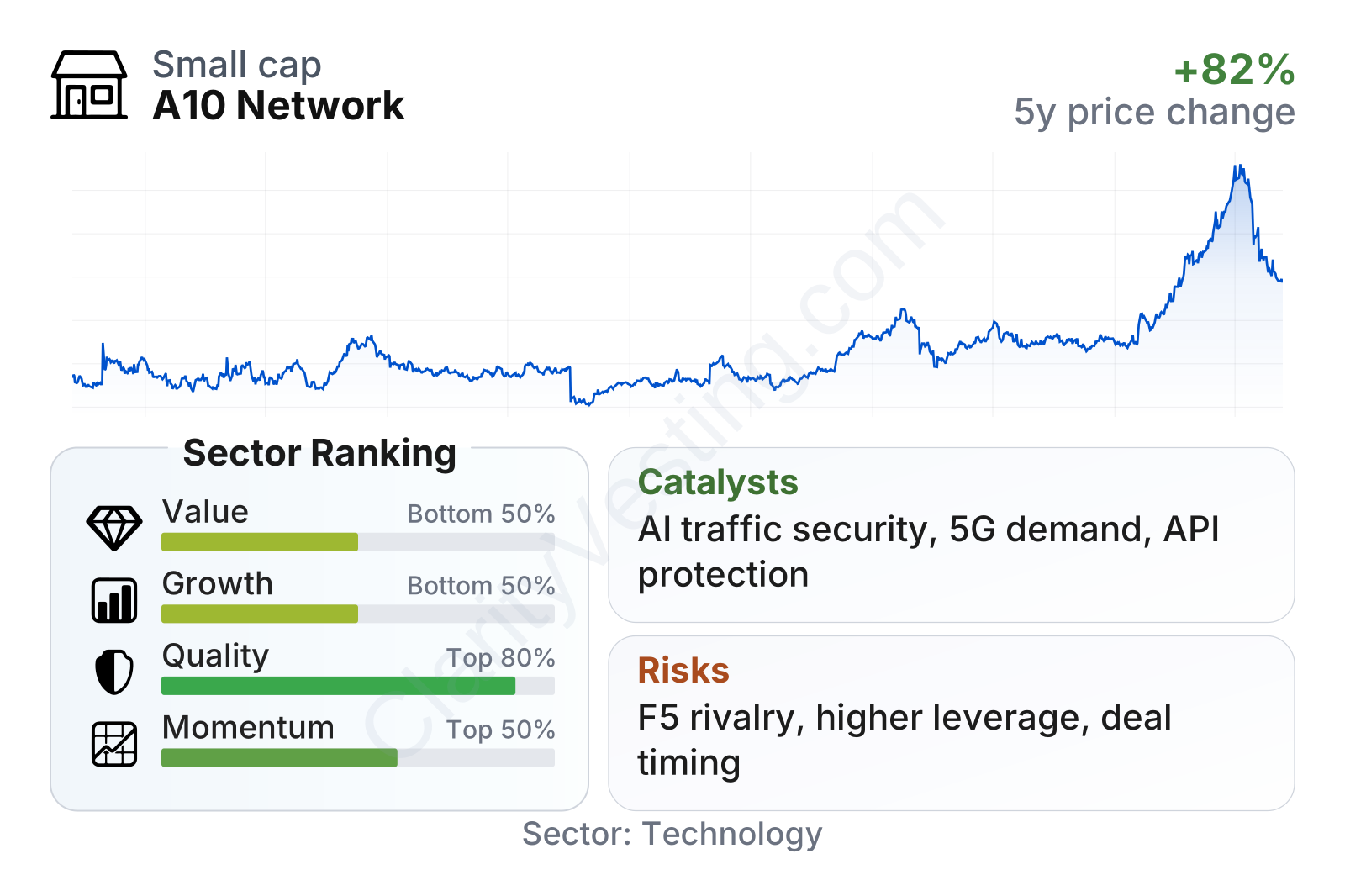
A10 currently sits in a mixed but generally solid fundamental position. Profitability and capital efficiency look stronger than much of the software infrastructure sector, with operating and net margins clearly above typical peers. Growth is positive and near the sector’s middle range, but not exceptional over a five-year view. The biggest weak point is valuation: earnings and cash flow multiples are not low compared with the industry, especially after the strong share-price run.
The stock’s recent performance has been much stronger than the sector median over the last three years and over the last year excluding the most recent month, which suggests the market has become more optimistic about the company’s prospects. At the same time, the balance-sheet picture is less conservative than it used to be, so the quality profile is no longer as straightforward as the margin profile alone would suggest.
Growth
A10 operates in markets that are supported by durable long-term demand: cybersecurity, application delivery, cloud networking, API security, and carrier-grade infrastructure. These are not short-lived themes. Enterprises and telecom operators continue shifting more workloads online, protecting more APIs, and handling larger volumes of encrypted traffic. That creates steady demand for tools that inspect, optimize, and defend network traffic without slowing it down.
The company’s strategy broadly makes sense for this environment. It is focusing on areas where performance matters and where customers often prefer integrated platforms rather than a patchwork of point products. Management has also been steering the portfolio toward software, subscriptions, and security use cases, which can improve recurring revenue quality over time even if the transition is uneven quarter to quarter.
Revenue growth has not been perfectly smooth, but the recent pattern is better than the 2023 slowdown might suggest. After several weak quarters in 2023, growth returned in 2024 and strengthened further into 2025 and 2026, recently running in the mid-teens range year over year. That points to renewed demand momentum rather than a business stuck in low growth.
Cash generation remains another positive element. Free cash flow has moved around from year to year, but it has stayed solid overall and remains meaningful for a company of this size. That matters because it gives A10 room to fund product development, support acquisitions or partnerships, and absorb sales volatility without depending heavily on external financing.
A meaningful catalyst is the expansion of AI-related infrastructure. As AI workloads raise traffic volumes and increase the need for high-performance networking and security, vendors that can protect APIs, manage encrypted traffic, and defend against large-scale attacks may see broader demand. A10 has been positioning its products around this trend, especially in secure application delivery and cyber defense. Another catalyst is telecom modernization, including 5G and edge traffic growth, where A10 already has experience with service-provider customers.
Recent company communications have also highlighted progress in security offerings and new customer wins across enterprise and service-provider accounts. For a company of A10’s size, these launches and contract additions can materially influence sentiment because they show that the platform is still commercially relevant in a crowded market.
Risks
This article is for informational purposes only and does not constitute financial advice. Some content is AI-generated. See Disclaimer


