Stock Analysis · Academy Sports Outdoors Inc (ASO)
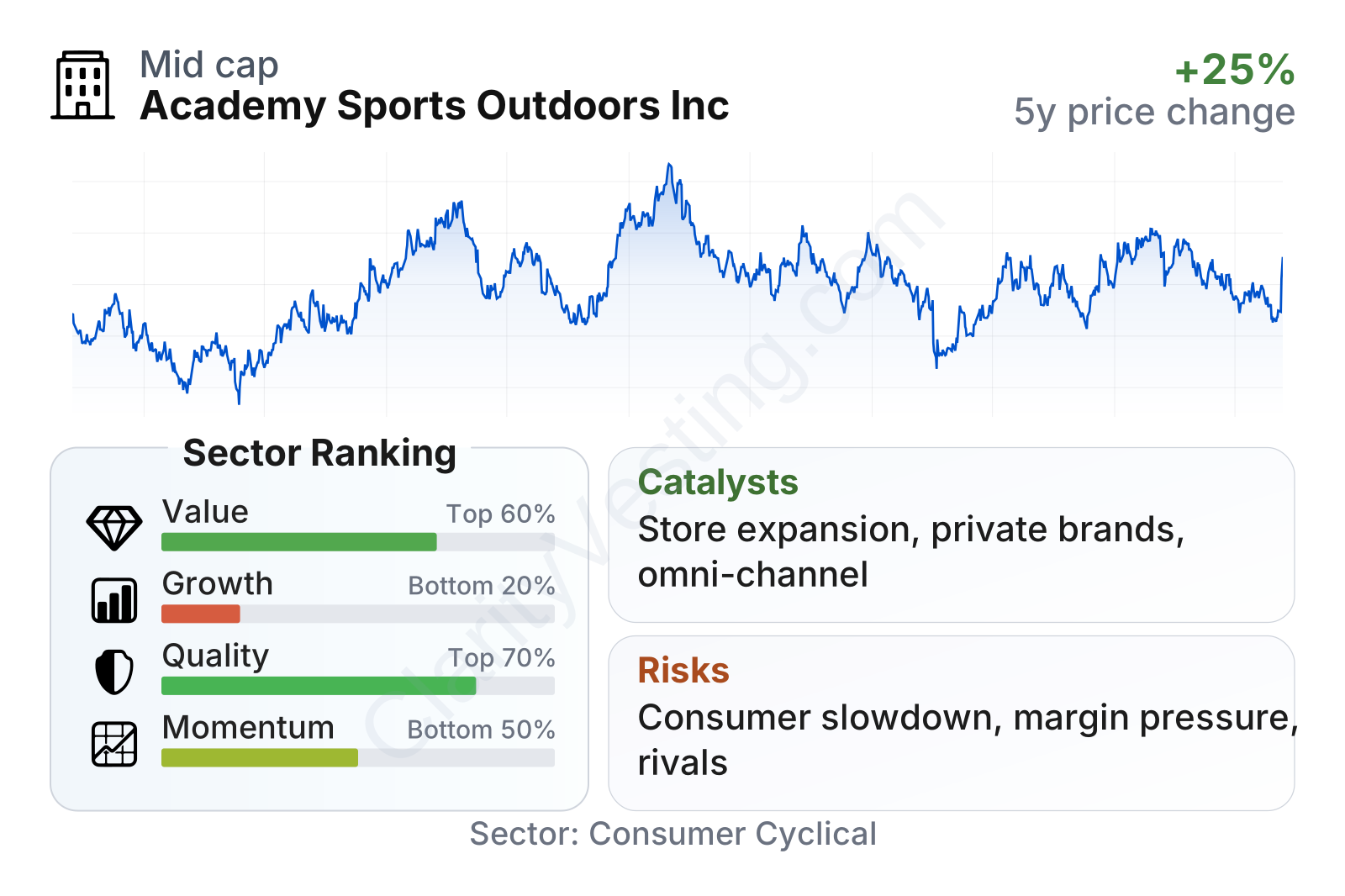
Stock Analysis · Academy Sports Outdoors Inc (ASO)

Overview

Academy Sports + Outdoors is a large sporting goods and outdoor recreation retailer in the United States. The company sells products for team sports, exercise, hunting, fishing, camping, backyard recreation, footwear, and apparel. Its stores are concentrated mainly in the South, Southeast, and Midwest, and it also operates an e-commerce business that extends its reach beyond its physical footprint. The basic idea behind the business is straightforward: offer a broad assortment at value-oriented prices to households that want both everyday athletic gear and outdoor lifestyle products.

Revenue comes primarily from merchandise sales through stores, with digital sales adding a smaller but strategically important share. Based on company disclosures, sales are usually spread across several major merchandise categories rather than relying on a single product line.

  • Outdoor: roughly the largest category, including hunting, fishing, camping, marine, and related gear.
  • Sports & Recreation: a major contributor, covering team sports, fitness, and recreational equipment.
  • Apparel: a meaningful share, including activewear, casual clothing, and seasonal items.
  • Footwear: another important segment, including athletic shoes, work boots, and casual footwear.
  • E-commerce and other: comparatively smaller as a separate channel, though online demand supports overall sales across categories.

The business model is attractive when consumers continue spending on affordable leisure activities close to home. It is less dependent on one premium niche than some competitors, but it is still exposed to discretionary spending trends. Over the last several years, the company has shown that it can remain profitable even as demand normalized after the unusually strong pandemic period, although margins have come down from peak levels.

The flow of the business over time shows a retailer that remains solidly profitable but is working through slower demand and heavier operating costs. Revenue and gross profit have held up better than net income, while selling and administrative expenses have taken a bigger share of sales more recently. That combination helps explain why earnings have softened even though the top line has stabilized.

Key Figures

MetricValueSector
DateJul 18, 2026
Context
SectorConsumer Cyclical
IndustrySpecialty Retail
Market Cap $3.01B
Beta 1.05
Value
(Cheapness)
P/E Ratio 8.5918.58
FCF Yield 7.85%7.99%
EBIT / EV 11.63%5.91%
PEG 0.58
Growth
(Business expansion)
Revenue Growth 6.70%5.50%
RPS Growth (5Y CAGR) 5.49%9.20%
EPS Growth (5Y CAGR) -48.00%-26.43%
Margin Growth (5Y Trend) -4.74%-0.18%
FCF Growth (5Y CAGR) -21.91%5.02%
Quality
(Business durability)
ROIC (Latest) 15.75%12.03%
ROIC (5Y Median) 23.84%10.82%
Net Debt / EBIT (Latest) 3.052.12
Net Debt / EBIT (5Y Median) 1.902.25
Operating Margin (Latest) 8.59%9.28%
Operating Margin (5Y Median) 11.51%9.64%
Debt to Equity (Latest) 91.98%75.23%
Profit Margin (Latest) 6.24%5.28%
Free Cash Flow (Latest) $236.75M
Momentum
(Price trend)
3Y Return -10.59%+10.68%
12M Return (excl. last month) +11.72%+5.26%
6M Return -16.27%-2.41%
Price vs. 200-Day MA -7.86%+1.55%
Better than sector median
Slightly worse than sector median
More than 20% worse than sector median

Academy Sports + Outdoors sits in the mid-cap range, with a market value a little above $3 billion, and its stock volatility is close to the broader market rather than extreme. The table points to a mixed profile: valuation looks inexpensive compared with much of the sector, quality is relatively solid, but long-term growth indicators are weak. Profitability remains respectable, especially on returns on invested capital, yet the company is no longer operating at the exceptional earnings level it reached earlier in the cycle.

The stock’s longer-term price path has been uneven. It climbed strongly after its public market debut, then moved through sharp swings as investors reassessed how sustainable pandemic-era demand really was. More recently, the share price has shown some recovery, but it still reflects caution around the company’s earnings trajectory rather than broad optimism.

Growth

Academy operates in a retail niche that has attractive long-term characteristics, even if it is not a high-growth industry. Sports participation, health and wellness spending, youth athletics, outdoor recreation, and demand for functional apparel all support the category over time. These are durable consumer habits, but they do not automatically translate into fast growth for every retailer. Execution matters a lot: store placement, inventory discipline, pricing, private brands, and customer convenience are what separate steady performers from weaker ones.

The company’s strategy for future expansion is sensible. Management has emphasized opening new stores in underpenetrated markets, improving supply chain capabilities, growing digital engagement, and increasing penetration of private-label and exclusive brands. That matters because new stores can expand the revenue base, while owned brands can support gross margin and help differentiate the assortment from rivals selling many of the same national labels.

Recent sales trends suggest the business may be moving out of a long normalization phase. Year-over-year revenue was negative for an extended stretch after the pandemic boom faded, but the latest pattern shows a return to positive growth. That does not mean the company is suddenly in a rapid expansion phase; it does suggest demand has become more stable and comparisons are easier. In the context of a retailer that had been digesting several softer quarters, that shift is meaningful.

Cash generation remains positive, which is important for a company balancing expansion, inventory needs, and shareholder returns. However, free cash flow has trended down from the very strong levels reached a few years ago. In practical terms, Academy is still producing cash, but it has less room for error than it did at its peak. For long-term analysis, that makes future store productivity and margin discipline central to the growth case.

One of the clearest catalysts is whitespace expansion. Academy still has a smaller store base than the largest national chains, and management has identified room to enter more markets over time. If newer locations perform well, they can lift sales and improve brand awareness beyond the company’s traditional regional stronghold. Another opportunity is the company’s focus on value, which can resonate when consumers trade down from higher-priced alternatives without leaving the category altogether.

Recent company communications have also highlighted ongoing store openings and operational initiatives aimed at supporting broader geographic reach. That is notable because the most credible growth path here is not based on a dramatic industry shift, but on consistent execution in physical expansion, merchandising, and omnichannel convenience.

Risks

The biggest risk is that Academy remains a discretionary retailer. If consumer budgets tighten, categories such as sporting equipment, outdoor gear, footwear, and apparel can all come under pressure. Even when traffic holds up, shoppers may shift toward lower-priced items or wait for promotions, which can squeeze margins. This is especially relevant because the company has already been operating with lower profitability than during its post-pandemic peak.

Balance sheet risk is not extreme, but leverage deserves attention. Debt relative to equity has improved from earlier highs, yet it remains somewhat above the sector median in the latest reading. Net debt relative to EBIT is also on the heavier side versus many peers. That does not point to immediate distress, but it does reduce flexibility if the business faces another prolonged earnings slowdown.

Profit margins tell a nuanced story. Academy’s net margin remains above the sector median, which shows the company still runs a fairly efficient retail model. The issue is direction: margins have been trending down over time from unusually strong levels. A business can remain profitable and still lose market confidence if investors see a steady step-down in earnings power.

Competition is intense. The main rivals include Dick’s Sporting Goods, Bass Pro Shops and Cabela’s, Walmart, Target, and online platforms such as Amazon for many overlapping categories. Dick’s is generally the strongest direct public-market comparison, with a larger national footprint, stronger brand visibility, and a premium position in key athletic categories. Academy’s counterweight is its value orientation, regional density, hunting and fishing exposure, and a customer mix that spans both sports and outdoor living. It is not the clear national leader, but it occupies a useful middle ground between specialty assortment and mass-market affordability.

Its competitive advantages are real but not unassailable. Store locations in many Southern markets, broad category coverage, recognized private brands, and a reputation for value help it defend share. Still, most of what it sells can also be found elsewhere, so pricing, availability, and convenience remain crucial. That makes execution risk more important than for a company protected by unique technology or a hard-to-replicate network effect.

No major scandal or governance breakdown stands out in recent official disclosures, but operating risk remains present in more ordinary forms: inventory misreads, tariff or sourcing pressure, weather effects on seasonal demand, and the challenge of expanding into new markets without weakening returns. For a retailer, these operational details can have a large impact on results even without headline-grabbing controversy.

Valuation

On conventional earnings valuation, Academy looks inexpensive. Its price-to-earnings multiple is well below the sector median and has stayed below the broader peer group for years. The same general picture appears in enterprise-value-based earnings measures, which also suggest the market is assigning a fairly restrained valuation to the business.

That discount exists for understandable reasons. The market is not treating Academy like a high-growth retailer, and the weak longer-term growth metrics support that caution. Earnings per share and free cash flow have both come down materially from earlier highs, and margin trends are less favorable than they once were. In other words, the low multiple is not simply a sign of neglect; it reflects a debate about what the company’s normalized earnings power really is.

At the same time, the current valuation does not imply a broken business. The company still generates profit, produces cash, and posts returns on invested capital that compare well with much of the sector. If store expansion and sales stabilization continue, the present multiple leaves room for the market to reassess the company more favorably. If margins continue to erode, the discount may prove justified. The stock therefore looks more like a business priced for moderation than one priced for strong optimism.

Conclusion

Academy Sports + Outdoors stands out as a profitable specialty retailer with a practical niche: value-focused sporting goods and outdoor merchandise in markets where its format still has room to expand. The company is no longer showing the extraordinary earnings strength seen in the years immediately after the pandemic, and that slowdown is visible in margins, free cash flow, and growth rankings. Even so, the core business remains healthy enough to generate solid returns and support expansion.

The central question is less about survival and more about durability. Academy appears well positioned to remain a relevant operator, but its long-term appeal depends on whether new stores, private brands, and steadier demand can offset the pressure of a highly competitive and cyclical retail environment. With the shares trading at a relatively modest earnings multiple, the market is clearly skeptical of a major growth revival. That skepticism looks understandable, but it may also understate the value of a disciplined retailer that is still profitable, still expanding, and still stronger than its muted valuation suggests.

Sources:

  • Academy Sports + Outdoors, Inc. — Annual Report on Form 10-K for fiscal year ended January 31, 2026
  • Academy Sports + Outdoors, Inc. — Quarterly Report(s) on Form 10-Q filed in 2026
  • Academy Sports + Outdoors, Inc. — Current Report(s) on Form 8-K filed in 2026
  • SEC EDGAR — Academy Sports + Outdoors, Inc. filings database
  • Academy Sports + Outdoors Investor Relations — 2026 earnings releases and presentation materials
  • Academy Sports + Outdoors Investor Relations — company overview and store expansion updates
  • Wikipedia — Academy Sports + Outdoors

This article is for informational purposes only and does not constitute financial advice. Some content is AI-generated. See Disclaimer


Sign up for exclusive research and insights.

Unsubscribe anytime.
