Stock Analysis · Amer Sports Inc (AS)
Overview
Amer Sports is a global sporting goods company that owns a portfolio of premium brands focused on outdoor gear, winter sports, and athletic apparel and footwear. The group is best known for Arc’teryx, Salomon, and Wilson. Its products range from technical jackets and trail-running shoes to tennis rackets, baseball gloves, ski equipment, and team sports gear. The company operates through wholesale partners, company-owned stores, e-commerce, and selected franchise locations, which gives it exposure to both brand building and direct consumer demand.
Revenue is mainly organized by brand platforms and consumer categories. Based on recent company reporting, the business is roughly split as follows:
- Technical Apparel, led by Arc’teryx: about 40% to 45% — premium outdoor clothing and equipment, especially shell jackets, insulated apparel, backpacks, and related gear.
- Outdoor Performance, led by Salomon: about 30% to 35% — trail-running shoes, hiking footwear, ski gear, apparel, and outdoor equipment.
- Ball & Racquet Sports, led by Wilson: about 20% to 25% — tennis, baseball, basketball, golf, and team sports products including rackets, balls, gloves, and accessories.
Geographically, Amer Sports has increasingly benefited from international demand, with strong positions in North America, Greater China, and EMEA. A notable feature of the model is its mix of premium brands with different seasonality and end markets: Arc’teryx is driven by high-end outdoor apparel, Salomon by performance outdoor activity and winter sports, and Wilson by recurring participation in racket and team sports.
The broad financial picture has improved meaningfully over the last few years: sales have expanded from a little above $3.0 billion in 2021 to around $6.6 billion on the latest trailing basis shown here, gross profit has risen strongly, and interest expense has fallen sharply. That combination helps explain the shift from losses earlier in the decade to much healthier profitability more recently.
Key Figures
| Metric | Value | Sector ⓘ |
|---|---|---|
| Date | Sep 12, 2026 | |
| Context | ||
| Sector | Consumer Cyclical | |
| Industry | Leisure | |
| Market Cap ⓘ | $16.33B | |
| Beta ⓘ | 1.98 | |
Value (Cheapness) | ||
| P/E Ratio ⓘ | 28.64 | 17.10 |
| FCF Yield ⓘ | 4.20% | 8.53% |
| EBIT / EV ⓘ | 5.43% | 6.46% |
| PEG ⓘ | 0.44 | |
Growth (Business expansion) | ||
| Revenue Growth ⓘ | 32.10% | 5.75% |
| RPS Growth (5Y CAGR) ⓘ | 16.81% | 9.14% |
| EPS Growth (5Y CAGR) ⓘ | 0.43% | -18.21% |
| Margin Growth (5Y Trend) ⓘ | 5.28% | -0.23% |
| FCF Growth (5Y CAGR) ⓘ | 25.65% | 4.91% |
Quality (Business durability) | ||
| ROIC (Latest) ⓘ | 9.10% | 12.61% |
| ROIC (5Y Median) ⓘ | N/A | 10.72% |
| Net Debt / EBIT (Latest) ⓘ | 0.43 | 2.10 |
| Net Debt / EBIT (5Y Median) ⓘ | 20.79 | 2.32 |
| Operating Margin (Latest) ⓘ | 11.92% | 9.25% |
| Operating Margin (5Y Median) ⓘ | 6.75% | 9.64% |
| Debt to Equity (Latest) ⓘ | 16.04% | 75.78% |
| Profit Margin (Latest) ⓘ | 7.35% | 5.33% |
| Free Cash Flow (Latest) ⓘ | $686.00M | |
Momentum (Price trend) | ||
| 3Y Return ⓘ | N/A | +14.53% |
| 12M Return (excl. last month) ⓘ | -11.83% | +3.08% |
| 6M Return ⓘ | -13.23% | +0.55% |
| Price vs. 200-Day MA ⓘ | -20.70% | -0.54% |
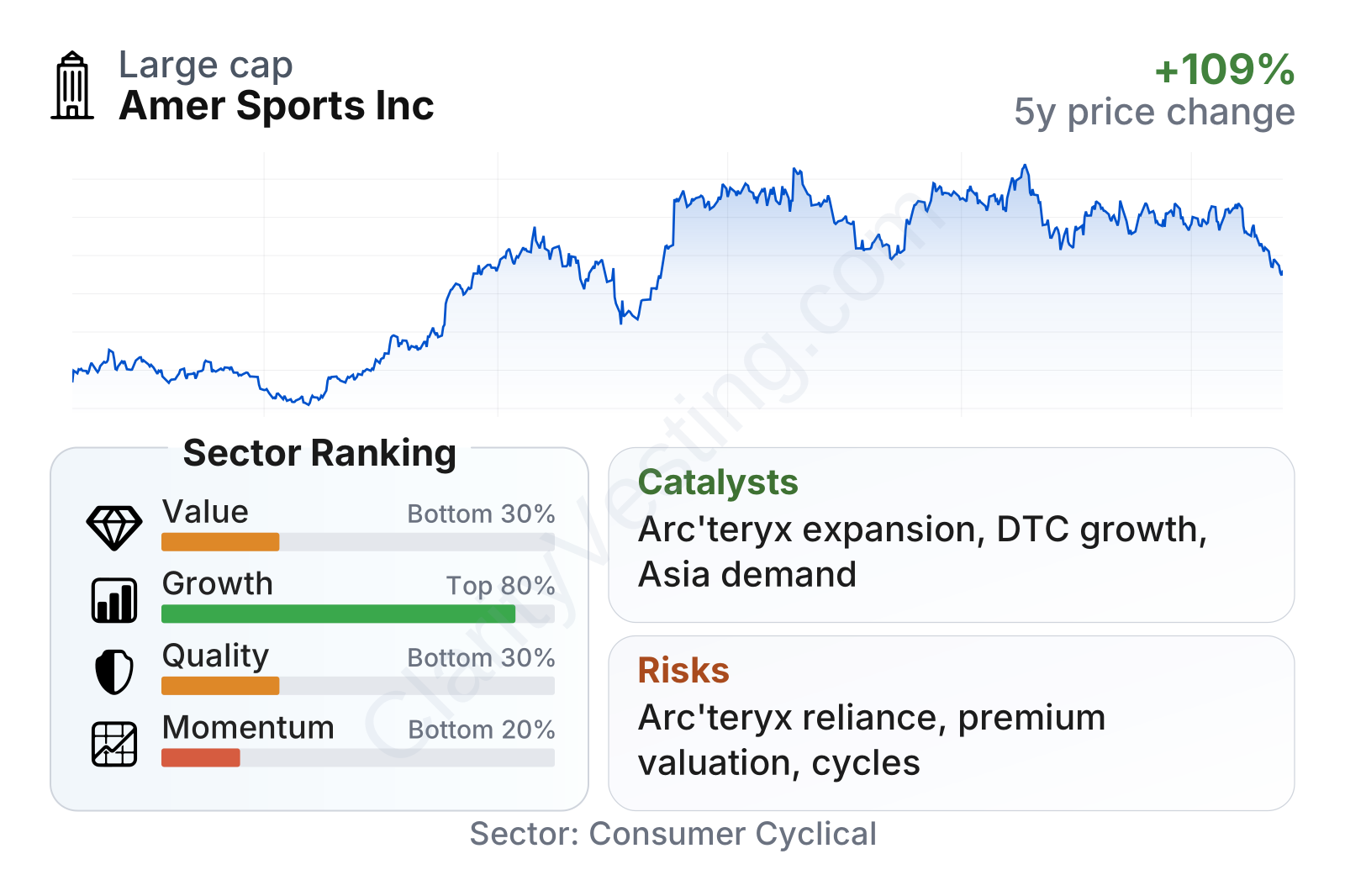
Amer Sports is now a large public company with a market value around the high-teens billions of dollars, but the share price has been volatile since listing. The stock moved from the low teens in early 2024 to the mid-$30s by mid-2026, with several large swings along the way. That volatility fits a business that is still being re-rated by the market as profitability improves and growth remains unusually strong for its sector.
The metrics table shows a business with strong growth, improving cash generation, and relatively conservative leverage, but also a stock that screens as more expensive than the sector median. Revenue growth of roughly 32% year over year stands far above the sector median near 6%, while operating margin and profit margin are also above typical sector levels. At the same time, the company’s P/E ratio remains well above the sector median, which means the market is already pricing in a meaningful part of the growth outlook.
Growth
Amer Sports operates in parts of the consumer market that have attractive long-term characteristics: premium outdoor apparel, performance footwear, racket sports, and health-and-wellness related participation trends. These categories have benefited from a durable shift toward active lifestyles, technical clothing worn both for sport and everyday use, and a greater willingness among consumers to pay for recognized premium brands.
The company’s strategy for future expansion is fairly clear. It is leaning heavily into premiumization, direct-to-consumer sales, and international brand development. Arc’teryx is the standout growth engine because it combines high pricing power, strong brand identity, and room for store expansion and digital penetration. Salomon adds exposure to trail running and outdoor performance, which are still growing globally, while Wilson gives the group a more stable presence in established sports categories.
Recent growth has not just been positive; it has stayed at a high level for several quarters, running around 24% to 32% year over year before reaching roughly 32% most recently. That consistency matters because it suggests the company is not relying on a single short-lived rebound. It also compares very favorably with most consumer discretionary peers.
Cash generation has improved sharply as well. Free cash flow has climbed from under $0.1 billion in late 2024 to nearly $0.5 billion by early 2026 on the periods shown, while the latest trailing twelve-month figure in the metrics table is around $0.7 billion. For a branded consumer company, that is important because it creates more flexibility for store openings, marketing, product innovation, supply-chain investment, and balance-sheet strengthening without depending as heavily on outside financing.
A meaningful catalyst is the company’s continued expansion of Arc’teryx and Salomon in Asia and through direct sales channels. Another is margin improvement: interest expense has fallen substantially from earlier periods, and stronger scale is helping more revenue convert into operating profit. Recent company updates have also pointed to ongoing brand momentum in technical apparel and outdoor performance, which supports the view that Amer Sports is gaining share rather than merely following category growth.
Risks
This article is for informational purposes only and does not constitute financial advice. Some content is AI-generated. See Disclaimer


