Stock Analysis · Arrow Electronics Inc (ARW)
Overview
Arrow Electronics is a large technology distributor and solutions provider. In simple terms, it sits between chipmakers and equipment manufacturers on one side, and business customers on the other. It helps customers source electronic components, enterprise computing products, and related engineering and supply-chain services. The company has operations across the Americas, Europe, the Middle East and Africa, and Asia-Pacific.
Its business is mainly organized into two large segments. Based on recent annual reporting, the revenue mix is approximately as follows:
- Global Components: about 69% of revenue. This unit distributes semiconductors, passive and electromechanical parts, and embedded components used in industrial equipment, transportation, aerospace, communications, and many other products. It also includes design engineering support and supply-chain services.
- Global Enterprise Computing Solutions: about 31% of revenue. This unit distributes data center, cloud, storage, security, networking, and software products, along with value-added services such as configuration, integration, and lifecycle support.
This mix matters because Arrow is not a pure chip company and not a pure software company. It is primarily a scale distribution business: very high revenue, but relatively thin margins. That structure can make the business more resilient than a single-product manufacturer, but it also means efficiency, inventory discipline, and customer demand cycles have an outsized effect on results.
Over the last several years, revenue and profit have been cyclical rather than steadily rising. The business expanded strongly in 2021 and 2022, then faced a broad slowdown in 2023 and 2024 as electronics demand normalized and customers worked through excess inventories. During 2025, sales began to recover, showing that Arrow remains tightly linked to the broader electronics and enterprise IT spending cycle.
The long-term pattern shows a business with a very large cost base relative to sales, which is normal for distribution. Gross profit and operating income improved materially in 2022, then compressed during the downturn in 2023 and 2024, with some stabilization afterward. That helps explain why Arrow can look inexpensive on earnings multiples while still carrying meaningful cyclicality.
Key Figures
| Metric | Value | Sector ⓘ |
|---|---|---|
| Date | Sep 12, 2026 | |
| Context | ||
| Sector | Technology | |
| Industry | Electronics & Computer Distribution | |
| Market Cap ⓘ | $10.87B | |
| Beta ⓘ | 1.19 | |
Value (Cheapness) | ||
| P/E Ratio ⓘ | 13.72 | 29.51 |
| FCF Yield ⓘ | 8.28% | 4.25% |
| EBIT / EV ⓘ | 8.58% | 2.85% |
| PEG ⓘ | 0.94 | |
Growth (Business expansion) | ||
| Revenue Growth ⓘ | 31.80% | 15.40% |
| RPS Growth (5Y CAGR) ⓘ | 5.88% | 8.56% |
| EPS Growth (5Y CAGR) ⓘ | -19.06% | -11.88% |
| Margin Growth (5Y Trend) ⓘ | -1.52% | 0.46% |
| FCF Growth (5Y CAGR) ⓘ | N/A | 9.80% |
Quality (Business durability) | ||
| ROIC (Latest) ⓘ | 9.19% | 9.44% |
| ROIC (5Y Median) ⓘ | 12.32% | 8.30% |
| Net Debt / EBIT (Latest) ⓘ | 1.75 | 0.54 |
| Net Debt / EBIT (5Y Median) ⓘ | 2.40 | 0.44 |
| Operating Margin (Latest) ⓘ | 3.07% | 9.58% |
| Operating Margin (5Y Median) ⓘ | 4.51% | 8.25% |
| Debt to Equity (Latest) ⓘ | 30.99% | 33.33% |
| Profit Margin (Latest) ⓘ | 2.26% | 7.14% |
| Free Cash Flow (Latest) ⓘ | $899.34M | |
Momentum (Price trend) | ||
| 3Y Return ⓘ | +80.92% | +45.48% |
| 12M Return (excl. last month) ⓘ | +70.42% | +23.48% |
| 6M Return ⓘ | +62.39% | +20.93% |
| Price vs. 200-Day MA ⓘ | +32.90% | +7.43% |
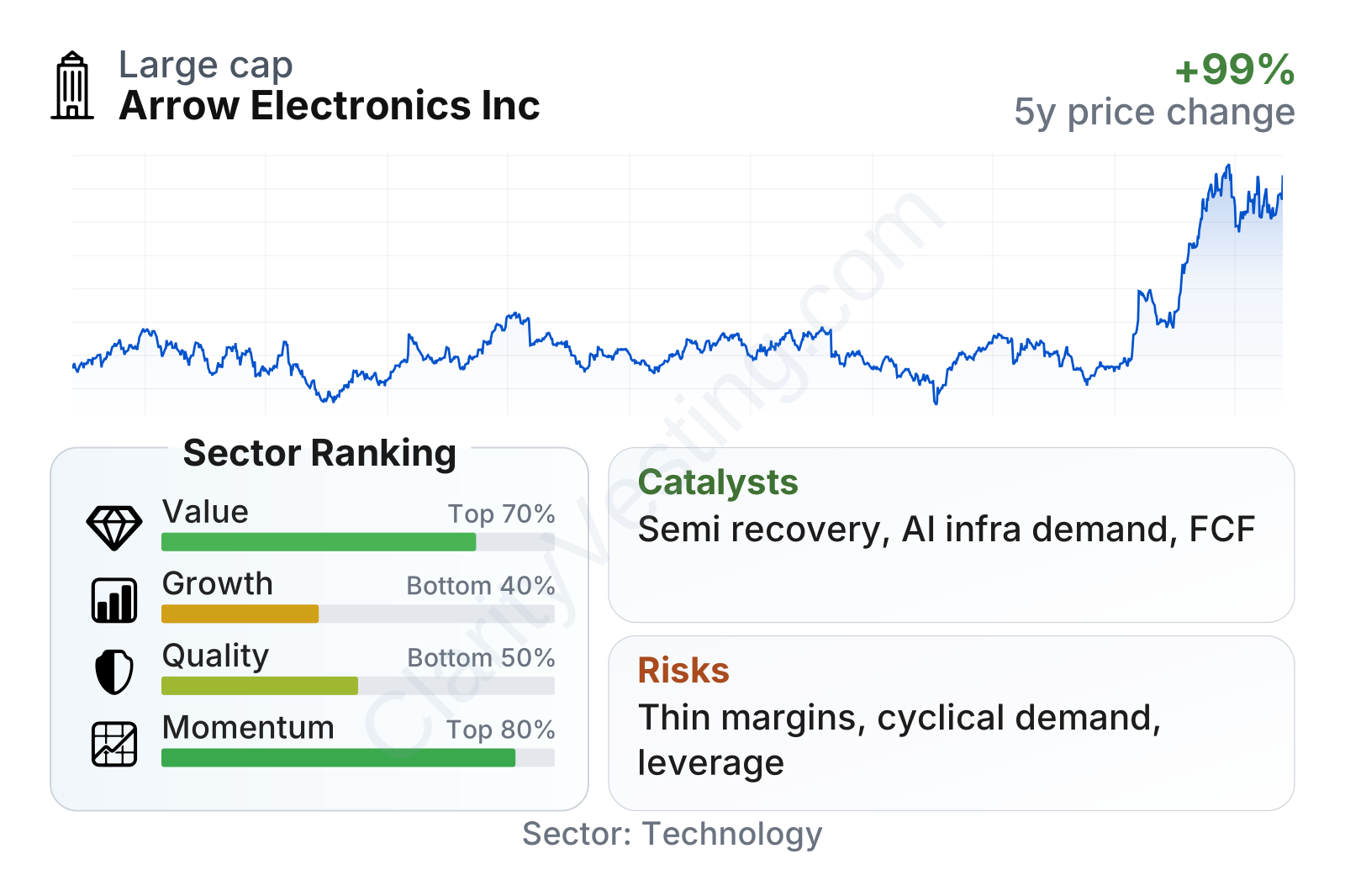
Arrow is a large-cap technology distributor with above-average share price volatility for the sector. The overall profile is mixed: valuation metrics look strong relative to many technology peers, momentum has been favorable, while quality and long-term growth rankings are less impressive. Cash generation is notable, and returns on invested capital are around the sector median in the most recent period, but profitability remains thin and leverage measured against operating earnings is higher than many technology companies.
Growth
Arrow operates in markets with favorable long-term demand drivers. Electronic components are essential to industrial automation, vehicles, aerospace, communications equipment, energy systems, and connected devices. On the enterprise side, businesses continue to invest in cloud infrastructure, cybersecurity, data management, and hybrid IT environments. Those are real structural tailwinds, even if Arrow’s own results tend to move in shorter cycles.
The company’s strategy is sensible for this kind of industry. Rather than relying on a single technology bet, Arrow spreads its exposure across thousands of suppliers and customers. That gives it reach across many end markets and allows it to benefit when design activity turns into production volumes. Its engineering support, embedded solutions capabilities, and value-added enterprise services also make it more than a basic middleman, which can help customer retention and wallet share.
Recent growth has clearly improved after a difficult period. Revenue growth turned sharply negative through 2023 and much of 2024, then recovered into positive territory and accelerated significantly by late 2025 and early 2026. That rebound suggests the inventory correction that hurt the business may be easing, especially in components. Even so, over a full five-year view, growth has been less consistent than the median technology company.
Cash generation is another point worth watching closely. Free cash flow rose strongly over several years, reflecting working-capital release and tighter operating discipline, although the most recent trailing figure sits below the earlier peak. For a distributor, this is important: earnings can be modest, but cash flow can still become meaningful when inventory and receivables are managed well. Arrow’s recent free cash flow yield is much stronger than the sector median, which supports the view that the market is not assigning a premium multiple to this recovery.
As for catalysts, several stand out. A continued recovery in semiconductor demand, normalization of customer inventory, and ongoing enterprise infrastructure spending could all help sales and margins. Arrow has also highlighted demand areas such as AI-related infrastructure, cloud, security, and intelligent edge applications in its business communications. These themes are large enough to matter, but the company usually benefits as an enabler of those trends rather than as the direct creator of the end technology.
Risks
This article is for informational purposes only and does not constitute financial advice. Some content is AI-generated. See Disclaimer


