Stock Analysis · Array Technologies Inc (ARRY)
Overview
Array Technologies is a U.S. solar equipment company focused on solar tracking systems. These are mechanical systems that rotate solar panels during the day so they follow the sun and produce more electricity than fixed-tilt installations. The company mainly serves large utility-scale solar projects, where power developers, engineering firms, and independent power producers want higher energy output from each project.
Its business is more specialized than a broad solar manufacturer. Array does not mainly make solar panels or inverters. Instead, it sells the structural and motion-control systems that sit under large solar arrays, along with related software, project services, and selected aftermarket support. That makes its results closely tied to utility-scale solar construction activity rather than rooftop demand.
Based on recent company disclosures, revenue is still overwhelmingly concentrated in hardware for large solar projects. A simple way to think about the business is:
- Solar tracking systems and related equipment: about 90% to 95% of revenue. This includes the company’s tracker products, drivetrain and controller elements, structural components, and project-delivered system packages.
- Services, software, and other project-related revenue: about 5% to 10% of revenue. This includes support activities tied to installation, project execution, and digital tools used to improve performance and operations.
Geographically, the company has historically been led by the United States, but it has also been working to expand internationally, especially in markets where utility-scale solar is growing and trackers are becoming a more common design choice.
One notable financial pattern is that revenue has swung sharply over the last several years, while gross profit held up better than revenue during the downcycle. That suggests pricing discipline and product mix helped cushion the slowdown, even though operating expenses and other charges pushed the company back into losses.
Key Figures
| Metric | Value | Sector ⓘ |
|---|---|---|
| Date | Sep 12, 2026 | |
| Context | ||
| Sector | Technology | |
| Industry | Solar | |
| Market Cap ⓘ | $818.36M | |
| Beta ⓘ | 1.79 | |
Value (Cheapness) | ||
| P/E Ratio ⓘ | N/A | 29.51 |
| FCF Yield ⓘ | 16.46% | 4.25% |
| EBIT / EV ⓘ | -3.04% | 2.85% |
| PEG ⓘ | 0.66 | |
Growth (Business expansion) | ||
| Revenue Growth ⓘ | -5.60% | 15.40% |
| RPS Growth (5Y CAGR) ⓘ | 6.42% | 8.56% |
| EPS Growth (5Y CAGR) ⓘ | -2.87% | -11.88% |
| Margin Growth (5Y Trend) ⓘ | N/A | 0.46% |
| FCF Growth (5Y CAGR) ⓘ | N/A | 9.80% |
Quality (Business durability) | ||
| ROIC (Latest) ⓘ | -9.26% | 9.44% |
| ROIC (5Y Median) ⓘ | -0.29% | 8.30% |
| Net Debt / EBIT (Latest) ⓘ | N/A | 0.54 |
| Net Debt / EBIT (5Y Median) ⓘ | N/A | 0.44 |
| Operating Margin (Latest) ⓘ | -4.62% | 9.58% |
| Operating Margin (5Y Median) ⓘ | -0.15% | 8.25% |
| Debt to Equity (Latest) ⓘ | -372.57% | 33.33% |
| Profit Margin (Latest) ⓘ | -7.25% | 7.14% |
| Free Cash Flow (Latest) ⓘ | $134.73M | |
Momentum (Price trend) | ||
| 3Y Return ⓘ | -77.45% | +45.48% |
| 12M Return (excl. last month) ⓘ | -14.73% | +23.48% |
| 6M Return ⓘ | -55.14% | +20.93% |
| Price vs. 200-Day MA ⓘ | -35.08% | +7.43% |
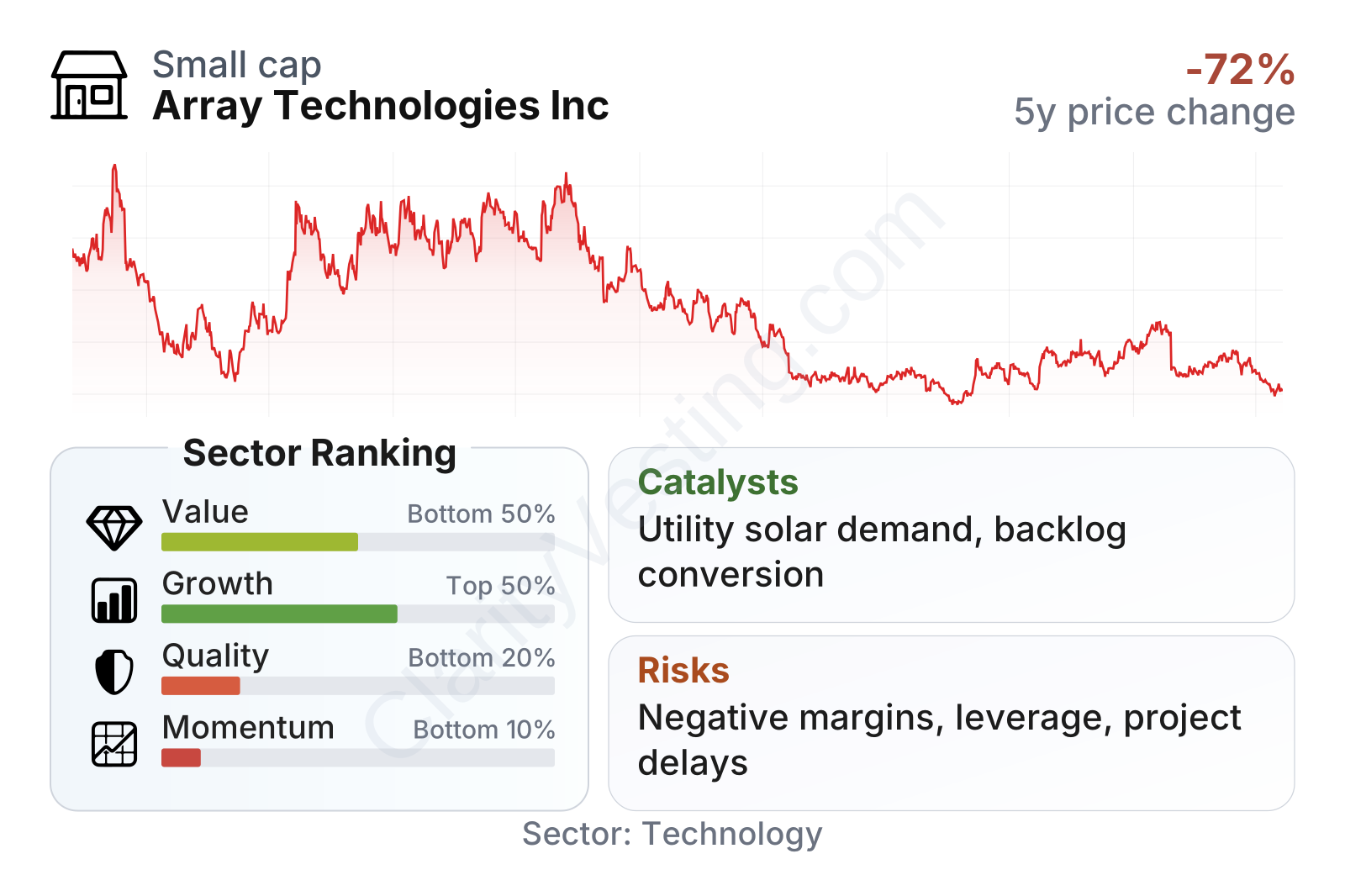
Array is currently a small-cap company with a stock that has been much more volatile than the broader market, as shown by a beta near 1.8. The metric table points to a mixed profile: valuation looks more favorable on free-cash-flow yield than much of the sector, but profitability and returns on capital are weak. Growth indicators sit around the middle of the sector rather than at the top, while share-price momentum has been among the weakest in its peer group.
The stock-price history also shows how cyclical sentiment has been. Shares traded above $20 at several points in 2022 and 2023, then fell into the mid-single digits before partly recovering. That kind of move usually means the market is still debating whether Array is facing a temporary slowdown or a more lasting reduction in earnings power.
Growth
Array operates in a market with a strong long-term tailwind. Utility-scale solar is one of the most active areas of new electricity generation, especially in the United States, where grid decarbonization, power-demand growth, and policy support continue to drive project development. Solar trackers are also structurally attractive within that market because they can lift energy production versus fixed-tilt systems, which often improves project economics.
The company’s strategy broadly makes sense for that environment. It is focused on a product category where performance, reliability, and installation efficiency matter a great deal, especially for very large projects. It has also expanded beyond its legacy domestic base through acquisitions and international positioning, which can help reduce dependence on one market over time. For a company like Array, future growth does not require winning every solar project; it mainly requires remaining relevant in utility-scale projects where trackers are preferred.
Near-term growth, however, has been uneven. Revenue growth was exceptionally strong in 2022, remained positive in parts of 2023, then turned sharply negative through much of 2024 before rebounding in parts of 2025 and softening again more recently. The latest year-over-year reading is still slightly negative, and below the sector median. In plain language, the industry opportunity is real, but Array’s own sales path has been bumpy because project timing, customer decisions, and broader solar-market disruptions have had a large effect.
Cash generation offers a more constructive signal than earnings alone. Free cash flow turned strongly positive after the deep outflow seen in 2022 and has remained positive, even though it has come down from the peak. That matters because this is a project-driven business where working capital can move significantly from period to period. Positive cash flow gives Array more room to manage downturns, invest in product development, and handle debt than its net-income line alone might suggest.
Recent company updates have also highlighted backlog, awarded orders, and product positioning around domestic content and project economics as important drivers. If U.S. utility-scale solar deployment stays healthy and financing conditions improve, those factors could create a meaningful opening for renewed order conversion. Another catalyst is the broader rise in electricity demand from data centers and industrial load growth, which can support more renewable generation buildout over time.
Risks
This article is for informational purposes only and does not constitute financial advice. Some content is AI-generated. See Disclaimer