Stock Analysis · Arm Holdings plc (ARM)
Stock Analysis · Arm Holdings plc (ARM)

Overview

Arm Holdings plc designs the basic chip architectures that many of the world’s electronic devices run on. Rather than manufacturing semiconductors itself, Arm mainly licenses its intellectual property to other companies, which then build their own chips using Arm’s designs. This business model is important because it allows Arm to benefit from very broad industry adoption without carrying the heavy capital costs of operating chip fabrication plants.

Its technology is best known for smartphones, where Arm-based processors have long been dominant, but the company has expanded far beyond mobile devices. Arm designs are now used in data center processors, automotive systems, industrial equipment, networking gear, consumer electronics, and a growing range of artificial intelligence workloads at the edge and in the cloud. In simple terms, Arm provides the blueprint and ecosystem that help chipmakers build efficient processors.

The company’s revenue mainly comes from two large streams: upfront licensing and ongoing royalties. Licensing revenue is generated when customers pay to access Arm’s latest architectures, cores, tools, and support. Royalty revenue is collected later when customers ship chips containing Arm technology. Arm’s annual reports also show smaller contributions from software tools, support, and related services. Based on the company’s recent reporting structure, the revenue mix can be summarized approximately as follows.

  • Royalties: roughly half of revenue, generated when Arm-based chips are shipped in volume.
  • License and other revenue: roughly the other half, driven by new design wins, access to newer platforms, software, and support.
  • End-market exposure: mobile remains the largest installed base, while automotive, cloud/data center, networking, and embedded systems are increasingly important growth areas.

One attractive feature of this model is that once Arm technology is embedded in a customer’s design, royalties can continue for years as that chip or product family ships into the market. At the same time, the model depends heavily on keeping Arm’s architecture relevant enough that customers continue choosing it for future generations of products.

The business has remained very high margin at the gross profit level, which is typical for intellectual-property-heavy companies. Over the last several years, revenue and operating income have both moved higher overall, although research spending has also risen sharply. That pattern suggests Arm is trying to widen its technological lead while demand from newer markets such as AI infrastructure and automotive improves.

Key Figures

MetricValueSector
DateJul 18, 2026
Context
SectorTechnology
IndustrySemiconductors
Market Cap $279.85B
Beta 3.77
Value
(Cheapness)
P/E Ratio 323.4731.76
FCF Yield 0.34%4.18%
EBIT / EV 0.42%2.56%
PEG 2.29
Growth
(Business expansion)
Revenue Growth 20.10%13.50%
RPS Growth (5Y CAGR) 15.00%8.57%
EPS Growth (5Y CAGR) -1.19%-21.87%
Margin Growth (5Y Trend) -5.56%0.41%
FCF Growth (5Y CAGR) 26.44%9.76%
Quality
(Business durability)
ROIC (Latest) 11.86%8.54%
ROIC (5Y Median) 11.95%8.12%
Net Debt / EBIT (Latest) -1.980.38
Net Debt / EBIT (5Y Median) -1.990.38
Operating Margin (Latest) 23.52%9.58%
Operating Margin (5Y Median) 23.52%8.25%
Debt to Equity (Latest) 5.52%33.52%
Profit Margin (Latest) 18.37%6.96%
Free Cash Flow (Latest) $951.00M
Momentum
(Price trend)
3Y Return N/A+30.91%
12M Return (excl. last month) +189.44%+28.90%
6M Return +154.20%+5.38%
Price vs. 200-Day MA +44.63%+7.61%
Better than sector median
Slightly worse than sector median
More than 20% worse than sector median

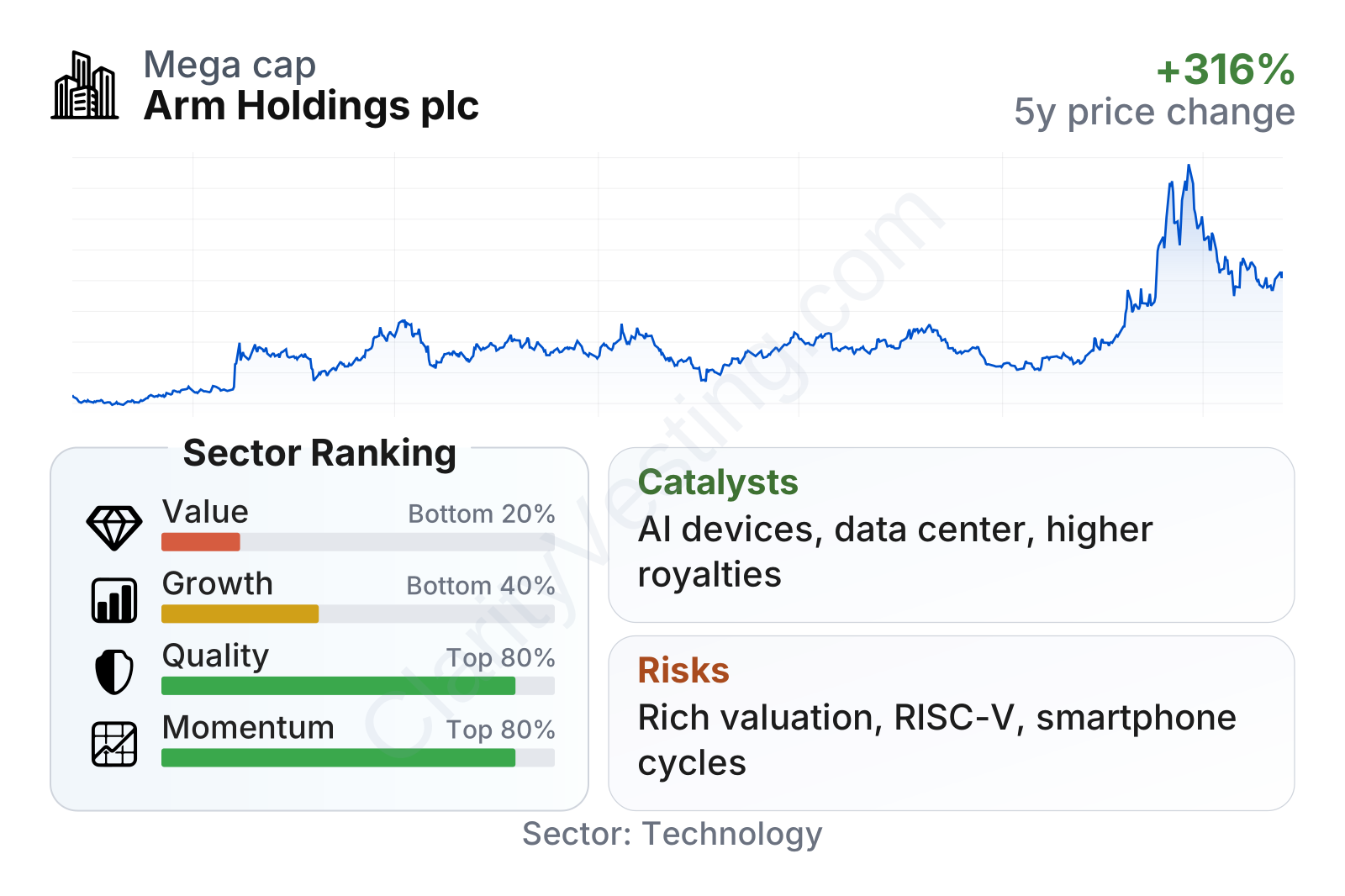
Arm stands out as a very large semiconductor company by market value, but its trading pattern has been unusually volatile, with a beta close to 3.8. The quality profile is strong: returns on invested capital are above the sector median, operating margin is around the mid-20% range, profit margin is around the high teens, and the balance sheet carries very little debt. Growth metrics are also solid, with revenue expansion and free cash flow growth ahead of many peers. The weak area is valuation, where the company ranks near the bottom of the sector on traditional measures, reflecting a market price that already assumes substantial future success.

The stock price history also shows how quickly expectations can shift. Since listing, shares have moved sharply upward and then corrected, which is common when a company is closely tied to major technology themes such as AI and advanced computing. That makes the name financially strong at the business level, but less stable at the share-price level.

Growth

Arm operates in one of the most important long-term areas in technology: the spread of computing into almost everything. Chips are becoming more central to phones, cars, factories, cloud servers, networking equipment, and AI devices. Within that broader shift, Arm’s core advantage is energy-efficient computing. That matters because modern devices need more performance without excessive power consumption, whether the product is a smartphone, an AI server, or a car’s onboard system.

The company’s strategy appears aligned with this trend. Management has emphasized expanding beyond its traditional mobile stronghold into data centers, automotive, AI-enabled devices, and custom silicon. This is a logical extension of Arm’s existing ecosystem. Once developers, chip designers, software vendors, and equipment makers are already familiar with the architecture, it becomes easier for Arm to deepen its position in adjacent markets.

Recent revenue growth has been strong, though not perfectly smooth quarter to quarter. The broader pattern points to a business still growing at a healthy double-digit pace, with several quarters showing much faster expansion. That is encouraging because it suggests Arm is not relying on a single mature market. Instead, multiple end markets appear to be contributing.

Cash generation has also improved meaningfully after a weak period. Free cash flow has recovered to roughly the same level as the stronger earlier period, which indicates that revenue growth is again converting into real financial flexibility. For a company centered on intellectual property, that matters because cash can be reinvested into research, software tools, ecosystem development, and partnerships rather than factories.

One of the strongest catalysts is the rise of AI computing. Arm has been pushing further into cloud infrastructure and AI-capable devices, where power efficiency and total system cost are becoming more important. Another visible growth driver is automotive, where modern vehicles increasingly resemble rolling computers with advanced driver assistance, infotainment, connectivity, and centralized processing. Arm is well positioned for this because carmakers and chip suppliers often prefer long-lived, well-supported platforms with broad software compatibility.

Recent company updates have also highlighted broader adoption of newer Arm architectures and stronger royalty content per chip. That can be more powerful than unit growth alone: even if total chip volumes are uneven, Arm can still grow if newer and more complex chips generate higher royalties per device. This is especially relevant in premium smartphones, AI-enabled PCs, data center processors, and automotive compute platforms.

Risks

Arm’s biggest strength is also a key risk: it is deeply influential, but it does not control the final chip product or the end customer relationship in the same way integrated chip companies often do. Arm depends on partners such as Qualcomm, Apple, MediaTek, Nvidia, AMD, Amazon, and many others to design, manufacture, market, and ship products based on its architecture. If those partners reduce reliance on Arm, negotiate more aggressively, or shift design priorities, Arm’s growth can be affected.

Another risk is concentration in royalties and end markets linked to consumer electronics, especially smartphones. Although Arm is diversifying, mobile remains a major foundation of the installed base. A slowdown in handset demand, slower upgrade cycles, or reduced chip content growth in phones could weigh on royalty momentum.

Competition is real, even if Arm remains a leader in processor architecture licensing. The company’s main rivals are not always direct like-for-like substitutes, which makes the landscape more complex.

  • x86 ecosystem: Intel and AMD remain powerful in PCs and servers, even as Arm gains ground in data centers and AI-related computing.
  • RISC-V: an open-standard architecture that is attracting interest because it can reduce dependence on proprietary licensing models.
  • In-house chip design: large technology companies increasingly develop custom silicon and may seek more bargaining power over architecture choices.

Arm still has major competitive advantages. It is one of the most widely adopted processor ecosystems in the world, with deep software support, a long history in low-power computing, and a licensing model that scales across many customers and product categories. These are meaningful barriers to entry. But leadership does not mean immunity. RISC-V, in particular, is worth watching because its appeal grows when customers want flexibility, lower licensing costs, or more control over design roadmaps.

Balance-sheet risk is low. Debt to equity has remained far below the semiconductor sector median, and the company has been in a net cash position relative to earnings. That gives Arm resilience and room to keep investing even if industry conditions soften.

Profitability is strong compared with peers, with margins consistently above sector norms. Even so, margins can fluctuate because Arm spends heavily on research and ecosystem development. That spending is strategically sensible, but if revenue growth slows while expenses continue rising, operating leverage could weaken. The long-term record already shows that margin improvement has not been perfectly linear.

A further issue is valuation-related risk in the market itself. Because expectations are high, even solid business execution may not always be enough to support the share price if growth merely normalizes. The stock’s large swings over the past year underline that point.

Recent public disclosures also show Arm becoming more assertive about monetization and platform value, which can help growth but may create friction with some customers. In a business built on industry relationships, pricing power and ecosystem diplomacy need to stay in balance.

Valuation

Arm’s valuation is the most difficult part of the long-term picture. The market is assigning a very high premium to the company relative to the broader semiconductor sector. Traditional valuation measures such as earnings multiple, cash flow yield, and EBIT relative to enterprise value all indicate an expensive stock. The company’s PEG ratio also suggests that a large part of expected future growth is already embedded in the price.

Even after coming down from the most extreme levels, Arm’s earnings multiple remains several times higher than the sector median. That does not automatically mean the valuation is irrational. Premium valuations can persist for businesses with strong competitive positions, asset-light economics, and exposure to major structural themes such as AI and cloud computing. Arm checks many of those boxes. The issue is that the gap is very large, leaving less room for disappointment.

The current price therefore appears to reflect more than today’s financial profile. It reflects the market’s belief that Arm can become much more important in servers, AI infrastructure, automotive compute, and higher-value custom chip platforms. If that expansion continues, the valuation can look more understandable over time. If growth cools toward more ordinary semiconductor levels, the stock can look stretched very quickly.

In other words, the valuation seems justified only under a scenario where Arm keeps translating its architectural importance into steadily rising royalties, broader market share outside mobile, and durable cash generation. The business quality is high, but the market price leaves little doubt that investors are already treating Arm as a strategic winner rather than a merely solid chip IP company.

Conclusion

Arm is a distinctive semiconductor company because it sits at the center of chip design without taking on the manufacturing burden of a traditional chipmaker. That model has produced high margins, strong returns on capital, low leverage, and expanding free cash flow. The business is also positioned in attractive markets, with AI, automotive, cloud infrastructure, and custom silicon offering meaningful room beyond its established mobile base.

The main challenge is not whether Arm matters technologically; it clearly does. The harder question is how much of that importance can be converted into faster royalty growth and broader influence across the next wave of computing platforms. Arm has real advantages in ecosystem depth, efficiency, and global adoption, but it also faces pressure from powerful customers, entrenched processor incumbents, and emerging alternatives such as RISC-V.

That leaves the company in a strong operating position but a demanding valuation context. Financially, Arm looks healthier and more profitable than many semiconductor peers. In market terms, however, the stock already reflects unusually high expectations. The overall picture is that of a high-quality franchise with credible long-term expansion paths, but one whose market value requires continued strong execution across several new growth fronts.

Sources:

  • Arm Holdings plc — Annual Report on Form 20-F for the fiscal year ended March 31, 2026
  • Arm Holdings plc — Investor Relations earnings materials and shareholder letters for fiscal 2026
  • SEC EDGAR — Arm Holdings plc filings database
  • Arm Holdings plc — Company website and product overview materials
  • Wikipedia — Arm Holdings basic company history and corporate background

This article is for informational purposes only and does not constitute financial advice. Some content is AI-generated. See Disclaimer


Sign up for exclusive research and insights.

Unsubscribe anytime.
