Stock Analysis · Arcos Dorados Holdings Inc (ARCO)
Overview
Arcos Dorados Holdings is the largest independent McDonald’s franchisee in the world. It operates and franchises McDonald’s restaurants across Latin America and the Caribbean, covering a very large geographic footprint that includes Brazil, Mexico, Argentina, Chile, Colombia, Peru, Uruguay, Costa Rica, Panama, and several other markets. In practical terms, the company earns money by selling food and beverages through McDonald’s-branded restaurants and by collecting income from restaurants operated by sub-franchisees.
The business is still primarily a restaurant operator rather than a pure royalty company, so most revenue comes directly from company-operated stores. Based on recent annual reporting, the revenue mix is approximately:
- Company-operated restaurant sales: about 93% to 95% — food, beverages, delivery, drive-thru, digital orders, and in-store sales from restaurants Arcos Dorados runs itself.
- Franchised restaurant revenues: about 3% to 5% — royalties, franchise fees, and related income from locations operated by franchisees.
- Other revenues: about 1% to 2% — mainly brand-related and ancillary items, depending on period and accounting classification.
Geographically, Brazil is the most important market and typically accounts for the largest share of systemwide sales and operating profit, followed by the North Latin America division and the South Latin America division. This matters because the company’s performance is influenced not just by restaurant demand, but also by local inflation, currencies, and consumer spending conditions in each country.
Its model combines the strength of the McDonald’s brand with local execution: menu adaptation, digital ordering, delivery partnerships, loyalty tools, and store modernization. That gives the company exposure to everyday consumer demand at affordable price points, while still depending heavily on efficient operations and disciplined pricing.
Over the last several years, revenue has expanded materially, while operating income and net income have also improved overall despite some margin pressure. The business has grown larger, but a meaningful share of each sales dollar still goes to food, labor, occupancy, and other operating costs, which is typical for restaurant operators.
Key Figures
| Metric | Value | Sector ⓘ |
|---|---|---|
| Date | Sep 12, 2026 | |
| Context | ||
| Sector | Consumer Cyclical | |
| Industry | Restaurants | |
| Market Cap ⓘ | $1.69B | |
| Beta ⓘ | 0.49 | |
Value (Cheapness) | ||
| P/E Ratio ⓘ | 6.57 | 17.10 |
| FCF Yield ⓘ | 5.65% | 8.53% |
| EBIT / EV ⓘ | 11.88% | 6.46% |
| PEG ⓘ | 0.54 | |
Growth (Business expansion) | ||
| Revenue Growth ⓘ | 14.30% | 5.75% |
| RPS Growth (5Y CAGR) ⓘ | 15.15% | 9.14% |
| EPS Growth (5Y CAGR) ⓘ | -14.34% | -18.21% |
| Margin Growth (5Y Trend) ⓘ | 3.22% | -0.23% |
| FCF Growth (5Y CAGR) ⓘ | -43.10% | 4.91% |
Quality (Business durability) | ||
| ROIC (Latest) ⓘ | 14.94% | 12.61% |
| ROIC (5Y Median) ⓘ | 14.73% | 10.72% |
| Net Debt / EBIT (Latest) ⓘ | 4.48 | 2.10 |
| Net Debt / EBIT (5Y Median) ⓘ | 4.90 | 2.32 |
| Operating Margin (Latest) ⓘ | 8.70% | 9.25% |
| Operating Margin (5Y Median) ⓘ | 7.28% | 9.64% |
| Debt to Equity (Latest) ⓘ | 264.67% | 75.78% |
| Profit Margin (Latest) ⓘ | 5.16% | 5.33% |
| Free Cash Flow (Latest) ⓘ | $95.41M | |
Momentum (Price trend) | ||
| 3Y Return ⓘ | -12.16% | +14.53% |
| 12M Return (excl. last month) ⓘ | +17.62% | +3.08% |
| 6M Return ⓘ | +5.28% | +0.55% |
| Price vs. 200-Day MA ⓘ | -1.15% | -0.54% |
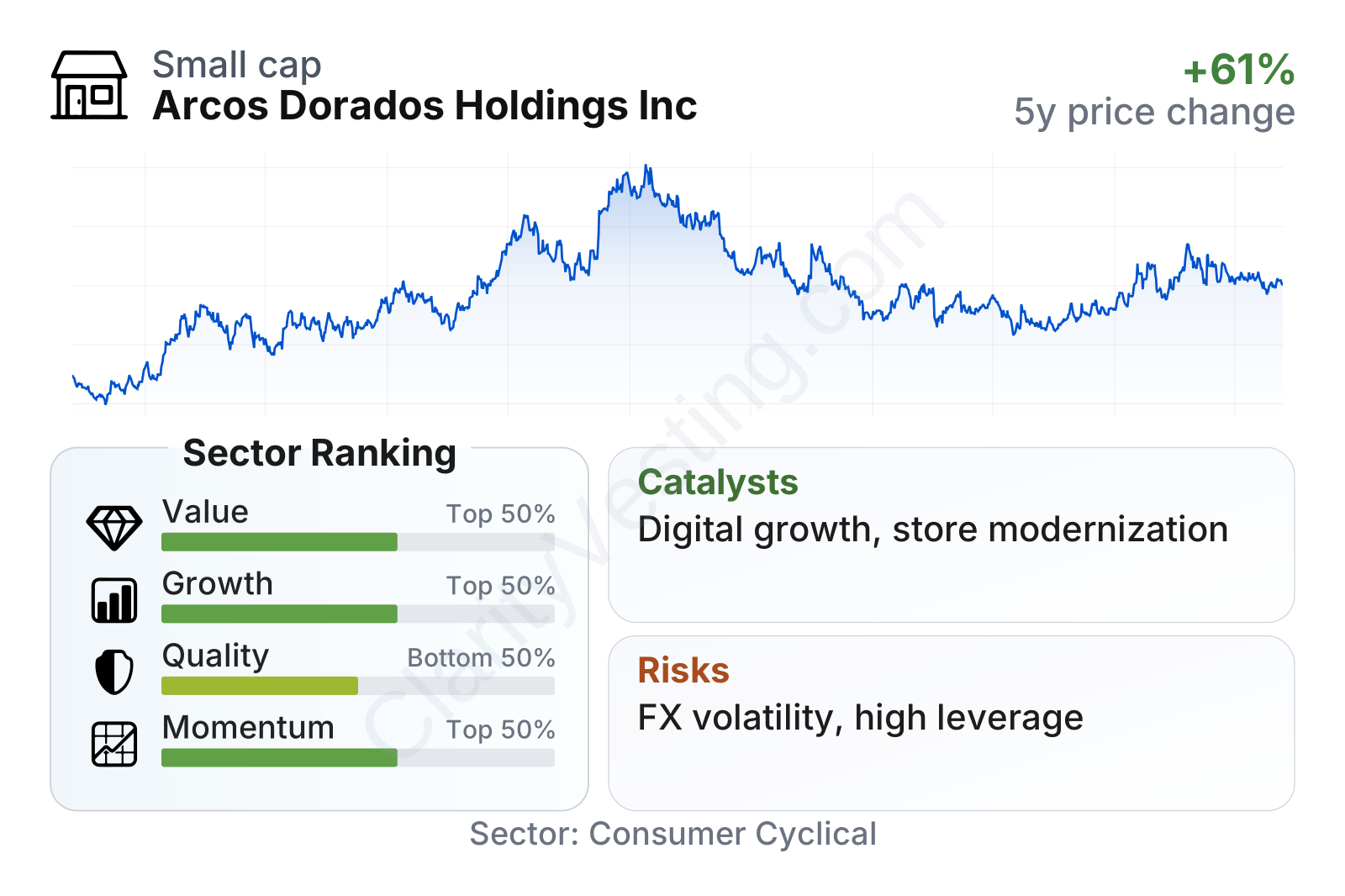
Arcos Dorados is a mid-sized public restaurant company with a relatively low share-price volatility profile, as shown by its beta near 0.5. The factor picture is mixed. Growth and recent momentum rank in the stronger half of the sector, helped by revenue expansion that has outpaced many restaurant peers. Value metrics also look optically cheap, especially the earnings multiple, but quality is held back by leverage and thinner margins than the sector median.
The stock’s longer-term price path shows a strong recovery from 2021 into early 2024, followed by a weaker stretch and then a partial rebound in 2026. That pattern fits a company whose operating progress has been real, but whose market valuation remains sensitive to Latin American macro conditions, currencies, and cash generation swings.
Growth
Arcos Dorados operates in a sector that can still grow over the long term in Latin America. Quick-service restaurants benefit from urbanization, rising use of delivery and mobile ordering, convenience-focused eating habits, and the strength of recognizable international brands. McDonald’s is especially well positioned in this category because it spans value meals, family dining, breakfast, dessert, and convenience occasions.
Arcos Dorados’ strategy is coherent for that environment. The company has been investing in restaurant modernization, Experience of the Future formats, digital sales channels, loyalty, drive-thru expansion, delivery, and menu innovation adapted to local markets. These initiatives can support higher traffic, larger average tickets, and better customer retention over time. For a restaurant business, this is important because modest improvements in traffic and restaurant-level efficiency can have a meaningful effect on profits.
Revenue growth has cooled from the unusually strong post-pandemic rebound, but the recent trend has turned positive again and remains ahead of the broader sector median. The latest year-over-year pace is in the low-teens range, while the five-year revenue-per-share growth rate is also stronger than many peers. That suggests the company is still expanding even after the easier recovery period ended.
Cash generation has been less smooth than revenue growth. Free cash flow moved from clearly positive levels to negative territory and then back to positive over the trailing twelve months. That rebound is encouraging because it shows the business can still convert earnings into cash, but the volatility also indicates that expansion spending, working capital, and country-level pressures can make annual cash results uneven.
A notable catalyst is the company’s digital ecosystem. Management has emphasized app usage, loyalty, self-order kiosks, and delivery integration, all of which can deepen customer frequency and improve restaurant throughput. Another catalyst is unit development and reimaging in underpenetrated or still-developing markets, particularly where McDonald’s retains room to add locations or gain share in modern quick-service dining.
Recent company updates have also pointed to continued focus on operational discipline, better restaurant economics, and portfolio optimization. In a fragmented regional restaurant landscape, scale purchasing, strong brand recognition, and a large installed store base can create a platform for steady comp sales growth when consumer conditions are supportive.
Risks
This article is for informational purposes only and does not constitute financial advice. Some content is AI-generated. See Disclaimer