Stock Analysis · Ares Capital Corporation (ARCC)
Overview
Ares Capital Corporation is a business development company, or BDC. In simple terms, it provides financing to middle-market businesses that are often too large for small-business lending but not large enough to rely only on public bond markets. Its focus is mainly on U.S. companies backed by private equity sponsors, and it typically invests through loans rather than buying whole businesses.
The company’s business model is straightforward: it raises capital from shareholders and lenders, then invests that money into a diversified portfolio of corporate debt and some equity positions. It earns income primarily from interest on those loans, plus fees and occasional gains when investments are repaid, refinanced, or sold. Because ARCC is structured as a BDC, it is required to distribute most of its taxable income, which helps explain why income payout has been a major part of its shareholder profile over time.
Based on the company’s recent filings, ARCC’s revenue sources are centered on investment income rather than product sales or services in the usual sense. The mix can shift from quarter to quarter, but the main sources are broadly the following:
- Interest income from debt investments: the largest source, typically the clear majority of total investment income. This mainly includes first-lien senior secured loans, second-lien loans, and other private credit positions made to portfolio companies.
- Capital structuring service fees and other fee income: a smaller but recurring source tied to underwriting, amendments, repayments, and other financing-related activity.
- Dividend income from equity investments: a modest source coming from preferred and common equity stakes in portfolio companies.
- Realized and unrealized gains or losses: these can materially affect reported earnings and net asset value, but they are less predictable than interest income and should not be treated like a steady revenue stream.
Portfolio composition is also important for understanding ARCC. Its investment portfolio has historically been weighted toward first-lien senior secured loans, which generally sit highest in the capital structure and are often considered safer than subordinated debt or equity. This matters because it gives the company a more defensive profile than lenders that rely more heavily on riskier financing layers.
ARCC is also one of the largest publicly traded BDCs, and that scale matters. A larger platform can bring broader deal flow, better access to funding markets, and more diversification across borrowers and industries than many smaller peers.
The broad earnings flow shows a business that remains highly profitable on an operating basis, but also one where interest expense is a major moving part. Revenue and net income recovered strongly after the weaker 2022 period, then softened somewhat in 2025. That pattern fits a lender whose results are closely tied to credit conditions, base rates, and portfolio valuations.
Key Figures
| Metric | Value | Sector ⓘ |
|---|---|---|
| Date | Nov 02, 2026 | |
| Context | ||
| Sector | Financial Services | |
| Industry | Asset Management | |
| Market Cap ⓘ | $13.80B | |
| Beta ⓘ | 0.66 | |
Value (Cheapness) | ||
| P/E Ratio ⓘ | 15.66 | 12.21 |
| P/B Ratio ⓘ | 0.99 | 1.26 |
| FCF Yield ⓘ | 12.68% | 9.99% |
| Dividend Yield ⓘ | 2.51% | 2.87% |
| EBIT / EV ⓘ | N/A | 8.24% |
| PEG ⓘ | 3.72 | |
Growth (Business expansion) | ||
| Revenue Growth ⓘ | -2.40% | 8.20% |
| RPS Growth (5Y CAGR) ⓘ | -3.91% | 12.31% |
| EPS Growth (5Y CAGR) ⓘ | -9.20% | -3.82% |
| BVPS Growth (5Y CAGR) ⓘ | 0.75% | 4.96% |
| Margin Growth (5Y Trend) ⓘ | -33.43% | -4.14% |
| FCF Growth (5Y CAGR) ⓘ | N/A | 4.70% |
| DPS Growth (5Y CAGR) ⓘ | 3.83% | 8.85% |
Quality (Business durability) | ||
| ROIC (Latest) ⓘ | N/A | 9.35% |
| ROE (Latest) ⓘ | 6.19% | 14.02% |
| ROA (Latest) ⓘ | 2.83% | 1.57% |
| ROIC (5Y Median) ⓘ | 5.63% | 7.78% |
| ROE (5Y Median) ⓘ | 12.20% | 12.12% |
| ROA (5Y Median) ⓘ | 5.48% | 1.28% |
| Net Debt / EBIT (Latest) ⓘ | N/A | 0.99 |
| Net Debt / EBIT (5Y Median) ⓘ | 8.88 | 0.73 |
| Net Debt / EBITDA (Latest) ⓘ | 8.24 | 0.77 |
| Operating Margin (Latest) ⓘ | N/A | 22.64% |
| Operating Margin (5Y Median) ⓘ | 61.68% | 24.52% |
| Debt to Equity (Latest) ⓘ | 108.45% | 58.67% |
| Profit Margin (Latest) ⓘ | 28.35% | 26.18% |
| Free Cash Flow (Latest) ⓘ | $1.75B | |
Momentum (Price trend) | ||
| 3Y Return ⓘ | +33.61% | +95.38% |
| 12M Return (excl. last month) ⓘ | +3.42% | +16.18% |
| 6M Return ⓘ | +4.83% | +7.10% |
| Price vs. 200-Day MA ⓘ | +4.41% | +5.51% |
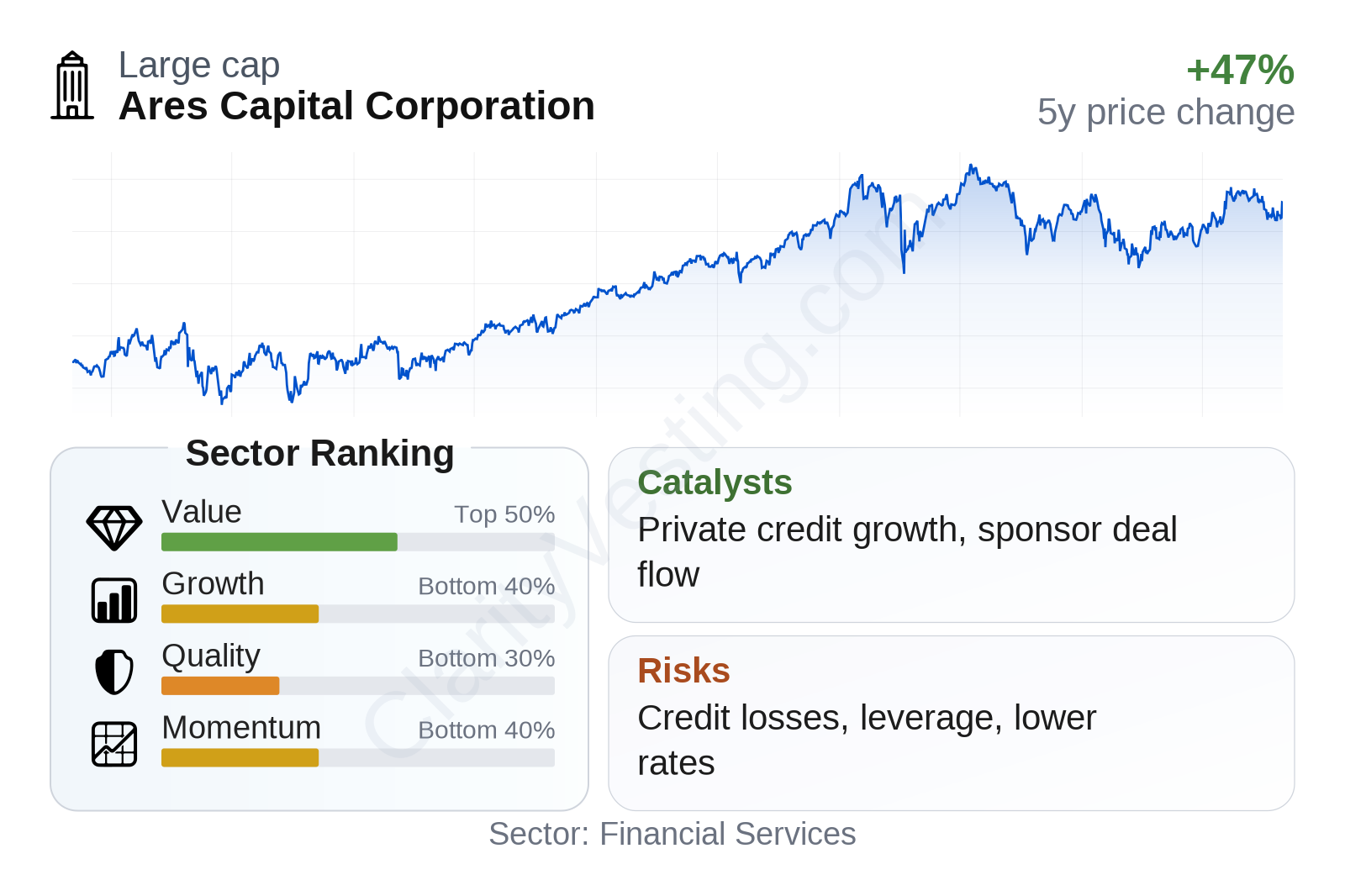
ARCC is a large company within its niche, with a market value in the low tens of billions of dollars and a below-market beta near 0.7, suggesting the shares have historically moved less than the broader equity market. The stock has trended upward over the last several years, although with pauses and pullbacks that are normal for a credit-focused lender.
The table points to a mixed but understandable profile. On valuation, ARCC screens around the middle of the sector overall: its price-to-earnings ratio is somewhat above the sector median, but its price-to-book ratio sits below the sector median and close to book value. Cash generation metrics appear comparatively solid. On growth and momentum, the picture is weaker, reflecting pressure on recent revenue growth, slower multi-year expansion, and more modest share performance than many financial stocks. Quality is also mixed: profitability on assets stands above the sector median, while return on equity has moved lower and leverage remains higher than the sector norm.
Growth
ARCC operates in private credit, a part of the financial sector that has grown meaningfully as banks have become more constrained by regulation and capital requirements. That structural shift has created more room for large non-bank lenders to finance middle-market companies. In that sense, the company is participating in a sector with long-term tailwinds, especially when sponsors and borrowers continue to look for flexible, customized financing.
The company’s strategy for growth is logical. It emphasizes scale, broad origination capabilities, and a portfolio tilted toward senior secured lending. That combination can support growth in assets while also aiming to limit downside from weaker credits. Being part of the wider Ares platform is also a meaningful advantage because it can improve access to borrower relationships, underwriting resources, and market intelligence.
Still, growth for a lender like ARCC should not be judged the same way as a fast-growing software business. What matters more is whether it can grow portfolio income, preserve credit quality, and maintain net asset value over a full cycle. Recent trends suggest a business that grew strongly during the higher-rate period, but whose expansion has moderated. Earnings per share improved meaningfully in 2023 and stayed solid in 2024 before easing in 2025, which suggests peak earnings may have been helped by unusually favorable rate conditions rather than pure portfolio growth.
The earnings trend shows resilience, but not a straight line upward. That matters because ARCC’s income benefits when loan yields rise, yet that benefit can fade if rates decline, spreads compress, or credit costs increase. For a long-term view, consistency matters more than a single strong year.
Book value per share is another important indicator for a BDC because it reflects the underlying value of the investment portfolio after liabilities. ARCC’s book value has been fairly stable with some improvement from the 2022 trough, although the long-term growth rate remains modest.
A relatively stable book value suggests the portfolio has held up reasonably well despite changing rate conditions. That is important because long-term compounding in a BDC depends not only on income distributions, but also on avoiding large erosion in net asset value.
As for recent opportunity, the main catalyst is less about a single headline and more about market structure. Private equity-backed middle-market borrowers still need capital for acquisitions, refinancings, and recapitalizations, and larger direct lenders continue to gain share. If traditional banks remain selective, platforms like ARCC can keep seeing favorable origination opportunities. Recent company updates have also continued to highlight portfolio activity, liquidity, and disciplined underwriting rather than any abrupt strategic shift, which supports a picture of steady execution.
Risks
This article is for informational purposes only and does not constitute financial advice. Some content is AI-generated. See Disclaimer