Stock Analysis · Digital Turbine Inc (APPS)
Overview
Digital Turbine is a mobile advertising and app distribution company. In simple terms, it helps phone makers, wireless carriers, app developers, and advertisers place apps and ads in front of smartphone users. Its software is built into parts of the mobile experience such as app discovery, app installation, and advertising placements, which gives the company a role between brands trying to reach users and the devices those users are holding.
The business has expanded over time from app installation technology into a broader mobile ad platform. Today, the company mainly earns money when advertisers buy mobile ad inventory through its platforms and when partners use its software to promote or install apps on devices. The company’s structure has changed through acquisitions and later cost cuts, but the core idea remains the same: monetize mobile user attention and app distribution.
Based on recent annual reporting, revenue is largely concentrated in advertising and app monetization activities, with a smaller contribution from platform and content-related services. The broad mix can be summarized as follows:
- On Device Solutions: app discovery, app installs, and carrier/OEM distribution relationships; roughly a meaningful but minority share of revenue.
- App Growth Platform: user acquisition and performance advertising tools for app publishers; a mid-sized contributor.
- AdColony / brand and performance advertising: mobile video and digital advertising demand; historically one of the largest pieces.
- Fyber / supply-side monetization: tools that help app publishers sell ad space; also a major revenue stream.
In practice, that means most of Digital Turbine’s revenue comes from the mobile advertising ecosystem, while its device-level distribution relationships are an important strategic differentiator rather than the sole revenue engine.
The latest operating picture suggests a business that is still sizable, with annual revenue a little above half a billion dollars, but one that has gone through a difficult reset after a much stronger period earlier in the decade. Gross profit has recovered better than revenue, which points to some improvement in mix and cost discipline, even though bottom-line profitability remains under pressure.
Over the last few years, revenue fell sharply from prior highs and then began to recover. Gross profit has held up better than total sales, while selling and administrative costs have come down. That is constructive, but interest expense has become much heavier, which helps explain why losses remain even as the business stabilizes.
Key Figures
| Metric | Value | Sector ⓘ |
|---|---|---|
| Date | Jul 18, 2026 | |
| Context | ||
| Sector | Technology | |
| Industry | Software - Application | |
| Market Cap ⓘ | $1.04B | |
| Beta ⓘ | 2.77 | |
Value (Cheapness) | ||
| P/E Ratio ⓘ | N/A | 31.76 |
| FCF Yield ⓘ | 1.07% | 4.18% |
| EBIT / EV ⓘ | -1.97% | 2.56% |
| PEG ⓘ | 0.69 | |
Growth (Business expansion) | ||
| Revenue Growth ⓘ | 19.60% | 13.50% |
| RPS Growth (5Y CAGR) ⓘ | -8.95% | 8.57% |
| EPS Growth (5Y CAGR) ⓘ | -24.48% | -21.87% |
| Margin Growth (5Y Trend) ⓘ | N/A | 0.41% |
| FCF Growth (5Y CAGR) ⓘ | -40.54% | 9.76% |
Quality (Business durability) | ||
| ROIC (Latest) ⓘ | -4.63% | 8.54% |
| ROIC (5Y Median) ⓘ | -3.66% | 8.12% |
| Net Debt / EBIT (Latest) ⓘ | N/A | 0.38 |
| Net Debt / EBIT (5Y Median) ⓘ | N/A | 0.38 |
| Operating Margin (Latest) ⓘ | -4.79% | 9.58% |
| Operating Margin (5Y Median) ⓘ | -5.54% | 8.25% |
| Debt to Equity (Latest) ⓘ | 191.95% | 33.52% |
| Profit Margin (Latest) ⓘ | -6.68% | 6.96% |
| Free Cash Flow (Latest) ⓘ | $11.19M | |
Momentum (Price trend) | ||
| 3Y Return ⓘ | -23.67% | +30.91% |
| 12M Return (excl. last month) ⓘ | +14.32% | +28.90% |
| 6M Return ⓘ | +58.16% | +5.38% |
| Price vs. 200-Day MA ⓘ | +47.85% | +7.61% |
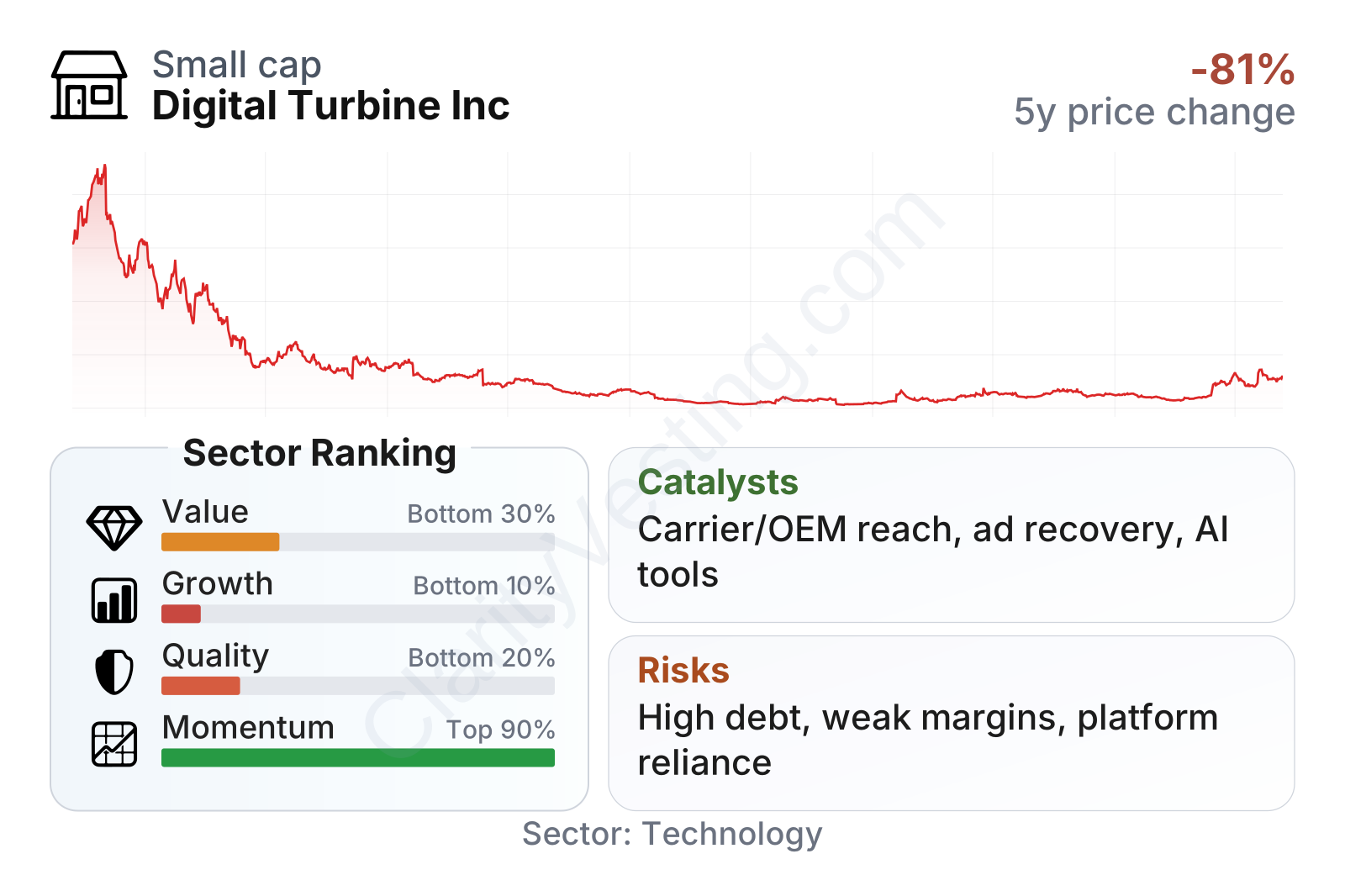
Digital Turbine currently looks weak on value, growth, and quality compared with much of the software sector, while recent share-price momentum has improved sharply. The company is small by sector standards, very volatile, and still operating with negative margins and returns on capital. One positive point is that recent year-over-year revenue growth has moved back above the sector median, but the longer-term record remains uneven.
The stock’s multi-year chart shows how dramatic the reset has been. Shares traded at very elevated levels in 2021, then fell heavily through 2022, 2023, and 2024 before rebounding at times in 2025. That pattern usually reflects more than market mood alone: it often signals that the market is reassessing the company’s earnings power, debt burden, and competitive position.
Growth
Digital Turbine operates in a sector that still has long-term relevance. Mobile advertising, app monetization, and user acquisition remain important as consumers continue spending time on smartphones. That said, this is not a business simply riding industry growth. The company’s own performance depends on whether it can protect its device partnerships, improve ad-market execution, and rebuild a healthier margin structure after a period of contraction.
The recent trend is somewhat more encouraging than the longer-term picture. Revenue growth turned positive again after a long slump, and the latest annual period showed a noticeably stronger year-over-year increase. That suggests the business may be moving out of pure decline and into a stabilization phase.
The growth chart shows a very clear cycle: explosive expansion earlier in the period, then a long decline, and more recently a return to positive comparisons. For long-term analysis, that matters because it suggests the company is no longer only managing shrinkage. The key question now is whether this rebound is durable or just a temporary recovery from a weak base.
Strategy also matters here. Digital Turbine’s main advantage is that it has direct relationships with mobile carriers and device manufacturers, which can make its app distribution and monetization tools more embedded than those of a typical ad-tech intermediary. If management can use those relationships to cross-sell more advertising and monetization products, the company could extract more value from the same partner base.
Cash generation offers a small but notable sign of progress. Free cash flow has been inconsistent, turning negative during the downturn, but it has returned to positive territory over the trailing twelve months.
That recovery is still modest relative to the company’s size, so it does not yet signal a fully repaired financial profile. Still, moving back into positive free cash flow is important because it gives the company a bit more flexibility while it works through restructuring and debt-related pressures.
Recent company updates have centered on operating discipline, product integration, and efforts to sharpen execution across its ad and distribution platforms. The meaningful opportunity is not a single breakthrough announcement, but the possibility that a leaner cost base combined with renewed revenue growth could improve earnings much faster than sales if the turnaround continues.
Risks
The main risk is that Digital Turbine is not currently producing healthy profits. Operating margin remains negative, profit margin is still below zero, and returns on invested capital are also negative. That means the business is generating sales, but not yet converting them into a level of profitability that compares well with the broader software group.
The balance sheet is another major concern. Debt relative to equity has risen far above the sector norm and remains elevated, even after some improvement from peak levels. A ratio near 190% is high for a company with negative operating income, especially when interest expense has become a much larger drag on results. This increases sensitivity to any slowdown in advertising demand or execution misstep.
Profitability trends show why the market remains cautious. A few years ago, Digital Turbine was posting positive net margins that compared reasonably well with peers. Since then, margins moved deeply negative and have only partially improved. The direction is better than the trough, but the company is still far from the profitability profile that would normally support a premium valuation.
Competition is intense. Digital Turbine operates in parts of the market that overlap with large ad-tech platforms, mobile measurement and user-acquisition tools, supply-side ad monetization providers, and companies with direct app-store or operating-system control. Competitors can include firms tied to Google, Apple, AppLovin, The Trade Desk in certain advertising workflows, Unity in mobile app monetization and acquisition, and various specialized mobile ad-tech vendors. Digital Turbine is not the clear industry leader across the full chain. Its strongest edge is narrower: privileged distribution access through carrier and OEM relationships.
That edge is real, but it is not invincible. Large platform owners control the broader mobile ecosystem, privacy rules continue to evolve, and advertisers can rapidly shift budgets if performance weakens. In ad tech, scale, data access, and demand concentration often favor the largest platforms. Digital Turbine therefore needs to prove that its device-level integration creates enough differentiation to protect pricing and partner relevance.
There is also execution risk from the company’s past acquisition strategy. Digital Turbine assembled multiple businesses to create a broader platform, but integration and market weakness were followed by falling revenue, impairments, losses, and a much lower stock price. The recent turnaround signs are useful, yet the company is still rebuilding credibility after that difficult stretch.
No major public-domain evidence points to a scandal-driven risk in the recent period, but the financial and strategic risks are substantial enough on their own: leverage, inconsistent cash flow, and dependence on a successful turnaround in a highly competitive market.
Valuation
Valuing Digital Turbine requires caution because traditional earnings multiples are not very useful when a company is reporting losses. The usual price-to-earnings measure is currently not meaningful, which already says a lot about the situation: the market is not valuing the company on a stable profit base today.
Historically, the stock once traded at very high earnings multiples when the market expected strong growth and much higher future profitability. That premium disappeared as growth slowed and earnings turned negative. Compared with the software sector’s typical valuation range, Digital Turbine no longer carries that kind of optimism.
Even so, “cheap” is not a simple label here. The market capitalization is around the low-billion-dollar range, which is much smaller than many software peers, but the business also has weaker quality metrics, a lower free-cash-flow yield than the sector median, negative operating earnings relative to enterprise value, and a balance sheet that limits flexibility. In other words, the stock price reflects distress and uncertainty, not just overlooked value.
The more constructive argument is that if the recent revenue recovery continues and cost controls hold, the current valuation could be explained by turnaround potential rather than by current fundamentals. The more skeptical argument is that a company with negative margins, high leverage, and only modest free cash flow does not yet have enough evidence to justify a richer multiple. At this stage, the valuation looks tied more to recovery expectations than to established business strength.
Conclusion
Digital Turbine remains an interesting but demanding long-term case. The company operates in a relevant part of the mobile economy, has real strategic relationships with carriers and device makers, and has recently shown signs of revenue stabilization and a return to positive free cash flow. Those are meaningful improvements after a severe downturn.
At the same time, the business is still carrying the weight of its prior expansion cycle. Profit margins remain negative, debt is high, interest costs are heavy, and the company is not the dominant force in the broader ad-tech landscape. Its competitive position is best described as specialized rather than leading.
The overall picture is therefore tilted toward a turnaround profile rather than a proven compounding profile. The recent rebound in operations and share price suggests the market sees recovery potential, but the financial quality of the business still looks weak relative to the sector. For a long-term perspective, the company currently stands out more for the scale of its possible operational recovery than for the steadiness or resilience that usually defines stronger software franchises.
Sources:
- Digital Turbine, Inc. — Annual Report on Form 10-K for fiscal year ended March 31, 2026
- Digital Turbine, Inc. — Quarterly Reports on Form 10-Q filed in 2026
- Digital Turbine, Inc. — Current Reports on Form 8-K filed in 2026
- SEC EDGAR — Digital Turbine, Inc. filings database
- Digital Turbine Investor Relations — earnings releases and shareholder materials published in 2026
- Digital Turbine Investor Relations — company-hosted earnings call materials and presentations
- Wikipedia — Digital Turbine basic company background
This article is for informational purposes only and does not constitute financial advice. Some content is AI-generated. See Disclaimer


