Stock Analysis · Appian Corp (APPN)
Overview
Appian is a software company focused on helping organizations build, automate, and improve business processes. Its platform is used to create applications with limited hand-coding, connect data from different systems, and automate repetitive work. Typical customers include large enterprises and government agencies that need to manage complex workflows such as case management, compliance, procurement, customer service, and internal operations.
The business is built around a subscription-driven software model, supported by professional services. In simple terms, Appian sells access to its platform and then also helps customers deploy and expand it. Based on the company’s recent annual reporting structure, revenue is mainly organized as follows:
- Cloud subscriptions, approximately 67% of total revenue: recurring fees for access to Appian’s cloud platform, including workflow automation, application development, process orchestration, and AI-related capabilities delivered as a service.
- Professional services, approximately 22% of total revenue: consulting, implementation, training, and support work tied to new deployments and platform expansion.
- Self-managed subscriptions, approximately 11% of total revenue: software subscription revenue from customers running Appian in their own environments rather than on Appian’s cloud.
This mix matters because cloud subscriptions are usually the most scalable and predictable part of the business. Over time, a larger share from recurring software subscriptions can improve durability and profitability, while services tend to be lower margin but can help drive adoption.
The long-term financial pattern has also improved. Revenue has risen steadily over the last several years, gross profit has expanded, and operating losses have narrowed sharply before turning into a small operating profit in 2025. At the same time, research and development spending remains significant, showing that Appian is still investing heavily in product capabilities rather than simply maximizing short-term earnings.
The broad takeaway is that Appian has been shifting from a growth-at-all-costs profile toward a more balanced model with rising scale, continued product investment, and much better cost discipline.
Key Figures
| Metric | Value | Sector ⓘ |
|---|---|---|
| Date | Sep 12, 2026 | |
| Context | ||
| Sector | Technology | |
| Industry | Software - Infrastructure | |
| Market Cap ⓘ | $2.44B | |
| Beta ⓘ | 0.94 | |
Value (Cheapness) | ||
| P/E Ratio ⓘ | N/A | 29.51 |
| FCF Yield ⓘ | 3.14% | 4.25% |
| EBIT / EV ⓘ | 0.50% | 2.85% |
| PEG ⓘ | N/A | |
Growth (Business expansion) | ||
| Revenue Growth ⓘ | 19.10% | 15.40% |
| RPS Growth (5Y CAGR) ⓘ | 16.99% | 8.56% |
| EPS Growth (5Y CAGR) ⓘ | N/A | -11.88% |
| Margin Growth (5Y Trend) ⓘ | N/A | 0.46% |
| FCF Growth (5Y CAGR) ⓘ | N/A | 9.80% |
Quality (Business durability) | ||
| ROIC (Latest) ⓘ | 6.28% | 9.44% |
| ROIC (5Y Median) ⓘ | -25.73% | 8.30% |
| Net Debt / EBIT (Latest) ⓘ | 13.61 | 0.54 |
| Net Debt / EBIT (5Y Median) ⓘ | N/A | 0.44 |
| Operating Margin (Latest) ⓘ | 1.61% | 9.58% |
| Operating Margin (5Y Median) ⓘ | -16.57% | 8.25% |
| Debt to Equity (Latest) ⓘ | -280.78% | 33.33% |
| Profit Margin (Latest) ⓘ | -1.34% | 7.14% |
| Free Cash Flow (Latest) ⓘ | $76.75M | |
Momentum (Price trend) | ||
| 3Y Return ⓘ | -27.07% | +45.48% |
| 12M Return (excl. last month) ⓘ | +23.48% | +23.48% |
| 6M Return ⓘ | +38.21% | +20.93% |
| Price vs. 200-Day MA ⓘ | +23.03% | +7.43% |
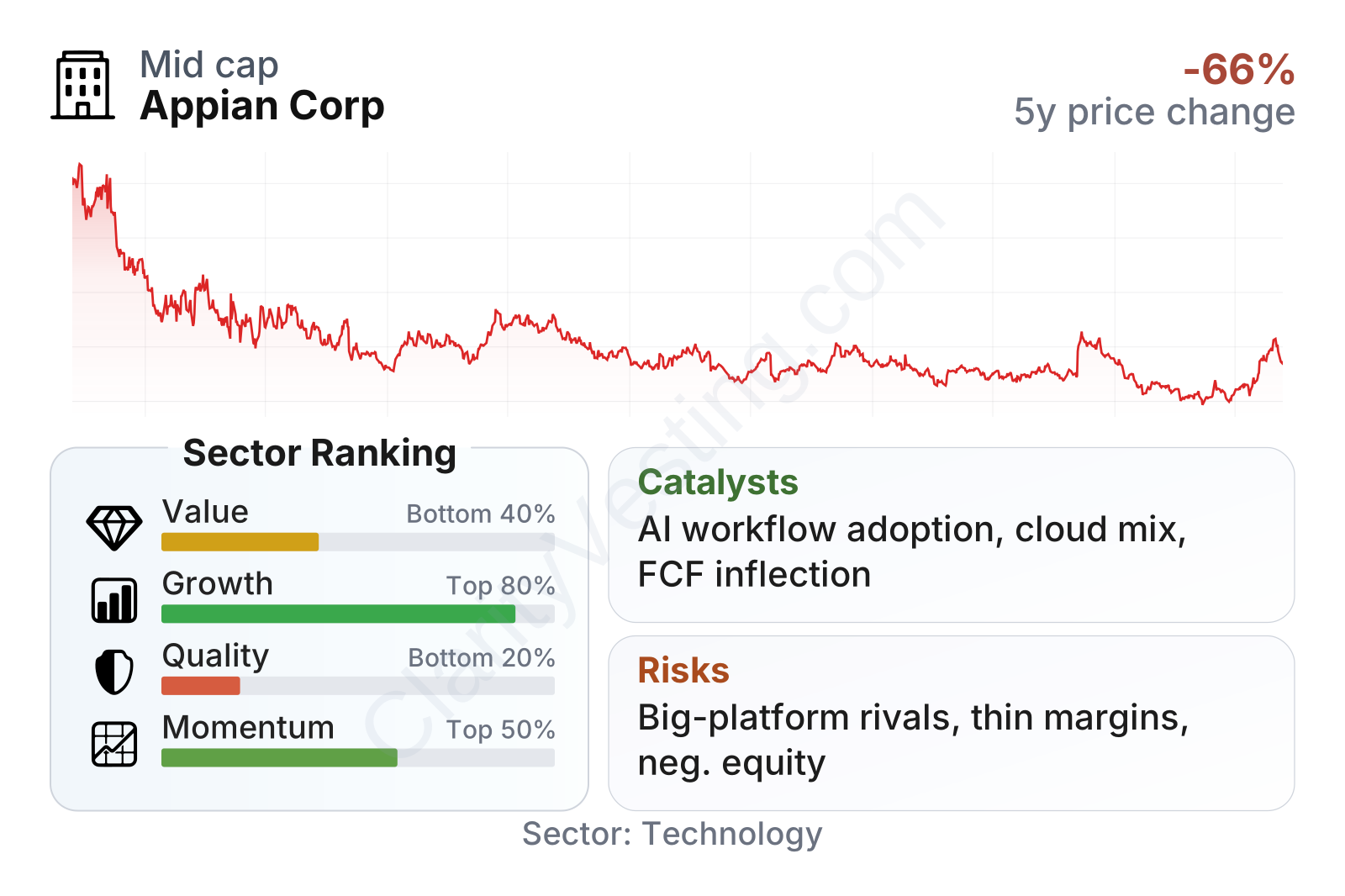
Appian is a mid-sized software company with lower share-price volatility than many technology names, as suggested by a beta below 1. On growth, it ranks in the stronger part of its sector: recent revenue growth is around 19%, above the sector median, and its five-year revenue-per-share growth is also clearly ahead of many peers.
Profitability and balance sheet quality are more mixed. Free cash flow has improved meaningfully and now compares favorably with the sector on a yield basis, but operating margin and return on invested capital still trail the industry median. Some debt-related ratios look distorted because shareholders’ equity has turned negative, so those figures should be read carefully rather than literally. Momentum is also uneven: the stock has rebounded over the last six months, but its longer multi-year share-price performance remains weak relative to the broader software group.
Growth
Appian operates in a part of software that still has room to grow: workflow automation, low-code development, process orchestration, and enterprise AI. These tools address a practical problem for businesses and governments: too many processes are still slow, manual, fragmented, and expensive. That gives Appian exposure to a durable trend rather than a short-lived niche.
The company’s strategy is coherent. It is not trying to compete as a broad consumer AI brand or as a giant horizontal cloud platform. Instead, it is focused on helping organizations automate mission-critical work and connect systems that already exist. That can make the product especially relevant in regulated industries and public sector environments where reliability, auditability, and process control matter as much as speed.
Recent growth trends support that positioning. Revenue growth accelerated again after a slower stretch in 2024, returning to roughly the high-teens to low-20s range through much of the latest period. That is a healthy level for a company of Appian’s size, especially because it is happening alongside much better operating discipline than in earlier years.
Cash generation has become one of the more important changes in the business. Appian moved from clearly negative free cash flow a few years ago to positive free cash flow more recently, with a strong upward trend. For long-term analysis, this is meaningful because it suggests growth is becoming less dependent on external funding and more supported by the business itself.
A key catalyst is the growing interest in AI agents and automation inside enterprises. Appian has been integrating AI capabilities into its platform in a way that fits its existing product logic: automate tasks, route decisions, summarize information, and help users move work through a process faster. If enterprises increasingly want AI embedded into operational workflows rather than used as a standalone tool, Appian’s positioning could become more relevant.
Another opportunity is the public sector and large-enterprise market, where digital transformation projects often take years and create follow-on expansion work. Once Appian is adopted for an important workflow, customers may add more use cases over time, which can deepen recurring software revenue.
Risks
This article is for informational purposes only and does not constitute financial advice. Some content is AI-generated. See Disclaimer


