Stock Analysis · Appfolio Inc (APPF)
Overview
AppFolio is a software company focused on the real estate industry. Its main product is a cloud-based platform that helps property managers, landlords, and real estate investment managers run everyday operations in one system. That includes marketing vacant units, screening applicants, signing leases, collecting rent, handling maintenance, accounting, reporting, and resident communication. The company also offers software for community associations and investment management, but residential property management remains the core of the business.
The business model is mainly recurring. Customers typically pay subscription fees to use the software, and AppFolio also earns money from transaction-based services that run through the platform. This matters for long-term analysis because recurring software revenue can be stable, while payment and screening activity can rise as customers process more work inside the system.
Based on recent company disclosures, AppFolio’s revenue can be understood in two broad buckets:
- Core Solutions subscription revenue: approximately 70% to 75% of total revenue. This includes the main software platform used for property management, accounting, leasing, maintenance workflows, and related tools.
- Value Added Services: approximately 25% to 30% of total revenue. This includes payment processing, tenant screening, risk mitigation services, electronic payments, and other transactional services tied to activity on the platform.
The mix shows that AppFolio is not only selling software seats. It is also monetizing the activity that happens after customers adopt the platform. That creates a useful combination: recurring revenue from subscriptions and additional upside when customer usage grows.
Over the last several years, the company has expanded revenue meaningfully while improving profitability. Revenue rose from about $359 million in 2021 to about $951 million in 2025. During that period, operating income moved from near break-even to a much more substantial level, helped by scale and improved expense discipline.
The financial flow illustrates an important shift: AppFolio remained willing to spend heavily on product development, but revenue has grown faster than operating costs in recent years. Research and development remains a large expense, which is typical for a software company still investing for expansion, yet margins are now far stronger than they were during the 2022 loss period.
Key Figures
| Metric | Value | Sector ⓘ |
|---|---|---|
| Date | Sep 12, 2026 | |
| Context | ||
| Sector | Technology | |
| Industry | Software - Application | |
| Market Cap ⓘ | $7.29B | |
| Beta ⓘ | 0.85 | |
Value (Cheapness) | ||
| P/E Ratio ⓘ | 46.76 | 29.51 |
| FCF Yield ⓘ | 3.69% | 4.25% |
| EBIT / EV ⓘ | 2.62% | 2.85% |
| PEG ⓘ | 7.45 | |
Growth (Business expansion) | ||
| Revenue Growth ⓘ | 19.30% | 15.40% |
| RPS Growth (5Y CAGR) ⓘ | 26.98% | 8.56% |
| EPS Growth (5Y CAGR) ⓘ | N/A | -11.88% |
| Margin Growth (5Y Trend) ⓘ | 16.46% | 0.46% |
| FCF Growth (5Y CAGR) ⓘ | 207.49% | 9.80% |
Quality (Business durability) | ||
| ROIC (Latest) ⓘ | 30.35% | 9.44% |
| ROIC (5Y Median) ⓘ | 0.96% | 8.30% |
| Net Debt / EBIT (Latest) ⓘ | -0.98 | 0.54 |
| Net Debt / EBIT (5Y Median) ⓘ | -0.18 | 0.44 |
| Operating Margin (Latest) ⓘ | 17.88% | 9.58% |
| Operating Margin (5Y Median) ⓘ | 1.29% | 8.25% |
| Debt to Equity (Latest) ⓘ | 6.80% | 33.33% |
| Profit Margin (Latest) ⓘ | 15.13% | 7.14% |
| Free Cash Flow (Latest) ⓘ | $269.08M | |
Momentum (Price trend) | ||
| 3Y Return ⓘ | +11.49% | +45.48% |
| 12M Return (excl. last month) ⓘ | -27.77% | +23.48% |
| 6M Return ⓘ | +18.37% | +20.93% |
| Price vs. 200-Day MA ⓘ | +11.28% | +7.43% |
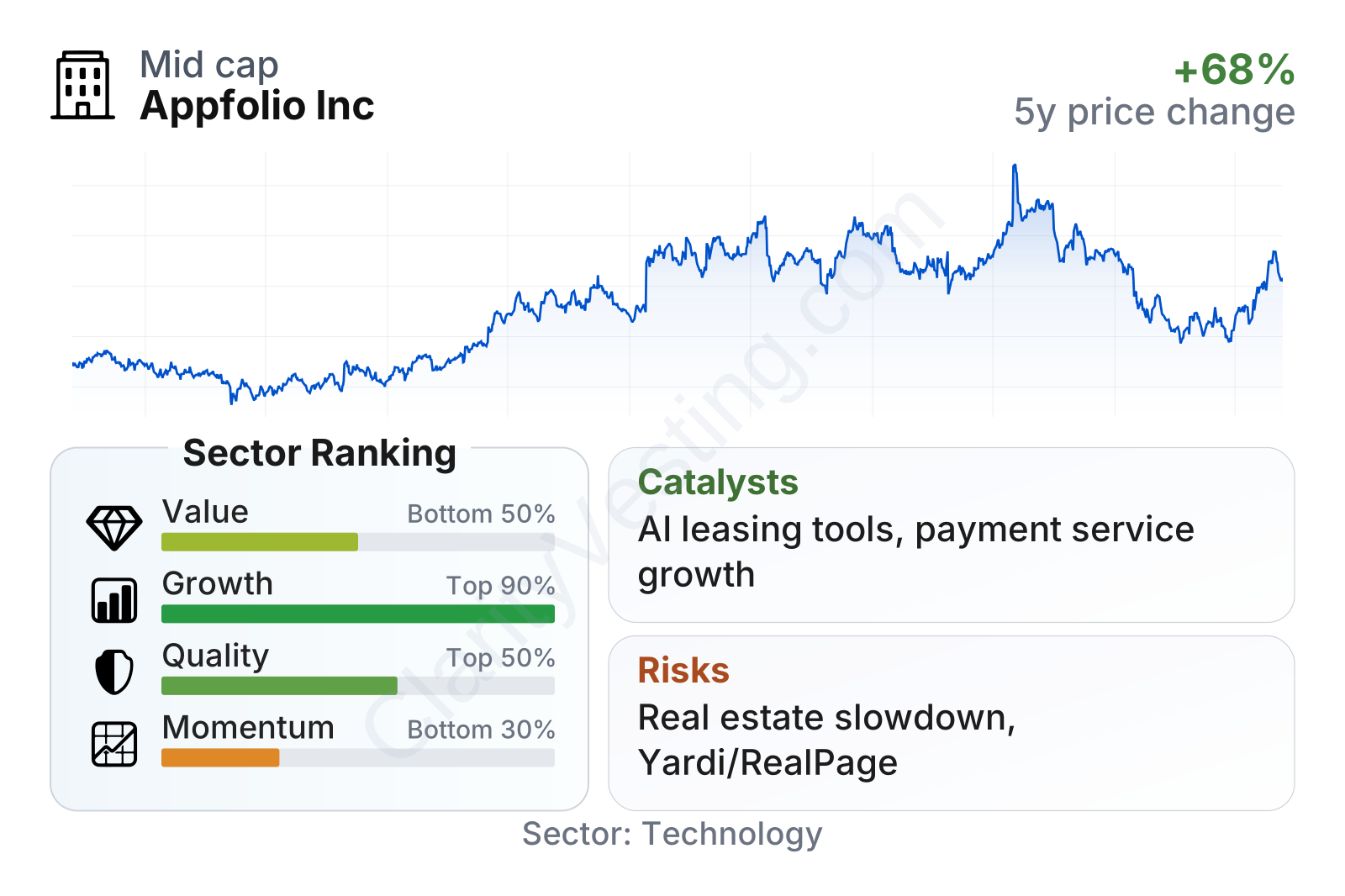
AppFolio stands out for business performance more than for recent share price momentum. Growth ranks near the top of the software sector, with revenue growth around 19% year over year and a much stronger five-year expansion rate than the sector median. Profitability has also improved sharply: operating margin is close to 18%, profit margin is around 15%, and return on invested capital is above 30%. The balance sheet is especially strong, with very low leverage and net cash rather than meaningful net debt. The weaker point is market sentiment: the stock’s recent 6-month, 12-month, and 3-year returns have trailed much of the sector despite stronger fundamentals.
Growth
AppFolio operates in a favorable niche within software because property management is still going through a long digital upgrade. Many landlords and property managers continue to replace fragmented tools, manual processes, and legacy software with more integrated cloud platforms. That secular trend supports demand for software that saves labor, reduces errors, improves compliance, and centralizes operations.
The company’s strategy also makes sense for future growth. Rather than offering a narrow tool, AppFolio is building an operating system for property managers. That approach can support customer retention because once accounting, leasing, payments, maintenance, and communication all run through the same platform, switching becomes more disruptive. It also creates room for expansion revenue as customers adopt more modules and more transaction services.
Revenue growth has cooled from the very high rates seen in 2023 and early 2024, but it remains strong at around the high-teens to low-20s range recently. For a company already approaching $1 billion in annual revenue, that is still a solid pace. More importantly, the slowdown looks more like normalization after an unusually fast stretch than a collapse in demand.
Cash generation has improved even faster than revenue. Free cash flow has climbed from a modest level a few years ago to well above $200 million on a trailing basis. That suggests the company is not relying only on accounting profits; it is increasingly turning growth into real cash that can support product development, acquisitions, or simply reinforce financial flexibility.
One meaningful catalyst is artificial intelligence. AppFolio has been adding AI-driven tools intended to help automate leasing, maintenance workflows, communication, and operational tasks inside its property management suite. In this market, AI is less about flashy consumer features and more about reducing repetitive work for property managers who handle large portfolios with limited staff. If these tools meaningfully improve productivity, they could support stronger customer retention, pricing power, and broader adoption across the installed base.
Another growth lever is wallet-share expansion. Because AppFolio already serves customers through mission-critical software, every added service such as payments, screening, or risk-related tools can increase revenue per customer without requiring the same effort as winning a brand-new account. That can be especially attractive in vertical software, where customer relationships tend to be long-lasting once a platform becomes embedded in daily operations.
Risks
This article is for informational purposes only and does not constitute financial advice. Some content is AI-generated. See Disclaimer


