Stock Analysis · Applovin Corp (APP)
Overview
AppLovin is a software company focused on mobile app marketing, advertising, and monetization. In simple terms, it helps app developers attract users, place ads, and earn money from their apps. The company built its position mainly in mobile gaming, but its advertising tools increasingly reach beyond gaming into broader digital advertising categories. Its core proposition is that better software and machine learning can match ads with users more efficiently, improving returns for advertisers while raising revenue for publishers.
In recent years, AppLovin has become much more centered on advertising software than on owning game studios. The business mix changed materially after the company sold large parts of its apps segment, leaving a model that is more asset-light and more dependent on its ad technology platform. That matters for long-term analysis because software-based ad businesses usually scale better than content ownership, provided the technology remains effective and demand stays strong.
Based on the company’s recent filings, revenue is now overwhelmingly driven by advertising. The main sources are approximately the following:
- Advertising revenue: about 75% to 80% of total revenue. This includes AppLovin’s ad platform for advertisers and app publishers, where the company earns money from ad placements, performance campaigns, and related software-driven monetization.
- Apps revenue: about 20% to 25% of total revenue. This historically included revenue from owned mobile game studios and in-app purchases, although this part has become less important after asset sales.
The broader financial profile shows a striking shift: revenue has become more profitable, cost of revenue has fallen sharply as a share of sales, and operating income has expanded much faster than revenue. That is consistent with a transition toward a higher-margin software platform rather than a content-heavy operating model.
One of the most important takeaways is not just that sales grew, but that the company kept a far larger share of each revenue dollar over time. Research and development remains meaningful, but total operating expenses grew much more slowly than gross profit, which helps explain the jump in earnings and cash generation.
Key Figures
| Metric | Value | Sector ⓘ |
|---|---|---|
| Date | Sep 12, 2026 | |
| Context | ||
| Sector | Communication Services | |
| Industry | Advertising Agencies | |
| Market Cap ⓘ | $105.65B | |
| Beta ⓘ | 2.49 | |
Value (Cheapness) | ||
| P/E Ratio ⓘ | 23.47 | 18.61 |
| FCF Yield ⓘ | 4.26% | 13.68% |
| EBIT / EV ⓘ | 3.58% | 4.54% |
| PEG ⓘ | 0.66 | |
Growth (Business expansion) | ||
| Revenue Growth ⓘ | 52.80% | 5.40% |
| RPS Growth (5Y CAGR) ⓘ | 18.42% | 4.62% |
| EPS Growth (5Y CAGR) ⓘ | 64.86% | -18.01% |
| Margin Growth (5Y Trend) ⓘ | 70.55% | 1.10% |
| FCF Growth (5Y CAGR) ⓘ | 82.38% | 5.88% |
Quality (Business durability) | ||
| ROIC (Latest) ⓘ | 77.22% | 8.38% |
| ROIC (5Y Median) ⓘ | 14.91% | 8.32% |
| Net Debt / EBIT (Latest) ⓘ | 0.16 | 1.99 |
| Net Debt / EBIT (5Y Median) ⓘ | 2.46 | 2.94 |
| Operating Margin (Latest) ⓘ | 77.79% | 14.89% |
| Operating Margin (5Y Median) ⓘ | 42.09% | 12.96% |
| Debt to Equity (Latest) ⓘ | 111.13% | 59.59% |
| Profit Margin (Latest) ⓘ | 64.58% | 8.77% |
| Free Cash Flow (Latest) ⓘ | $4.50B | |
Momentum (Price trend) | ||
| 3Y Return ⓘ | +676.88% | +46.64% |
| 12M Return (excl. last month) ⓘ | -34.96% | +2.16% |
| 6M Return ⓘ | -27.90% | +5.05% |
| Price vs. 200-Day MA ⓘ | -32.77% | +2.88% |
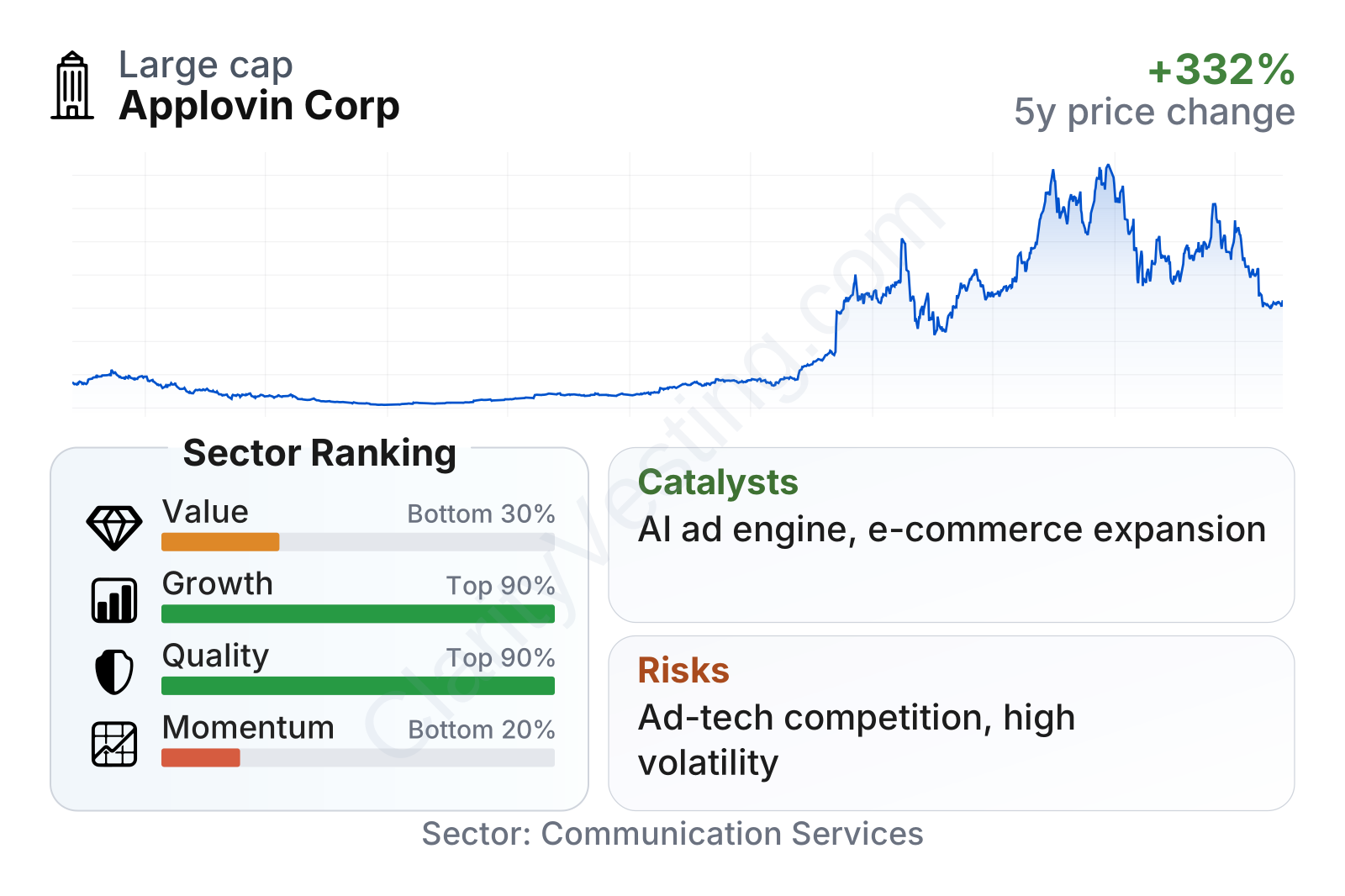
AppLovin is now a very large company by market value, but the stock still behaves like a high-volatility growth name, with a beta well above 2. On operating performance, the picture is unusually strong: growth and quality rank near the top of its sector, while value metrics look less attractive because the market is already pricing in strong execution. Momentum is mixed. The stock has delivered exceptional gains over three years, but the shorter-term trend has been much weaker, showing how quickly sentiment can swing in a company tied to fast-changing ad technology expectations.
Growth
AppLovin operates in a sector with durable long-term expansion drivers. Digital advertising continues to take share from traditional media, and performance advertising remains especially attractive because customers can measure results directly. Mobile apps are also a large and global market, giving AppLovin a wide base of advertisers and publishers. On top of that, the use of machine learning in ad targeting and campaign optimization is becoming a central competitive factor across the industry, which fits directly with AppLovin’s product direction.
The company’s strategy makes sense for future growth because it is concentrating on the part of the business with the strongest economics: advertising software. Selling down game assets simplified the business and reduced the need to rely on hit-driven content. In its place, AppLovin is emphasizing its ad engine, which management has positioned as the main driver of advertiser performance and publisher monetization. If that technology continues to deliver measurable returns, it can support both customer retention and expansion into new ad categories.
Revenue growth has been volatile from quarter to quarter, which is normal in advertising and especially in a company reshaping its business mix. Still, the more recent pattern stands out: year-over-year growth has moved far above typical sector levels, including several quarters above 50%. That suggests AppLovin is not merely benefiting from industry growth, but also taking share or improving monetization faster than many peers.
Cash generation has strengthened even faster than revenue. Free cash flow climbed from a few hundred million dollars several years ago to well above $4 billion on a trailing basis. That kind of expansion is a major growth signal because it shows the model is scaling efficiently, not just producing headline sales. It also gives the company more room to reduce debt, repurchase shares, invest in product development, or pursue selective acquisitions.
A meaningful catalyst is AppLovin’s push beyond gaming. The company has historically been strongest in mobile games, but a broader move into e-commerce and other performance advertising categories could expand its addressable market substantially. Another catalyst is continued adoption of its AI-driven ad tools, especially if advertisers see better conversion rates or lower customer acquisition costs. In 2026, public company communications continued to highlight platform efficiency and demand for the company’s ad solutions, which supports the idea that the opportunity is still widening rather than maturing.
Risks
This article is for informational purposes only and does not constitute financial advice. Some content is AI-generated. See Disclaimer


