Stock Analysis · Applied Digital Corporation (APLD)
Overview
Applied Digital Corporation is a digital infrastructure company focused on supplying large-scale computing capacity. In simple terms, it builds and operates specialized facilities with power, cooling, networking, and operations support for customers that need heavy computing workloads. The company started with crypto-related hosting, but its current direction is much more centered on high-performance computing and artificial intelligence infrastructure, including data centers designed for GPU-based workloads.
That business model matters because Applied Digital is not trying to become a major AI software company. Instead, it is positioning itself as a landlord and operator of the physical infrastructure that AI and other compute-intensive services need. This includes data center space, power access, equipment hosting, and in some cases cloud or computing services tied to those facilities.
Based on recent company filings, revenue has historically come from a mix of legacy cloud services and hosting operations, but the company’s strategic emphasis has shifted sharply toward next-generation data center capacity for AI and high-performance computing customers. Precise segment percentages can move quickly as new facilities ramp, but the broad revenue picture appears to be:
- Cloud services and GPU-related computing: a meaningful and growing share, tied to compute capacity sold to customers needing AI or high-performance workloads.
- Data center hosting / colocation services: recurring infrastructure revenue from housing customer equipment and providing power and site operations.
- Legacy crypto hosting-related activity: still part of the company’s background, but no longer the main long-term strategic focus.
What stands out most is the speed of the business transition. Over the last several years, revenue has expanded dramatically, but so have operating costs and capital needs. The company is building for a much larger opportunity than the one it served in its earlier crypto-centered phase.
The overall financial flow shows a business scaling rapidly: revenue and gross profit have climbed sharply, but operating expenses have also expanded fast enough to keep earnings deeply negative. That pattern is typical of an infrastructure buildout phase, but it also means execution has to improve materially for scale to translate into durable profitability.
Key Figures
| Metric | Value | Sector ⓘ |
|---|---|---|
| Date | Sep 12, 2026 | |
| Context | ||
| Sector | Technology | |
| Industry | Information Technology Services | |
| Market Cap ⓘ | $7.33B | |
| Beta ⓘ | 5.73 | |
Value (Cheapness) | ||
| P/E Ratio ⓘ | N/A | 29.51 |
| FCF Yield ⓘ | -37.88% | 4.25% |
| EBIT / EV ⓘ | -1.61% | 2.85% |
| PEG ⓘ | 1.83 | |
Growth (Business expansion) | ||
| Revenue Growth ⓘ | 406.60% | 15.40% |
| RPS Growth (5Y CAGR) ⓘ | 96.28% | 8.56% |
| EPS Growth (5Y CAGR) ⓘ | -9.79% | -11.88% |
| Margin Growth (5Y Trend) ⓘ | N/A | 0.46% |
| FCF Growth (5Y CAGR) ⓘ | N/A | 9.80% |
Quality (Business durability) | ||
| ROIC (Latest) ⓘ | -3.36% | 9.44% |
| ROIC (5Y Median) ⓘ | -22.48% | 8.30% |
| Net Debt / EBIT (Latest) ⓘ | N/A | 0.54 |
| Net Debt / EBIT (5Y Median) ⓘ | N/A | 0.44 |
| Operating Margin (Latest) ⓘ | -31.30% | 9.58% |
| Operating Margin (5Y Median) ⓘ | -79.53% | 8.25% |
| Debt to Equity (Latest) ⓘ | 286.47% | 33.33% |
| Profit Margin (Latest) ⓘ | -39.92% | 7.14% |
| Free Cash Flow (Latest) ⓘ | -$2.78B | |
Momentum (Price trend) | ||
| 3Y Return ⓘ | +382.12% | +45.48% |
| 12M Return (excl. last month) ⓘ | +108.08% | +23.48% |
| 6M Return ⓘ | -3.86% | +20.93% |
| Price vs. 200-Day MA ⓘ | -18.20% | +7.43% |
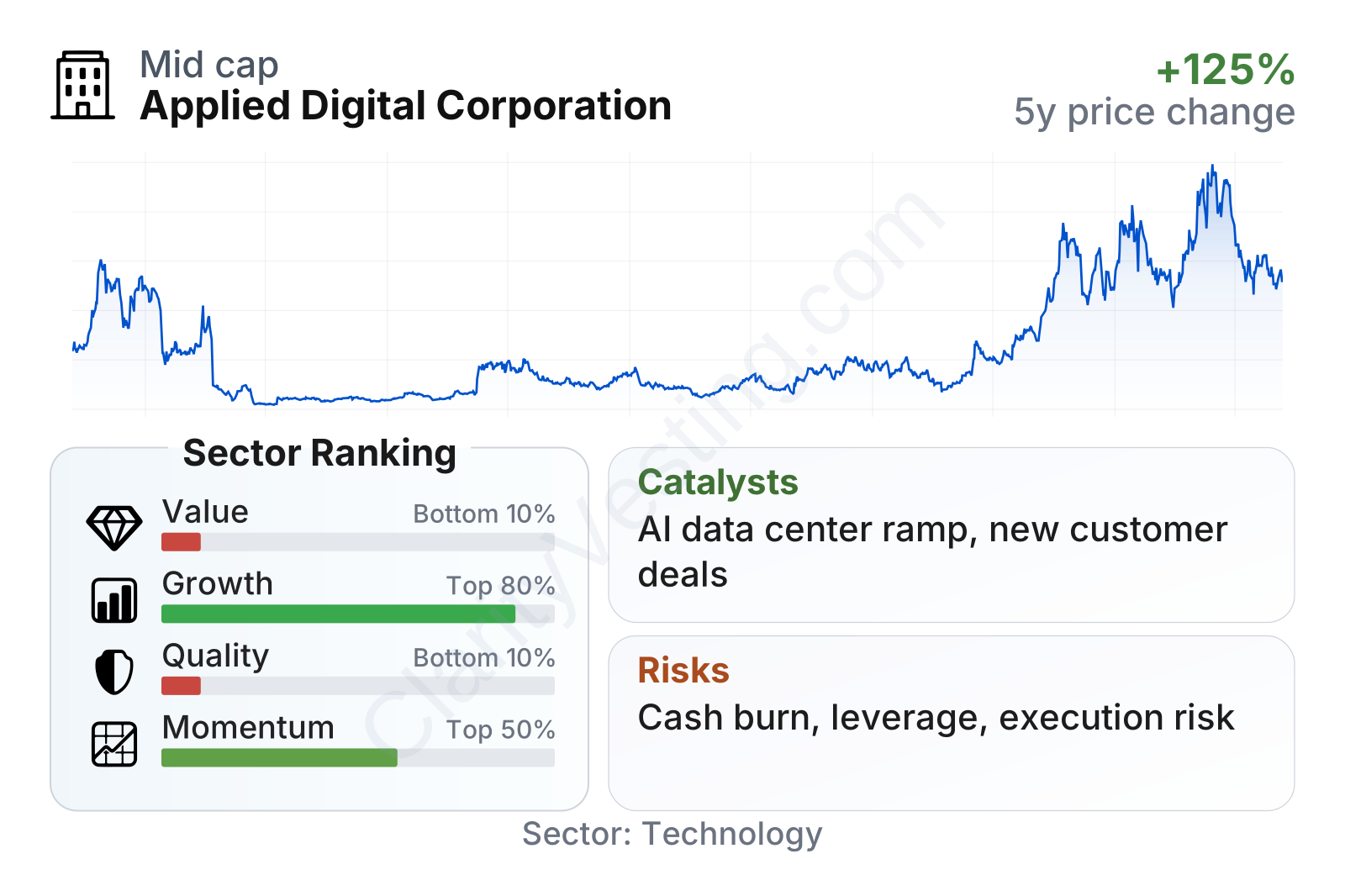
Applied Digital is now a mid-cap technology infrastructure company with unusually high share-price volatility. The table points to a very uneven profile: growth is strong relative to much of the sector, but quality and valuation measures are weak because the company remains unprofitable and is consuming large amounts of cash. Momentum has been strong over multi-year and prior 12-month periods, although the more recent trend has cooled.
The stock’s history also shows that the market has repeatedly changed its view of the company, first around crypto exposure and later around AI infrastructure expectations. That helps explain the very high beta: the shares have moved far more aggressively than the average technology stock.
Growth
Applied Digital operates in one of the market’s most active infrastructure themes: the need for more computing capacity for AI, machine learning, and other data-heavy workloads. This is a genuine growth area because advanced models require dense power, efficient cooling, large data transfer capacity, and purpose-built facilities. Those are hard assets, and they are difficult to bring online quickly in attractive locations.
The company’s strategy broadly makes sense within that context. Rather than competing directly with the largest cloud software platforms, it is trying to supply the physical backbone those workloads require. If management can secure customers before or as new capacity opens, the model could benefit from long-term contracts, recurring revenue, and high demand for powered data center space.
Revenue growth has been highly volatile, but the latest period shows an acceleration that is far above the sector median. That suggests the company’s newer infrastructure initiatives are starting to show up more clearly in reported results, even if the path has not been smooth from quarter to quarter.
The main growth complication is cash consumption. Free cash flow has become much more negative as the company invests heavily in new facilities and capacity. For an infrastructure business, that is not unusual during expansion, but the scale of the outflow means future growth depends on continued access to capital and successful project ramp-ups.
A major catalyst is the broader industry shortage of AI-ready data center capacity in locations with sufficient power. Applied Digital has emphasized large-scale campus development and partnerships around high-performance computing infrastructure. Recent company communications have also highlighted contract wins, financing activity, and development progress tied to AI-oriented facilities. For a business of this size, a few large customer agreements can change the revenue base quickly.
Risks
This article is for informational purposes only and does not constitute financial advice. Some content is AI-generated. See Disclaimer