Stock Analysis · Amphenol Corporation (APH)
Overview
Amphenol Corporation is a large manufacturer of electronic interconnect products. In simple terms, it makes the parts that allow electronic systems to connect, transmit power, and move data reliably. Its products include connectors, cable assemblies, antennas, sensors, and related components used in equipment ranging from mobile devices and cloud data centers to military systems, factory machinery, cars, and broadband networks.
The company operates across a wide set of end markets, which is one of its defining characteristics. Rather than depending on a single industry, Amphenol sells into communications, aerospace, defense, automotive, industrial, mobile devices, information technology, and broadband applications. This diversification helps reduce the impact of weakness in any one customer group while giving the company multiple ways to grow when demand shifts between sectors.
Based on recent company disclosures, Amphenol’s revenue mix is spread across several major end markets. Exact percentages can move from quarter to quarter, but the broad structure is clear:
- IT datacom solutions: approximately 25% to 30% of revenue. This includes products used in cloud infrastructure, servers, storage, and high-speed data transmission.
- Mobile devices: approximately 20% to 25%. This covers interconnect and antenna solutions for smartphones and other portable electronics.
- Defense and commercial aerospace: approximately 10% to 15%. These are highly engineered connectors and systems for aircraft and military platforms.
- Automotive: approximately 10% to 15%. This includes products tied to electrification, advanced electronics, and vehicle connectivity.
- Industrial: approximately 10% to 15%. Applications include factory automation, energy, instrumentation, and heavy equipment.
- Mobile networks: approximately 5% to 10%. This segment serves telecom infrastructure and wireless network equipment.
- Broadband and other markets: approximately 5% to 10%. This includes cable and broadband infrastructure along with smaller niche applications.
Amphenol’s business model is built on large product breadth, deep customer relationships, and frequent bolt-on acquisitions. It does not usually depend on one blockbuster product. Instead, it wins by being embedded across many systems where reliability, miniaturization, and performance matter.
The company’s financial flow has expanded sharply over the last several years. Revenue, gross profit, operating income, and net income have all moved meaningfully higher, with 2025 standing out as a major step up. Just as important, profitability has scaled along with sales rather than being diluted by growth.
Key Figures
| Metric | Value | Sector ⓘ |
|---|---|---|
| Date | Sep 12, 2026 | |
| Context | ||
| Sector | Technology | |
| Industry | Electronic Components | |
| Market Cap ⓘ | $206.94B | |
| Beta ⓘ | 1.24 | |
Value (Cheapness) | ||
| P/E Ratio ⓘ | 41.96 | 29.51 |
| FCF Yield ⓘ | 2.28% | 4.25% |
| EBIT / EV ⓘ | 3.70% | 2.85% |
| PEG ⓘ | 0.92 | |
Growth (Business expansion) | ||
| Revenue Growth ⓘ | 55.00% | 15.40% |
| RPS Growth (5Y CAGR) ⓘ | 0.98% | 8.56% |
| EPS Growth (5Y CAGR) ⓘ | 14.31% | -11.88% |
| Margin Growth (5Y Trend) ⓘ | 6.49% | 0.46% |
| FCF Growth (5Y CAGR) ⓘ | 38.80% | 9.80% |
Quality (Business durability) | ||
| ROIC (Latest) ⓘ | 19.04% | 9.44% |
| ROIC (5Y Median) ⓘ | 17.83% | 8.30% |
| Net Debt / EBIT (Latest) ⓘ | 1.78 | 0.54 |
| Net Debt / EBIT (5Y Median) ⓘ | 1.23 | 0.44 |
| Operating Margin (Latest) ⓘ | 27.30% | 9.58% |
| Operating Margin (5Y Median) ⓘ | 20.56% | 8.25% |
| Debt to Equity (Latest) ⓘ | 121.43% | 33.33% |
| Profit Margin (Latest) ⓘ | 17.73% | 7.14% |
| Free Cash Flow (Latest) ⓘ | $4.71B | |
Momentum (Price trend) | ||
| 3Y Return ⓘ | +297.13% | +45.48% |
| 12M Return (excl. last month) ⓘ | +52.99% | +23.48% |
| 6M Return ⓘ | +28.11% | +20.93% |
| Price vs. 200-Day MA ⓘ | +14.91% | +7.43% |
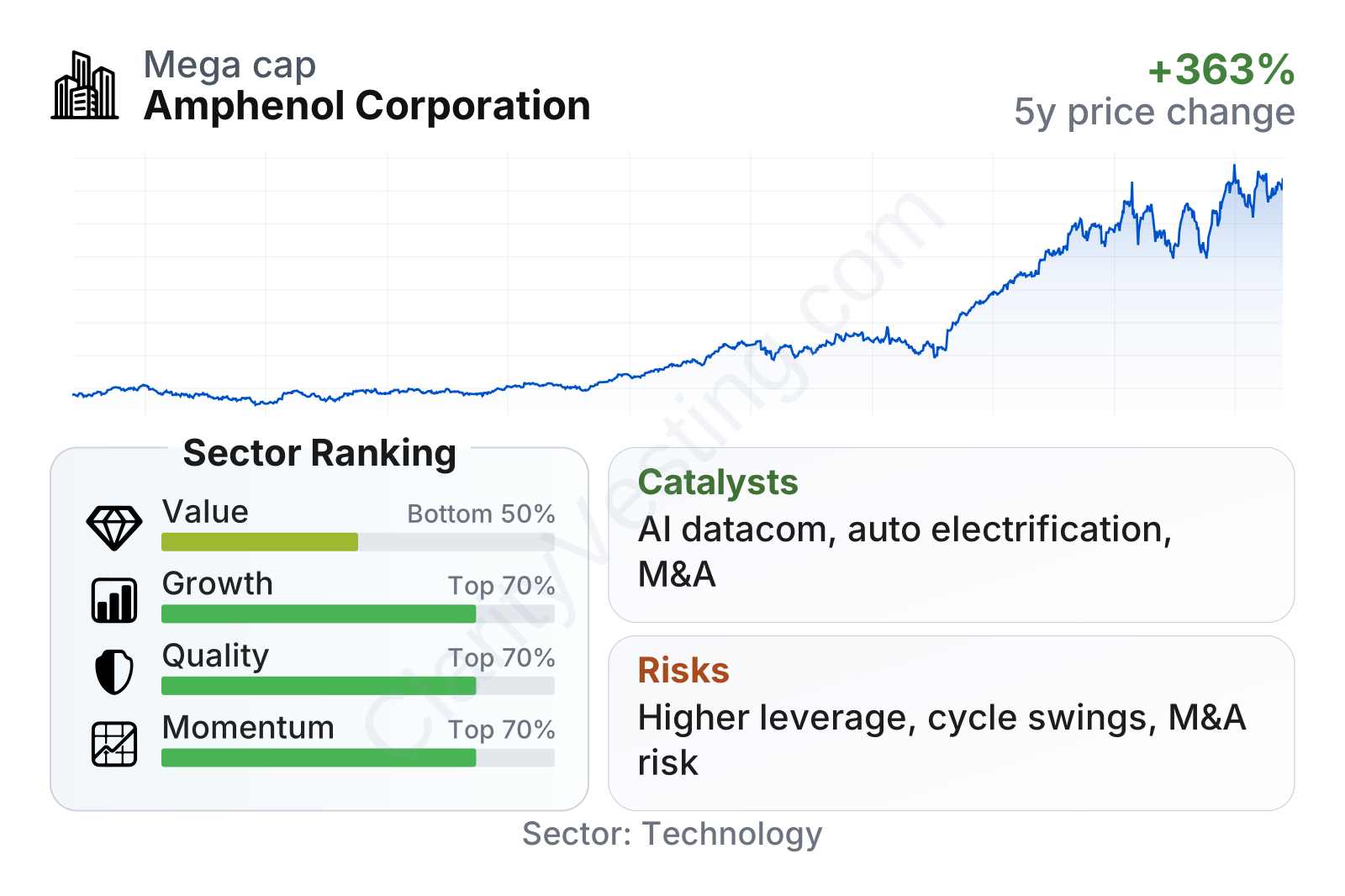
Amphenol stands out as a very large company with above-sector strength in growth, quality, and momentum, while its valuation metrics look less attractive than much of the technology component group. Profitability is notably strong, with operating margins and returns on invested capital well ahead of the sector median. The trade-off is that the shares already reflect a lot of that strength, and leverage is materially higher than the sector norm following recent expansion and acquisition activity.
The share price trend over the last several years has been exceptionally strong, especially from 2024 into early 2026, although there was some pullback after the peak. That pattern suggests the market has been rewarding the company for sustained execution and accelerating demand exposure, particularly in data-heavy and electronics-intensive markets.
Growth
Amphenol operates in sectors with solid long-term demand drivers. The most important are data center expansion, artificial intelligence infrastructure, rising electronic content in vehicles, aerospace recovery, defense spending, and broader connectivity needs across industrial and communications equipment. All of these trends require more high-performance connectors, power systems, and signal transmission components, which is exactly where Amphenol is positioned.
The company’s strategy also fits these markets well. It combines internal product development with a long history of acquisitions, usually buying specialized component businesses and integrating them into its broader platform. That approach can work well in a fragmented industry because many customers want reliable suppliers with a wide catalog, global manufacturing capability, and engineering support. Amphenol has built that scale over decades.
Recent revenue growth has been unusually strong. After a softer period in 2023, growth reaccelerated sharply through 2024 and into 2025-2026, reaching levels far above the sector median. That kind of rebound suggests the company is not only benefiting from better end-market demand but also gaining from its exposure to faster-moving areas such as cloud and data infrastructure.
Cash generation has also improved dramatically. Free cash flow has more than doubled over the last few years, reaching well above $4 billion on a trailing basis. That matters because it gives Amphenol flexibility to keep funding acquisitions, expand production, invest in engineering, and support shareholder returns without relying entirely on external financing.
A strong catalyst is the buildout of AI-related infrastructure. High-speed data transfer, power distribution, and thermal-aware system architecture all increase the need for specialized interconnect products. Amphenol’s presence in IT datacom makes this especially relevant. Another catalyst is automotive electrification, where vehicles require more connectors, sensors, and power management components than traditional designs.
Recent company updates have also pointed to continued acquisition activity and broad-based demand strength across several end markets. For Amphenol, acquisitions are not a side activity; they are part of the operating model. When done well, they widen the product portfolio and create new channels for cross-selling.
Risks
This article is for informational purposes only and does not constitute financial advice. Some content is AI-generated. See Disclaimer


