Stock Analysis · Angel Studios Inc (ANGX)
Overview
Angel Studios Inc operates in filmed entertainment and media distribution. The company is best known for building a platform around faith-oriented, family-friendly, and values-based content, combining streaming access with theatrical releases, paid memberships, and a community model that lets audiences help promote and support projects. In simple terms, it sits between a studio, a distributor, and a direct-to-consumer media platform.
Based on the company’s public filings, its revenue mix is driven primarily by media and entertainment activities rather than a diversified set of unrelated businesses. The exact split can change meaningfully from one period to another because film releases can create large swings, but the business can broadly be read through the following channels:
- Theatrical distribution and box office participation – the largest revenue driver in stronger release periods. This includes ticket sales economics and related distribution receipts from films released in theaters.
- Streaming and platform-related revenue – recurring digital access, app-based viewing, and platform monetization tied to Angel’s audience ecosystem.
- Memberships, pay-it-forward, and community-supported monetization – audience funding mechanisms and premium access features that are central to Angel’s model.
- Licensing, home entertainment, and ancillary sales – revenue from content rights, digital purchases, subscriptions through partners, and other downstream monetization.
- Merchandise and other revenue – a smaller contribution tied to branded products and miscellaneous media-related income.
What makes the company unusual is not just the content focus, but the commercial model. Angel Studios tries to reduce some of the traditional marketing burden of entertainment launches by relying on a loyal audience community to promote titles, vote on projects, and help fund distribution demand. That can be powerful when a title resonates, but it also means results can be volatile because a small number of releases can heavily influence annual performance.
Over the last several years, the business has shown sharp revenue swings: a strong rebound in 2023, a major setback in 2024, and then a very large jump in 2025. That pattern suggests the company is still in a scaling phase rather than operating as a stable, mature media business. Costs have also risen quickly, especially operating expenses, which has prevented revenue growth from translating into durable profitability.
The long-term picture from the income flow is striking: revenue has expanded sharply from earlier levels, but operating costs have grown even faster. Gross profit improved in the strongest years, yet selling, administrative, and content-related spending expanded enough to push the company into deep operating losses more recently.
Key Figures
| Metric | Value | Sector ⓘ |
|---|---|---|
| Date | Oct 31, 2026 | |
| Context | ||
| Sector | Communication Services | |
| Industry | Entertainment | |
| Market Cap ⓘ | $896.43M | |
| Beta ⓘ | -0.00 | |
Value (Cheapness) | ||
| P/E Ratio ⓘ | N/A | 18.47 |
| FCF Yield ⓘ | -7.51% | 14.23% |
| Dividend Yield ⓘ | N/A | 2.78% |
| EBIT / EV ⓘ | -13.30% | 4.73% |
| PEG ⓘ | N/A | |
Growth (Business expansion) | ||
| Revenue Growth ⓘ | 27.50% | 6.10% |
| RPS Growth (5Y CAGR) ⓘ | -19.91% | 4.57% |
| EPS Growth (5Y CAGR) ⓘ | N/A | -17.96% |
| Margin Growth (5Y Trend) ⓘ | N/A | 1.32% |
| FCF Growth (5Y CAGR) ⓘ | N/A | 5.75% |
| DPS Growth (5Y CAGR) ⓘ | N/A | 5.19% |
Quality (Business durability) | ||
| ROIC (Latest) ⓘ | N/A | 9.19% |
| ROIC (5Y Median) ⓘ | N/A | 8.24% |
| Net Debt / EBIT (Latest) ⓘ | N/A | 1.92 |
| Net Debt / EBIT (5Y Median) ⓘ | N/A | 2.88 |
| Net Debt / EBITDA (Latest) ⓘ | N/A | 1.22 |
| Net Debt / Assets ⓘ | 12.35% | 18.63% |
| EBITDA / Interest ⓘ | N/A | 8.36 |
| Operating Margin (Latest) ⓘ | -30.08% | 15.68% |
| Operating Margin (5Y Median) ⓘ | -19.06% | 13.39% |
| Debt to Equity (Latest) ⓘ | -264.44% | 59.65% |
| Profit Margin (Latest) ⓘ | -37.51% | 8.74% |
| Free Cash Flow (Latest) ⓘ | -$67.34M | |
Momentum (Price trend) | ||
| 3Y Return ⓘ | N/A | +46.16% |
| 12M Return (excl. last month) ⓘ | N/A | +1.26% |
| 6M Return ⓘ | +50.47% | 0.00% |
| Price vs. 200-Day MA ⓘ | +26.45% | +0.87% |
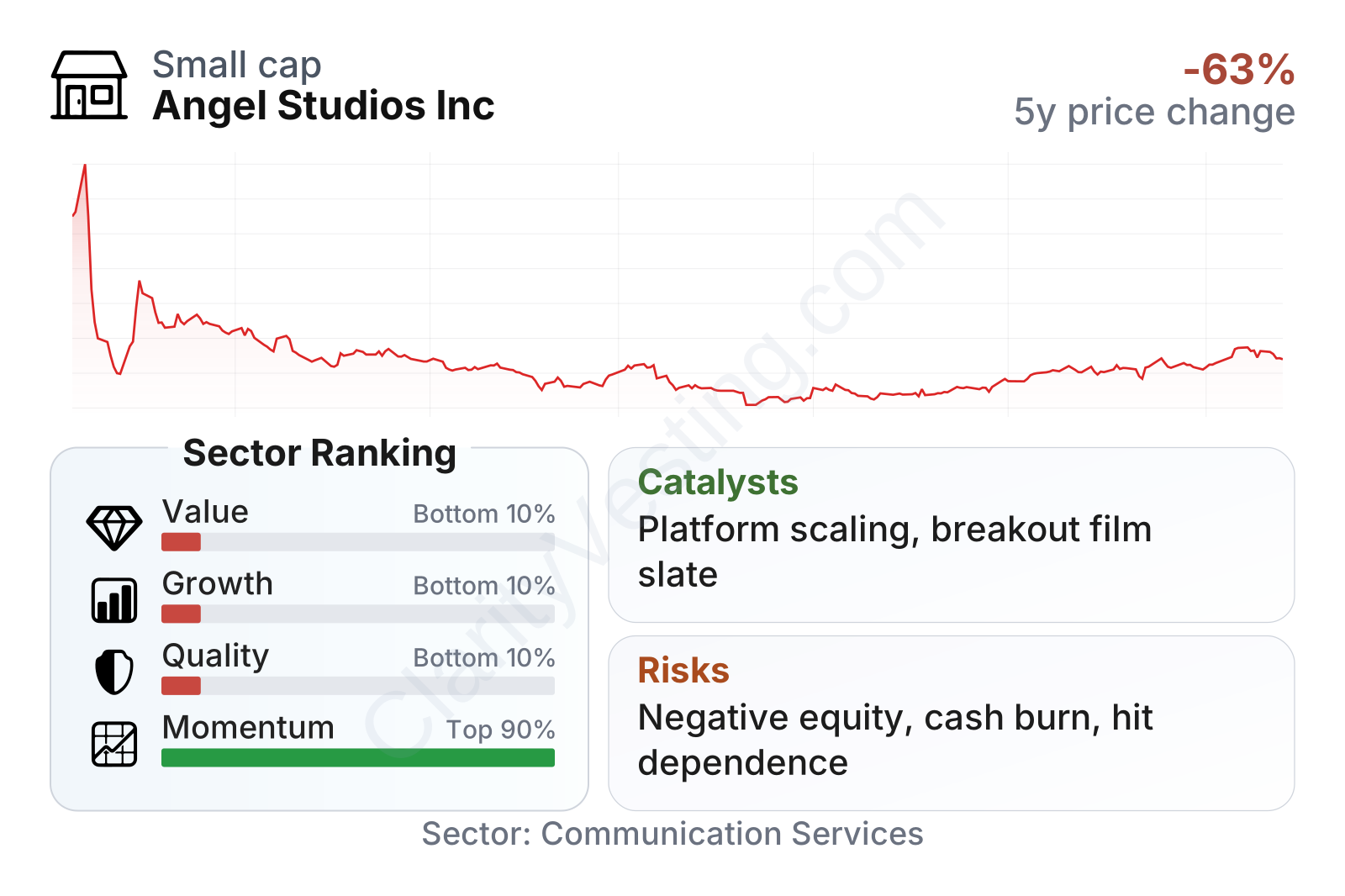
Angel Studios is a small-cap entertainment company, so the stock can move sharply in both directions. The share price history reflects that volatility: a steep decline from late 2025 into mid-2026 was followed by a strong rebound over recent months. In factor terms, the market has recently rewarded the stock’s momentum, but the underlying fundamentals remain weak. The company ranks near the bottom of its sector on value, growth quality, and operating quality measures, mainly because it is still losing money and burning cash. Revenue growth remains a positive point, with year-over-year growth still well above the sector median, but that strength has not yet translated into healthy margins or free cash flow.
Growth
The company operates in a part of the entertainment market that still has room to expand. Demand for streaming content remains large, while theatrical distribution continues to reward films that reach clearly defined audience groups. Angel Studios is targeting a niche that major media groups have often underserved: viewers looking for faith-based, family-friendly, and values-centered entertainment. That positioning gives the company a clearer identity than many smaller studios.
Its strategy for growth is logically coherent. Rather than competing head-on with the biggest streaming platforms on volume, Angel is trying to build a direct relationship with a specific audience and then monetize that relationship across multiple channels: theatrical release, app viewing, memberships, and community participation. If that ecosystem scales, the company could gain better economics from customer loyalty and lower marketing inefficiency than a traditional studio model.
The recent revenue trajectory shows why the market remains interested. Growth was exceptionally high in late 2025 and remained positive into mid-2026, even after slowing sharply from the earlier surge. A slowdown from extremely high growth is normal, but the more important question is whether the company can convert bigger revenue into repeatable earnings rather than one-off spikes tied to a handful of successful titles.
Cash generation is the bigger concern inside the growth narrative. Free cash flow remains meaningfully negative, although the cash burn improved somewhat from late 2025 into early 2026. For a media company investing in content, negative free cash flow is not automatically unusual, but it becomes harder to justify if losses continue for too long or if each new growth phase requires even heavier spending.
A visible catalyst is the company’s ability to keep turning audience enthusiasm into broader distribution success. Angel’s model works best when a release breaks beyond its core base and attracts mainstream theatrical or streaming demand. Another potential catalyst is the expansion of its owned platform, where recurring relationships can become more valuable than one-time title performance. If management can improve monetization per user while controlling content and marketing costs, the growth case becomes much stronger.
Recent company communications and filings also suggest continued emphasis on expanding the title slate and platform reach. That matters because scale is essential in media: a larger library, more recurring user engagement, and better distribution leverage can improve profitability over time. The opportunity is real, but the company still has to prove that scale will produce durable economics rather than larger swings.
Risks
This article is for informational purposes only and does not constitute financial advice. Some content is AI-generated. See Disclaimer


