Stock Analysis · Abercrombie & Fitch Company (ANF)
Overview
Abercrombie & Fitch Company is a specialty apparel retailer that designs, sources, markets, and sells casual clothing, activewear, outerwear, personal care items, and accessories. Its business is built around a portfolio of lifestyle brands aimed mainly at teens, college-age consumers, and young adults. The company operates through stores, e-commerce websites, and digital marketplaces, with a growing emphasis on direct-to-consumer sales and international reach.
The group’s revenue comes primarily from its two brand families, with Hollister now representing the larger business and Abercrombie brands contributing the rest. Based on the latest annual filing, revenue is split approximately as follows:
- Hollister brands: about 58% of revenue. This includes Hollister and Gilly Hicks, focused on teen and young adult apparel, denim, fleece, activewear, intimates, and swim.
- Abercrombie brands: about 42% of revenue. This includes Abercrombie & Fitch and abercrombie kids, centered on more elevated casualwear, dresses, shirting, denim, and seasonal fashion basics for adults and children.
From a channel perspective, the business is increasingly digital and globally diversified. In recent filings, direct-to-consumer sales, including online and company-operated stores, remained the core engine, while physical stores still matter for brand visibility, customer acquisition, and omnichannel fulfillment. Geographically, the United States remains the largest market, with Europe, the Middle East, Africa, and Asia-Pacific adding meaningful diversification.
What stands out in the business mix is not only sales growth but also a much stronger profit structure than a few years ago. Revenue has climbed from roughly $3.7 billion in fiscal 2021 to more than $5.2 billion in fiscal 2025, while operating income and net income expanded far faster, showing that the turnaround was driven by both demand and better execution.
The profit flow shows a business that became materially more efficient after the weak 2023 period. Sales increased strongly over the last two fiscal years, gross profit widened, interest expense dropped sharply, and net income moved from nearly break-even to well above $500 million. That combination suggests the recent improvement was not only a top-line rebound but also a margin and balance-sheet repair.
Key Figures
| Metric | Value | Sector ⓘ |
|---|---|---|
| Date | Sep 12, 2026 | |
| Context | ||
| Sector | Consumer Cyclical | |
| Industry | Apparel Retail | |
| Market Cap ⓘ | $6.07B | |
| Beta ⓘ | 0.97 | |
Value (Cheapness) | ||
| P/E Ratio ⓘ | 13.14 | 17.10 |
| FCF Yield ⓘ | 9.34% | 8.53% |
| EBIT / EV ⓘ | 13.23% | 6.46% |
| PEG ⓘ | 3.62 | |
Growth (Business expansion) | ||
| Revenue Growth ⓘ | 4.80% | 5.75% |
| RPS Growth (5Y CAGR) ⓘ | 16.35% | 9.14% |
| EPS Growth (5Y CAGR) ⓘ | 144.82% | -18.21% |
| Margin Growth (5Y Trend) ⓘ | 4.39% | -0.23% |
| FCF Growth (5Y CAGR) ⓘ | 20.28% | 4.91% |
Quality (Business durability) | ||
| ROIC (Latest) ⓘ | 37.58% | 12.61% |
| ROIC (5Y Median) ⓘ | 31.70% | 10.72% |
| Net Debt / EBIT (Latest) ⓘ | 0.99 | 2.10 |
| Net Debt / EBIT (5Y Median) ⓘ | 0.56 | 2.32 |
| Operating Margin (Latest) ⓘ | 13.42% | 9.25% |
| Operating Margin (5Y Median) ⓘ | 12.02% | 9.64% |
| Debt to Equity (Latest) ⓘ | 95.05% | 75.78% |
| Profit Margin (Latest) ⓘ | 10.04% | 5.33% |
| Free Cash Flow (Latest) ⓘ | $566.46M | |
Momentum (Price trend) | ||
| 3Y Return ⓘ | +177.90% | +14.53% |
| 12M Return (excl. last month) ⓘ | +10.42% | +3.08% |
| 6M Return ⓘ | +72.73% | +0.55% |
| Price vs. 200-Day MA ⓘ | +47.24% | -0.54% |
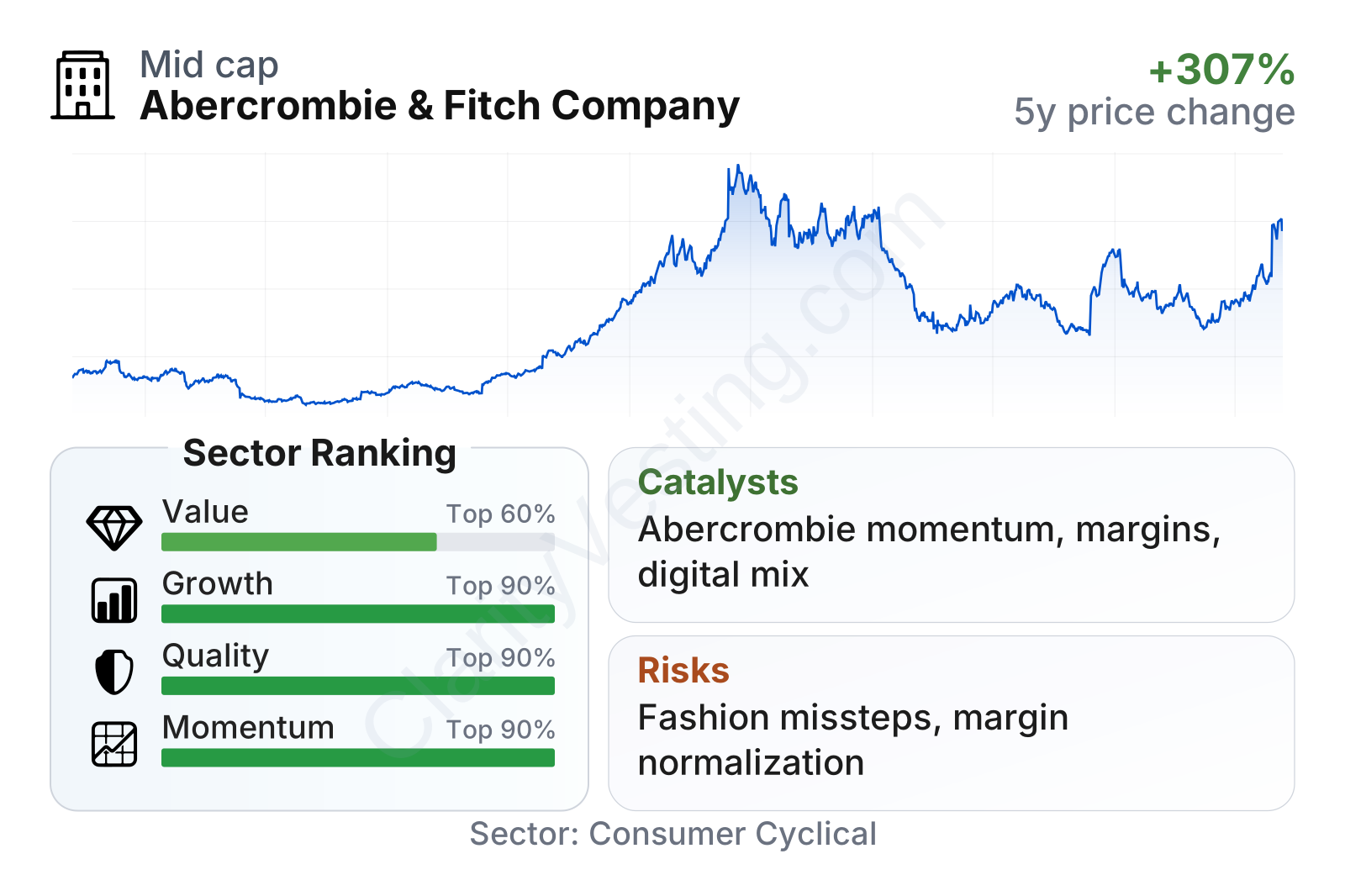
Abercrombie & Fitch currently sits in a strong position on growth, quality, and momentum relative to much of the apparel retail sector. Profitability is notably above sector medians, with operating margin around the low teens and net margin around 10%, both materially stronger than many peers. Returns on invested capital are also unusually high for a retailer. On valuation, the earnings multiple is below the sector median even after the stock’s strong multi-year rise, although that lower multiple reflects market caution about how durable the current profit level may be.
The market profile is also worth noting. This is no longer a small turnaround case, but a mid-sized retailer with meaningful brand recognition and a share price that has already experienced a large re-rating since 2023. Even so, leverage relative to operating earnings remains controlled, which gives the company more flexibility than many apparel peers during softer periods.
Growth
Apparel retail is not a high-growth industry in the same way as software or semiconductors, but it can still create attractive long-term expansion when a brand gains relevance, pricing power, and better inventory discipline. That is the opportunity Abercrombie & Fitch has been pursuing. The company has repositioned its brands toward fewer promotions, stronger product assortments, faster read-and-react merchandising, and better customer targeting. So far, that strategy has translated into both sales gains and margin expansion.
Revenue growth has cooled from the exceptional pace seen in 2024, but it has remained positive. That matters because maintaining growth after a large rebound is often harder than achieving the initial recovery. The recent pattern points to normalization rather than collapse: the company moved from very high double-digit gains to low- and mid-single-digit growth, which is more typical for a mature retail business.
Cash generation has also improved substantially compared with the difficult period in 2023. Free cash flow turned sharply positive in 2024 and stayed solid afterward, even if it has not moved in a straight line each year. For a retailer, this is important because cash supports store investments, technology spending, supply chain improvements, and shareholder returns without depending heavily on new borrowing.
One of the clearest catalysts is the continued strength of the Abercrombie brand itself, which has benefited from fashion relevance, better full-price selling, and stronger engagement with young adult consumers. Hollister is also important because it is the larger revenue contributor and gives the group another path to growth if management can keep that brand resonating with its younger audience. International expansion, digital penetration, and category growth in areas such as dresses, denim, and active-inspired assortments remain additional drivers.
Recent company updates in 2026 continued to highlight sales growth, disciplined inventory management, and confidence in the brand portfolio, even as management acknowledged a less predictable consumer environment. The significant opportunity is therefore not based on opening an entirely new business line, but on extending a turnaround that has already produced unusually strong results for a traditional apparel retailer.
Risks
This article is for informational purposes only and does not constitute financial advice. Some content is AI-generated. See Disclaimer


